HCM City seeks ways to increase exports

Ho Chi Minh City’s Department of Industry and Trade has unveiled a project to promote exports over the next five years.
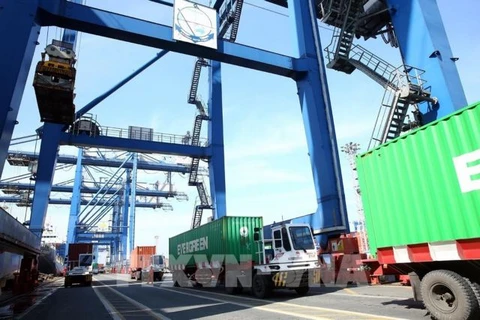
HCM City seeks ways to increase exports ảnh 1HCM City trade authorities unveil eight measures to boost exports. Photo: VNA

HCMCity (VNS/VNA) –
 Ho Chi Minh City’s Department of Industry and Trade hasunveiled a project to promote exports over the next five years.

‘DevelopingExports in HCM City until 2025, with a Vision to 2030’forecasts opportunities for and challenges to exports, identifies the mostcompetitive export sectors and products and propose solutions and strategiesfor developing exports.

Itwill take growth quality as the foundation to shift to exports of services andintangible goods such as software and digital content, encourage links betweenthe country's various regions to increase exports to markets withwhich Vietnam has free tradeagreements, improve the competitiveness of export items by capitalising on thecity’s comparative advantages, join global value chains, and increase linksbetween businesses.

Firmsshould speed up digital transformation to expand exports amid risingcross-border e-commerce, the Ministry of Industry and Trade said.

Dang Hoang Hai, director of the ministry’s Vietnam e-Commerce and Digital EconomyAgency, said together with opportunities from new-generation free tradeagreements, the trend of shifting from traditional to digital-based businessmodels is becoming common.

Digitaltransformation is an effective solution for firms to expand their export marketsand create a flexible and efficient export model, he said.

Anumber of Vietnamese firms are now setting up business-to-business andbusiness-to-consumer e-commerce business models, he added.

Ona global scale, cross-border e-commerce is developing rapidly and has become amajor trend in trade in recent years.

Theproject will also develop logistics, replan sea and river ports in the city andtheir infrastructure, improve transport links between HCM City and otherproduction areas so that the city becomes a logistics and export services hub.

Itwill develop human resources, reform public services and employ IT to create anintegrated and shared import-export database for businesses’ use.

Thecity will concentrate on the eight following solutions to increase its exportsover the next decade:

Improvethe technical level of the mechanical industry to enable a shift up the valuechain with higher chances of diversification while boosting the growth ofsupporting industries to raise the rate of domestic production.

Improvethe ability to export software and digital content related to finance andtourism.

Promoteresearch and development activities, foster the growth of supporting industriesto raise the rate of domestic production while attracting investment in hi-techprojects to support electrical – electronic products and launch the ‘SaigonInnovation Network’ at the Saigon Hi-tech Park.

Improvethe competitiveness of conventional labour-intensive export groups, develop thelocal market for feedstock and raw materials for manufacturing andvalue-added services.

Strengthenthe strategy for logistics growth in the city.

Increasethe performance of investment and trade promotion tasks for typical exportproducts in the globalisation era.

Continueto reform administrative procedures to ensure more transparency and reduce theprocessing time and cost, and adopt solutions for reducing the time it takesfor both documents and goods at customs by half.

Cooperatewith research units and educational institutions to train quality humanresources.

Exportsby companies based in the city in the first eight months of the year were worth28.4 billion USD, a 4 percent increaseyear-on-year, according to the Department of Industry and Trade./.
VNA
See more

Thanks to digital transformation among local officials, Tam Dao commune of Phu Tho province has achieved an almost 100% on-time rate for processing administrative applications, helping improve public services for residents. (Photo: VNA)

Institutional reform fuels private sector's growth in Phu Tho province

The private sector is increasingly emerging as a key growth engine of the economy. To unleash its potential and ensure sustainable development, the northern province of Phu Tho is stepping up institutional and administrative reforms to cut costs, shorten procedures, and build a more transparent, business-friendly investment climate.

Hoa Phat Wharf inside the Dung Quat Economic Zone (Photo: VNA)

Dung Quat EZ, Quang Ngai IPs draw nearly 19.4 bln USD

The Dung Quat Economic Zone and Quang Ngai industrial parks have so far attracted 441 projects worth around 19.4 billion USD, according to the Dung Quat Economic Zone and Quang Ngai Industrial Parks Authority (DEZA).

The Kim Long Motor Hue factory (Photo: VNA)

Hue courts capital to turn industrial zones into growth engine

The economic and industrial zones in Hue city host more than 200 active investment projects worth over 152 trillion VND (5.84 billion USD), with 139 already operational. Since the start of 2026, they have generated about 32 trillion VND, contributed 4.2 trillion VND to the state budget and brought in 730 million USD in exports, while employing more than 46,000 workers.

Processing cashew nuts for export at Nguyen Thong Co., Ltd. in Dak Lak province. (Photo: VNA)

Vietnam’s exports to New Zealand post strong growth

According to the Customs Department, two-way trade reached 844 million USD in the first half of 2026, of which Vietnam’s exports to New Zealand totaled 399.7 million USD, up 18.8% year-on-year, while imports stood at 444 million USD.

Starting from September 2026, agricultural products from the Mekong Delta are expected to be transported directly from Cai Cui Port to Guangxi, China. (Photo: VNA)

Investing in logistics to boost agricultural production and exports

Logistics is increasingly becoming a major bottleneck for exports as transport costs rise and requirements for data management, low emissions and supply chain transparency become more stringent, requiring coordinated investment in logistics infrastructure, data infrastructure and transport capacity.

Harvesting rice in the Mekong Delta (Photo: VNA)

Vietnam seen as gateway for Canadian farm produce to ASEAN

As Canada steps up trade diversification and seeks to reduce its dependence on the North American market, Vietnam could serve both as a market for Canadian goods and a base for Canadian businesses to build production capacity and expand operations in the region.

Illustrative image (Photo: VNA)

Turkish cooperatives open sourcing channel for Vietnamese businesses

The Vietnam Trade Office recommended that Vietnamese businesses in agriculture and food actively study cooperative networks in different localities in Türkiye and consider them an additional channel for accessing raw materials, processing partners, and distribution networks.

Delegates at the signing ceremony (Photo: VNA)

VPI, Beicip-Franlab Asia deepen oil, gas cooperation

Under the MoU, VPI and Beicip-Franlab Asia will undertake advanced studies in geology, geophysics, and reservoir engineering to support exploration, field development, and oil and gas resource assessment.

A visitor explores Vietnamese coffee at the expo. (Photo: VNA)

Vietnam pushes coffee, farm produce at Hong Kong food expo

After nearly 200 years, especially since the Doi Moi (renewal) began in 1986, Vietnamese coffee is now exported to more than 100 countries and territories and supports about 2.6 million jobs. Vietnam remains the world’s second largest coffee exporter, holding roughly 19-21% of the global market, and is the top producer of Robusta coffee.

Delegates at the event (Photo: VNA)

Da Nang hosts 2026 International Logistics Forum

Co-hosted by the Ministry of Industry and Trade and the Da Nang People’s Committee, the forum put modern logistics, strategic infrastructure, digital transformation, green growth and international connectivity at the centre of discussions.

Prime Minister Le Minh Hung speaks at the working session. (Photo: VNA)

Monetary policy must ensure macro stability, support growth: PM

The SBV was required to keep policy interest rates steady and add liquidity so lenders can access cheaper funding. It must manage the exchange rate in line with market developments, coordinate monetary tools, and intervene to stabilise the foreign exchange market, while maintaining close oversight of gold. Lenders must continue cutting costs, stabilising lending rates, and delivering substantive reductions.