Health ministry issues latest guidance on COVID-19 vaccination

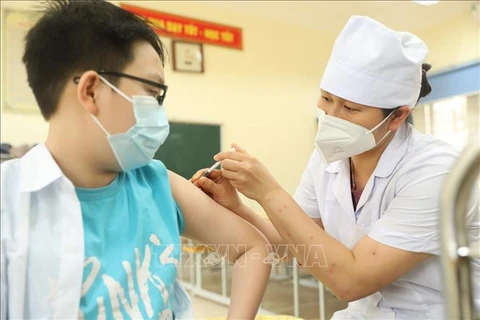
The Ministry of Health has issued its latest guidance on COVID-19 vaccinations, which asks all agencies to continue administering booster doses for those 18 and above, and complete second doses for those aged 5-12 within August.
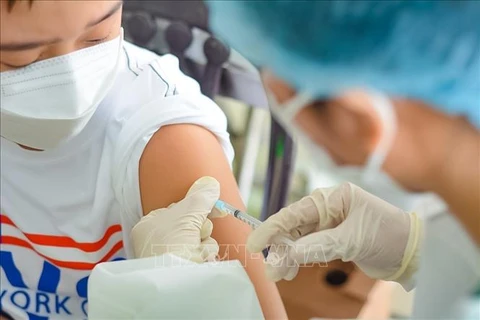
Health ministry issues latest guidance on COVID-19 vaccination ảnh 1All agencies are asked to continue administering booster doses for those 18 and above, and complete second doses for those aged 5 -12 in August. (Photo: VNA)
Hanoi (VNA) - The Ministry of Health has issued its latest guidanceon COVID-19 vaccinations, which asks all agencies to continue administering booster doses for those 18 and above, andcomplete second doses for those aged 5-12 within August.

The rollout of fourthdoses should also be expedited for those aged 18 and above who require it.

Authorities should alsomake plans for the administration of third doses for children aged 12 -17 yearsold.

Additionaldose

The guidance clearlystates that an additional dose (not the third dose) is given to those aged 18or older, including people with moderate and severe immunodeficiency, such aspeople undergoing cancer treatment.

Thesegroups include organ transplant recipients who are taking immunosuppressivedrugs; people receiving T-cell antibody receptor therapy (a type of treatmentthat helps the immune system attack and destroy cancer cells) or have a stemcell transplant (within the past two years); people with moderate or severeprimary immunodeficiency; people with advanced or untreated HIV; people who areon active treatment with corticosteroids or high-dose immunosuppressive drugs;people who have received the full basic dose of Sinopharm vaccine (Vero cell)or Sputnik V vaccine.

The guidance says thatone additional injection should be administered within 28 days to three monthsafter the initial first two doses.

People who have beeninfected with COVID-19 should be vaccinated immediately after recovering and completingmedical isolation as required.

Third dose 

People who areapplicable for the third dose of COVID-19 vaccination are those 18 years oldand older who have received the full basic shots (one, two or three dependingon the type of vaccine and the additional dose if available).

The guidance states thisdose should be at least three months after the last dose of the basic coverage.

Fourthdose (second booster dose)

The target group of thefourth dose are people aged 50 and over; people aged 18 years and over withmoderate to severe immunodeficiency; people aged 18 years and older who are inhigh-risk groups for exposure to COVID-19 such as health workers, frontlineofficials (police forces, army, teachers, people working in the transportationsector, etc.) people providing essential services, people working at touristservice establishments, trade centres, supermarkets, markets), workers, andpeople working in industrial parks.

The type of vaccine tobe injected is the mRNA vaccine (Pfizer or Moderna vaccine); AstraZeneca; orthe same type of vaccine as the third dose (first booster shot).

This shot should betaken at least four months after the third dose.

Boosterdose (third dose) for children 12-17 years old

Children from 12years old to 17 years old who have received full basic doses are applicable fora booster. The latest guidance has indicated Pfizer shots for children of5-12 and Moderna shots for those of 6-12./.
VNA
See more

A doctor provides dental checkup for a student. (Photo: VNA)

Free health checkups for children ahead of new school year

According to the Hanoi Department of Health, the city has 4,776 educational institutions with more than 2.2 million preschool and school students. The health campaign will run from August 18 to September 4, targeting 100% coverage before the new school year begins.

Spraying insecticide to prevent dengue fever in Dan Hoa commune, Hanoi. (Photo: VNA)

Hanoi steps up dengue prevention as cases rise

According to the Hanoi Centre for Disease Control (CDC), 316 dengue cases were recorded across 74 communes and wards in the city from August 7-14, up 81 from the previous week. Eleven new outbreaks were also reported, bringing the total number since the beginning of 2026 to 63, with 24 still active.

Screening and early cancer detection using advanced medical equipment at a healthcare facility (Photo: VNA)

Vietnam targets Southeast Asia’s leading medical tourism position by 2030

Medical tourists to Vietnam currently mainly comprise overseas Vietnamese and visitors from Cambodia, Laos, the Republic of Korea, Japan, Australia and several European countries. Popular services include cosmetic dentistry, assisted reproduction, aesthetic medicine, general health check-ups and some advanced medical specialties.

An ambulance from the pre-hospital emergency care service in Phu Quoc special zone in An Giang province. (Photo: VNA)

Pre-hospital emergency care system to be launched nationwide

From 2027, the national pre-hospital emergency management platform will be put into operation, connecting data with the 113, 114 and 115 emergency call systems to facilitate rapid emergency dispatch and improve public access to emergency services.

Foreign patients travel to Vietnam for robotic cancer surgery at one-tenth of US costs

Foreign patients travel to Vietnam for robotic cancer surgery at one-tenth of US costs

With robot-assisted surgery costing tens of thousands of dollars in the US and Singapore, a growing number of international patients are traveling to Vietnam for robotic cancer surgery, including procedures for prostate, gynecological and gastrointestinal cancers, using the US made da Vinci Xi system at costs starting from just 3,000 USD.

Under a phased rollout beginning in 2026, every resident in Ho Chi Minh City will receive at least one annual health check-up or health screening. (Photo: VNA)

Ho Chi Minh City develops integrated multi-tier healthcare system

Under the new model, healthcare is organised into interconnected levels based on people's needs rather than administrative boundaries. Patients can move seamlessly between levels while their electronic health records and treatment information remain connected through digital platforms, referral systems, telemedicine, electronic medical records, and integrated health databases.

Doctors conduct heart and lung examinations for workers. (Photo: VNA)

Draft policy encourages people to prepare for old age from middle age

A draft circular guiding the implementation of the National Target Programme on Health Care, Population and Development (2026-2035) marks a shift from focusing solely on elderly care to encouraging healthy and independent ageing through early preparation. It covers healthy lifestyles, regular health check-ups, financial planning, suitable employment and home-based elderly care skills.