Health ministry raises alarm about use of e-cigarette among students

There have been numerous incidents of students requiring emergency medical attention due to nicotine poisoning and other chemicals present in e-cigarettes and heated cigarette products, according to the Ministry of Health’s Department of Medical Service Administration.
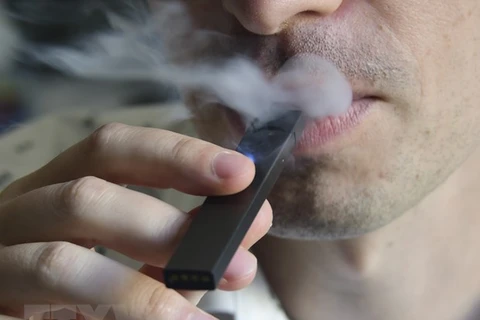
Health ministry raises alarm about use of e-cigarette among students ảnh 1On October 8, 2022, the Ministry of Education and Training held a direct communication session on the prevention and control of tobacco harms, particularly e-cigarettes, for students in Can Tho city (Photo: VNA)
Hanoi (VNS/VNA) - There have been numerousincidents of students requiring emergency medical attention due to nicotinepoisoning and other chemicals present in e-cigarettes and heated cigaretteproducts, according to the Ministry of Health’s Department of Medical ServiceAdministration.

The department said in a document sent to Departments of Health inprovinces and cities that the use of electronic nicotine delivery (END)products and heated tobacco products (HTPs) is on the rise among students.

Many students have had to be rushed to the emergency room due tonicotine poisoning and the harmful substances in e-cigarettes and heatedcigarettes.

The department said, besides the well-known harmful effects ofregular cigarettes, e-cigarettes and heated cigarettes also pose potentialrisks and contribute to social evils, such as drug abuse and other addictivebehaviours, which adversely affect the health and lifestyle of adolescents.

Moreover, these products cause immediate and long-term harm tohealth, the economy and society. The department urged more communicationand awareness-raising efforts about the dangers of these products.

To further reinforce communication and prevent the use of alltobacco products, the department suggested that provinces and cities' healthdepartments advise the People's Committees of provinces and cities to issuedirectives, instructing departments, branches, and media agencies to regularlypropagate the harmful effects of ordinary cigarettes, e-cigarettes, and heatedcigarettes.

Localities should promptly enforce regulations to prohibit the useof these products in agencies, offices, and educational and traininginstitutions; enhance inspection activities; and strictly deal with cases ofbuying, selling, and using e-cigarettes, heated cigarettes, and shisha.

Departments of health should collaborate with relevant mediaagencies and units to disseminate information on the harmful effects ofe-cigarettes and heated cigarettes to civil servants, public employees, andemployees at agencies and organisations, as well as people in the area.

The content can be integrated into meetings, seminars,conferences, agencies, units and community events.

Furthermore, health departments should work closely with educationand training departments to provide information and widely disseminate theharmful effects of new tobacco products to pupils, students, officials, andteachers at educational institutions. Healthcare facilities should alsoactively provide information about the harmful effects of new tobacco productsto patients, their family members, and people in the community.

During a scientific conference organised by the Ministry of Healthand the Ministry of Education and Training in 2022 to share research results ontobacco use among students aged 13-15 years old in Vietnam, data revealed thatthe rate of tobacco use among this age group increased from 0.2% in 2014 to 0.8%in 2022.

The use of new tobacco products such as e-cigarettes and heatedcigarettes is also on the rise among young people.

The rate of e-cigarette smoking among those over 15 years oldincreased from 0.2% in 2015 to 3.6% in 2020, with an especially high rate of7.3% among the 15-24 age group. Among students aged 13-15 years old, the rateof e-cigarette use is 3.5%, with male students at 4.3% and female students at2.8%.

E-cigarettes and heated tobacco products contain nicotine, alongwith approximately 15,500 flavourings, many of which are toxic and can havenegative health effects. They also pose a risk of fire and explosion and can bemixed with other substances, such as cannabis. 

The World Health Organization (WHO) has recommended thate-cigarettes are more harmful than traditional cigarettes and can causepremature health effects or interstitial lung disease, which progresses rapidlyand has a worse prognosis than lung cancer. Furthermore, e-cigarettes do nothave the same effect as regular cigarettes in aiding smoking cessation./.
VNA
See more

Under a phased rollout beginning in 2026, every resident in Ho Chi Minh City will receive at least one annual health check-up or health screening. (Photo: VNA)

Ho Chi Minh City develops integrated multi-tier healthcare system

Under the new model, healthcare is organised into interconnected levels based on people's needs rather than administrative boundaries. Patients can move seamlessly between levels while their electronic health records and treatment information remain connected through digital platforms, referral systems, telemedicine, electronic medical records, and integrated health databases.

Doctors conduct heart and lung examinations for workers. (Photo: VNA)

Draft policy encourages people to prepare for old age from middle age

A draft circular guiding the implementation of the National Target Programme on Health Care, Population and Development (2026-2035) marks a shift from focusing solely on elderly care to encouraging healthy and independent ageing through early preparation. It covers healthy lifestyles, regular health check-ups, financial planning, suitable employment and home-based elderly care skills.

The meeting between the Vietnam Military Medical University delegation and leaders of the Lao Ministry of National Defence in Vientiane (Photo: VNA)

Vietnam, Laos deepen military medical cooperation

Since 1954, Vietnam Military Medical University has trained 687 Lao military medical personnel, including 322 doctors, 67 master's degree holders, 10 doctorate holders, and dozens of specialist physicians, alongside hundreds of pharmacists and medical technicians.

Vietnam's first penis transplant from a brain-dead donor is successfully performed at Viet Duc University Hospital. (Photo published by VNA)

Vietnam reaches new milestone in reconstructive transplant surgery

As the first operation of its kind in Vietnam, the hospital spent months developing treatment protocols, studying international experience and assembling a multidisciplinary team that included experts in transplantation, andrology, microsurgery, anaesthesia, immunology and pathology.

Dr. Nguyen Thanh Xuan is performing brain surgery on a patient (Photo published by VNA)

National strategy aims to build advanced medical ecosystem

Vietnam's adjusted healthcare network master plan for 2021–2030, with a vision to 2050, also outlines a regional structure covering the country's six socio-economic regions. It envisages 17 provincial general hospitals serving regional functions, at least one highly specialised hospital in each region, and at least one advanced medical facility in every province and city.

Vietnamese Ambassador to Bulgaria Nguyen Thi Minh Nguyet and Prof. Dr. Nguyen Huu Tu, President of Hanoi Medical University, meet with Prof. Boycho Landjov, President of Sofia Medical University. (Photo: VNA)

Vietnam, Bulgaria forge closer medical ties

The visit's highlight was the signing of a memorandum of understanding (MoU) between Hanoi Medical University and Sofia Medical University, creating a long-term framework for academic exchanges, scientific research and institutional cooperation between the two countries' leading medical schools.

The Intensive Care Unit at Duc Giang General Hospital has continuously introduced and applied advanced specialised techniques to improve the treatment and survival of critically ill patients. (Photo: VNA)

40 years of renewal: Healthcare quality advanced for new era

Over the past four decades of Doi moi (Renewal), Vietnam’s healthcare sector has made remarkable progress, and is now well positioned to achieve further breakthroughs by harnessing science, technology and innovation to improve public health care in the new era, according to experts from the Vietnam Union of Science and Technology Associations (VUSTA).

Doctors from Cho Ray Hospital conduct preventive health screenings for residents at the Cho Lon ward health station. (Photo: VNA)

Ho Chi Minh City targets completion of universal health check-ups by December 15

According to the municipal Department of Health, as of July 20, a total of 732,873 residents had undergone periodic check-ups and had electronic health records established. The figure reflects encouraging initial results from the citywide campaign launched by the department and underscores local authorities' commitment to implementing one of the largest community healthcare programmes ever undertaken in the southern metropolis.