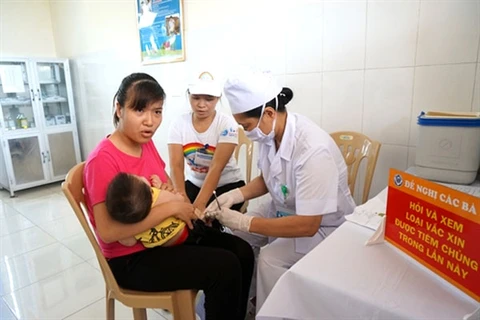
A doctor examines an infant at the Vietnam National Hospital of Paediatrics (Source: VNA)
 Hanoi (VNA) - Deputy Minister of Health Nguyen Thanh Long on March 6 sent an urgent official dispatch asking local authorities to step up preventive measures against whooping cough.
The move comes amid a rising number of affected children.
Since the beginning of this year, the Hanoi-based Vietnam National Hospital of Paediatrics has treated more than 50 children suffering from whooping cough, four of whom have died.
According to the hospital, most of the children were less than three months old, were not vaccinated against the disease, or vaccinated with inefficient doses, or whose mothers were not vaccinated and thus had no antibodies to pass on to the children.
Many children were hospitalised with serious pneumonia symptoms and had to be put on a respirator. Some cases were required to undergo hemodialysis due to their critical condition.
The Ministry of Health (MoH) has asked local authorities to recheck the list of children eligible for the national expanded programme on immunisation to ensure that at least 95 percent at ward level are vaccinated.
The ministry has also asked local authorities to vaccinate children whose vaccinations were delayed and intensify the awareness-raising campaign for locals, urging them to get their children vaccinated at the right time and with full doses.
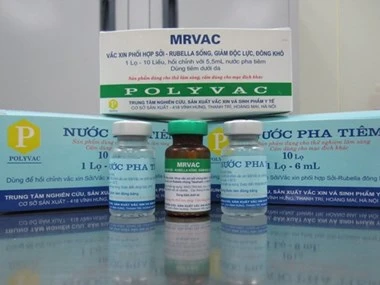
Currently, there are two types of vaccines against the disease -- DTP and Quinvaxem. The first dose should be injected when a child is two months old, the second dose one month later and the third dose two months later.
Whooping cough, or pertussis, is a highly contagious respiratory tract infection. It is dangerous in infants, especially those less than six months.
According to doctors, if an infant less than one month suffers from the disease, the rate of fatality can be as high as 90 percent. – VNA
The move comes amid a rising number of affected children.
Since the beginning of this year, the Hanoi-based Vietnam National Hospital of Paediatrics has treated more than 50 children suffering from whooping cough, four of whom have died.
According to the hospital, most of the children were less than three months old, were not vaccinated against the disease, or vaccinated with inefficient doses, or whose mothers were not vaccinated and thus had no antibodies to pass on to the children.
Many children were hospitalised with serious pneumonia symptoms and had to be put on a respirator. Some cases were required to undergo hemodialysis due to their critical condition.
The Ministry of Health (MoH) has asked local authorities to recheck the list of children eligible for the national expanded programme on immunisation to ensure that at least 95 percent at ward level are vaccinated.
The ministry has also asked local authorities to vaccinate children whose vaccinations were delayed and intensify the awareness-raising campaign for locals, urging them to get their children vaccinated at the right time and with full doses.
Currently, there are two types of vaccines against the disease -- DTP and Quinvaxem. The first dose should be injected when a child is two months old, the second dose one month later and the third dose two months later.
Whooping cough, or pertussis, is a highly contagious respiratory tract infection. It is dangerous in infants, especially those less than six months.
According to doctors, if an infant less than one month suffers from the disease, the rate of fatality can be as high as 90 percent. – VNA
VNA