High-tech FDI drives Vietnam’s economic evolution

High-tech foreign investments will continue to propel Vietnam’s economic growth for years to come, Michael Kokalari, chief economist at investment fund VinaCapital, has said.
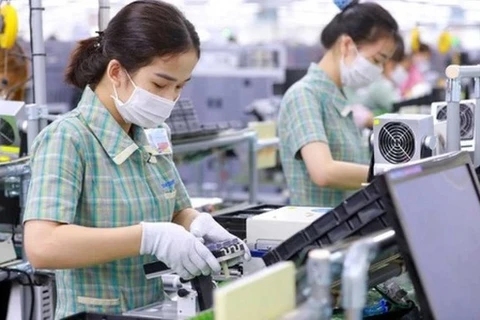
High-tech FDI drives Vietnam’s economic evolution ảnh 1Illustrative image (Photo: VNA)
HCM City (VNS/VNA) - High-tech foreign investmentswill continue to propel Vietnam’s economic growth for years to come, MichaelKokalari, chief economist at investment fund VinaCapital, has said.

Vietnam’s economic growth has been accelerating this year, and sothe World Bank (WB), International Monetary Fund (IMF) and others have sharplyrevised up their GDP growth forecasts for the country, with an increasingnumber of economists now expecting it to exceed 8% this year. This has promptedinvestors to ask what is different in Vietnam and why.

In a note, Kokalari said, quoting newly published research byeconomists at Harvard University, that one reason Vietnam is aneconomic outlier is that FDI is supporting the country’s manufacturing whilealso driving an increase in the complexity of products produced in Vietnam.

An increase in the complexity of the products a country is able tomake is the single most powerful growth driver for a developing country'seconomy, according to the economist.

“The recent announcements by Samsung, Apple and others make usconfident that high-tech foreign investments will continue propelling Vietnam’seconomic growth for years to come,” he said.

Samsung, Vietnam's single largest foreign investor, announced thatit would start producing semi-conductor parts in the country.

Apple said it would begin producing watches and MacBooks in Vietnam,the first time they will be made outside China.

Apple has “big plans for Vietnam” according to insiders, who alsonoted that the Apple Watch is particularly complicated to manufacture becauseof the challenge of squeezing so many components into such a small case.

According to research by the London School of Economics and theWorld Bank, FDI is instrumental in helping “developing economies move intohigher value-added parts of the value chain,” and high-tech FDI has had a bigpositive impact on Vietnam’s economy. 

Furthermore, Vietnam achieved the biggest jump in Harvard'sEconomic Complexity Index ranking in the last two decades, partly because theSamsung and Intel investments attracted a flurry of other high-tech investmentsfrom Apple, LG Electronics, Dell, and a number of Japanese firms.

The primary motivations for firms to set up high-tech factories inVietnam include a high-skill, low-wage workforce and the country’s geographicproximity to high-tech supply chains in Asia, according to Kokalari. 

Recent US-China trade tensions, especially the Bidenadministration’s recent announcement it would keep Trump’s tariffs on Chineseimports in place essentially ensures that multinational firms would continuepouring FDI into Vietnam for years to come, Kokalari said.

Vietnam’s trade surplus with the US more than doubled from 35billion USD in 2018 to 71 billion USD (20% of GDP) in 2021, during which timeits trade deficit with China also more than doubled to 54 billion USD. 

Movingup value chain propels GDP growth

According to economists, high-tech FDI boosts Vietnam's GDPin two ways: by lifting incomes and improving the country's capability toproduce complex products. 

The former supports GDP growth in the short-term since domesticconsumption accounts for two-thirds of Vietnam's GDP, while the latter booststhe country’s long-term economic prospects. 

The net result is that the production of smartphones, homeelectronics and other products with a relatively high degree of complexityultimately contributed over 1,000 USD of Vietnam's 3,000 USD per capita GDP in2020.

The revenues and earnings of most companies listed on Vietnam’sstock exchanges are primarily linked either directly or indirectly to domesticconsumption. 

This gives active stock managers ample opportunities to outperformthe benchmark VN-Index by assessing which companies’ stock prices are likely tobenefit the most from their exposure to the higher spending by Vietnam’semerging middle-class consumers that ultimately results from increasedhigh-tech FDI inflows.

Kokalari said “Foreign-owned factories in Vietnam still importmost of the components/production inputs they require to make the products theyexport, especially high-tech products like consumer electronics andsmartphones.

“We expect the imported content of Vietnam’s exports to plunge andthe local content contribution to soar as local firms develop their ability tosupply foreign companies with production inputs in the years ahead.

“Next, the nascent wave of FDI into the production of some of themost complicated products ever manufactured in Vietnam should lead to more‘spillover effects’ that will lead local manufacturers to diversify into highervalue-added segments in the value chain.”

The plans by Apple and Samsung to produce some of the mosttechnologically advanced products ever made in Vietnam would significantlyboost Vietnam's GDP growth in the years ahead, and ensure that the economic“decoupling” that Vietnam achieved this year could be sustained in 2023.

“Our day-to-day interactions with a wide range of Vietnamesebusinesses – from large cap listed companies to ultra tech-savvy smallentrepreneurs – continually make us appreciate the strong parallelsbetween Vietnam’s economy in the 2020s and Japan in the 1970s, when thatcountry embarked on its multi-decade climb up the global value chain. 

“We remain extremely bullish on Vietnam’s economic prospects andby extension on the prospects for much higher stock prices in the yearsahead.”/.
VNA

See more

An Phát Complex Industrial Park in Hai Phong City is one of the eco-friendly industrial parks. (Photo: VNA)

Green industrial parks become new magnet for FDI

Statistics show that about 80% of FDI enterprises prioritise investing in industrial parks with green energy infrastructure, reflecting a growing shift in investment preferences amid tightening global environmental standards.

Wood panel production at the Thuan An Wood JSC in Ho Chi Minh City (Photo: VNA)

Vietnamese businesses ride wave of investment in green manufacturing

Recent developments in private investment show that as confidence in the private sector has grown and is a key driver of economic development, investors are strengthening support for enterprises not only through capital but also management expertise and market connectivity.

Officers and soldiers of Son Tra Border Guard Station, Da Nang City Border Guard Command tell local fishermen about IUU fishing. (Photo: VNA)

Fishing solidarity groups help Vietnam with IUU “yellow card” warning removal

Over the years, coastal authorities in Da Nang have intensified efforts to educate fishermen about regulations, particularly the need to avoid illegal fishing in foreign waters. Local administrations and competent forces have also strengthened vessel registration and inspection procedures, installed vessel monitoring systems and ensured transparent declarations of catches at ports.

Representatives of Central Retail Vietnam and Lotte Plaza Market sign a distribution cooperation agreement at the networking event in Ho Chi Minh City on March 13. (Photo: VNA)

Vietnamese firms step up cooperation with international distribution chains

Connecting Vietnamese businesses with international distribution networks has been a key component of government-led trade promotion programmes for many years, which are designed to help domestic companies place goods directly into global retail systems rather than exporting solely through intermediaries.

Direct Hanoi–Amsterdam flights by Vietnam Airlines to begin on June 16. (Photo: Vietnam Airlines)

Vietnam Airlines to launch direct Hanoi–Amsterdam service on June 16

Under the plan, the Hanoi–Amsterdam route will commence operations on June 16, 2026, with an expected frequency of three return flights per week using modern wide-body Airbus A350 aircraft. This will be the first direct air link between Vietnam and the Netherlands, helping to shorten travel time and enhance connectivity between Vietnam and one of Europe’s key economic, logistics and aviation transit hubs.

Farmers harvest the 2025 Winter–Spring rice crop in An Giang province. (Photo: VNA)

An Giang accelerates export shift to meet green consumption trends

To enhance competitiveness, authorities are assisting businesses in obtaining globally recognised certifications such as GlobalG.A.P., Organic and HACCP, enabling key exports including rice, seafood and clean agricultural products to strengthen their position in global markets, according to Quang Xuan Lua, Director of the An Giang Centre for Trade and Investment Promotion.

Motorcycle riders refill their vehicles at a petrol station in Hanoi (Photo: VNA)

E5 RON92 biofuel price falls in latest adjustment

Since the beginning of this year, domestic fuel prices have undergone 14 adjustments, including five decreases and nine increases for RON95 and six declines and eight hikes for E5 RON92. Meanwhile, diesel price has fallen three times and risen 11 times.

A French customer is tasting Vietnamese lychee. (Photo: VNA)

Vietnamese agricultural products boost global brand recognition

Vietnam aims to achieve about 74 billion USD in agro-forestry-fishery export turnover this year. Expanding value-added products, improving quality standards and strengthening brand building, especially through international supermarket systems, will be key to enhancing the competitiveness and global recognition of Vietnamese agricultural products.

An apartment building developed by BCONS in Binh Duong (Photo: VNA)

Resolution 68 boosts businesses entering market

By the end of 2025, Vietnam had more than one million active enterprises. In the first two months of 2026, about 64,500 enterprises entered or re-entered the market, up 29.4% year-on-year, averaging 32,200 newly established or returning businesses per month.

A Vinh Long official introduces signature local products to Korean guests. (Photo: VNA)

Vinh Long courts Korean investment in key sectors

Vice Chairman of the provincial People’s Committee Nguyen Truc Son vowed to accompany investors and provide them with optimal conditions, while building a transparent and stable business environment to secure long-term engagement from foreign enterprises, particularly those from Daejeon.

Delegates at the launching ceremony (Photo: VNA)

Digital platform on overseas market development launched

With Vietnam’s network of 64 trade offices overseas, Deputy PM Son noted that connecting them through a modern digital platform could help establish a unified national trade information system that operates efficiently, transparently and with strong forecasting capacity.

The Government’s issuance of Decree No. 72/2026/ND-CP revising preferential import tariffs on several petrol products and raw materials is a timely move to diversify supply sources. (Photo: VNA)

Fuel import tariff cuts strengthen Vietnam’s energy resilience: experts

Economic expert Dinh Trong Thinh said revising fuel import tariffs helps diversify supply sources and reduce reliance on traditional markets, thereby strengthening Vietnam’s ability to cope with potential global supply shocks. Ensuring access to multiple energy sources is also vital for safeguarding national energy security, he added.