IMF optimistic about Vietnam's economic growth

The first half of this year saw a swift economic rebound as Vietnam’s pandemic restrictions eased following the adoption of a living-with-COVID strategy and a robust vaccination drive, according to an article published on the website of the International Monetary Fund (IMF), imf.org.
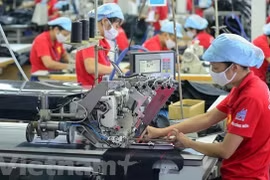
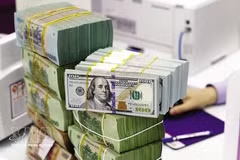
IMF optimistic about Vietnam's economic growth ảnh 1Illustrative image (Source: VNA)
Hanoi (VNA) – The first half of this yearsaw a swift economic rebound as Vietnam’s pandemic restrictions eased followingthe adoption of a living-with-COVID strategy and a robust vaccination drive,according to an article published on the website of the International MonetaryFund (IMF), imf.org.

Supportive policies such as low interest rates, strongcredit growth, and the government’s Programme for Socio-economic Recovery andDevelopment have been accompanied by strong manufacturing output and a recoveryin retail and tourism activity, the article said.

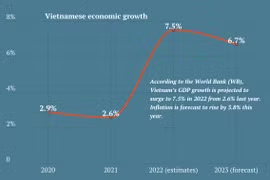
The IMF has recently raised Vietnam growth forecast to7% this year, lifting it by a full percentage point from three months earlierand the only significant upward revision among major Asian economies.

The fund lowered the projection for next year by 0.5percentage points to 6.7%, but that still contrasts with dimming prospectselsewhere and would be the fastest pace among Asia’s major economies.

By way of contrast, growth estimates for Asia werelowered to 4.2% and 4.6% for this year and next in the IMF’s latest WorldEconomic Outlook Update, the article noted.

Vietnam’s inflation pressure has been mostly limitedto some goods like fuels and related services like transport. Consumers arelargely insulated from the global surge in food prices because of ampledomestic supplies, pork prices declining from last year’s peak, and apreference for rice, which remains cheaper than other grains like wheat.Further, price gains for services, such as health and education, have also beenvery mild.

Consumer prices in the first seven months of the yearrose, but remain below the central bank’s 4% target for the year. The economy’sdelayed recovery last year has kept core inflation, which strips out volatilefood and energy costs, below regional peers.

Inflation, however, could pick up as economic activitygets back to full speed. Higher costs for transportation and commodities suchas fertilizers and animal feed could also raise prices for a broader range ofgoods and services, adding inflationary pressure.

Vietnam’s recovery also faces headwinds from globalgrowth decelerating from 6.1% last year. The IMF’s World Economic Outlooklowered estimates to 3.2% this year and 2.9% next year amid the Russia-Ukraineconflict, and the slowdown in China and major advanced economies. Such aslowdown implies reduced demand for Vietnam’s exports, especially from keytrade partners like the US, China, and the European Union.

In addition, financial conditions are tightening asinterest rates in the US and other advanced economies rise to curb inflation.That in turn increases financing costs and can lead to capital outflows.

Finally, greater uncertainty about global trade andfinancial markets could weigh on the recovery, especially if some industrieslose access to needed intermediate goods because of further supply-chaindisruptions. That could curtail foreign investment in Vietnam, slowing productionand technological growth.

Together, these factors mean policymakers must beagile and make timely changes. Fiscal policy should take the lead in aidingrecovery, yet flexibly adjusted to evolving economic conditions.

The central bank should focus on rising inflationaryrisks, and communicate that it’s ready to act as needed and remains committedto meeting its inflation target, according to the article.

Authorities should also continue addressing bad loansin the banking system and closely monitoring for potential risks in real estatemarkets to safeguard financial stability.

Tackling the challenges relating to labour, social safetynet coverage and climate-related risks will further unleash Vietnam to itsconsiderable growth potential and continue advancing on a sustainabledevelopment path toward higher income status, the article said./.
VNA
See more

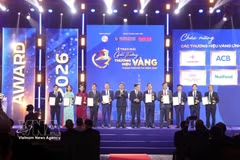
At the sixth Golden Brand Awards 2026 ceremony (Photo: VNA)

Ho Chi Minh City honours top 50 brands for 2026

The awards aim to recognise brands that can lead their industries, drive innovation and create a ripple effect across the business community, lifting the city’s standing in a new growth stage.

Luxury apartment projects in downtown Ho Chi Minh City (Photo: VNA)

Ho Chi Minh City's housing market sees price stabilisation, sharper buyer segmentation

According to Avison Young Vietnam, improved planning and infrastructure development have helped ease market uncertainty and prevented a complete freeze. More than 25,000 apartments are expected to enter the market in multiple launches between 2027 and 2030, with many projects scheduled to benefit from infrastructure improvements around 2030.

Vietnamese Deputy Minister of Industry and Trade Phan Thi Thang speaks at the forum (Photo: VNA)

Vietnam, Georgia look to more business opportunities

For Vietnamese firms, Georgia can serve as a gateway to broader regional markets, given its strategic location connecting the South Caucasus, Central Asia and China with European markets via the Black Sea.

Chairman of the Vietnamese Business Association in Laos (AVILA) Duong Dinh Bang (Photo: VNA)

PM’s visit injects fresh momentum into Vietnam-Laos special relations

At the 2026 Laos-Vietnam Investment Promotion Conference in Vientiane, the two PMs held direct dialogue with businesses and investors from both countries, affirming their determination to address bottlenecks in institutional frameworks, administrative procedures, transport infrastructure and payment connectivity. The goal of these efforts is to boost bilateral trade to 10 billion USD by 2030.

Deputy Secretary of the An Giang provincial Party Committee and Secretary of the Party Committee of the Phu Quoc special zone Dinh Van Noi speaks at the dialogue (Photo: baoangiang.com)

Phu Quoc moves to resolve infrastructure bottlenecks ahead of APEC 2027

Deputy Secretary of the An Giang provincial Party Committee and Secretary of the Party Committee of the Phu Quoc special zone Dinh Van Noi said an official information portal will be launched to receive public feedback, while hotlines for local leaders will allow businesses and residents to raise concerns directly.

Deputy Minister of Industry and Trade Phan Thi Thang at the forum. (Photo: VNA)

Vietnamese firms explore investment opportunities in Georgia

Priority areas with great cooperation potential include manufacturing, logistics infrastructure, renewable energy, tourism, hospitality, information and communications technology (ICT), and business process outsourcing (BPO), said a Georgian official.

Prime Minister Le Minh Hung and delegates launch the digital platform of the Vietnam Association of Small and Medium Enterprises (August 2026). Photo: VNA

Vietnamese businesses, entrepreneurs make growing contributions to national development

Vietnam Entrepreneurs’ Day is an opportunity to recognise businesses’ contributions and reinforce the entrepreneurial spirit, the pursuit of legitimate prosperity and national responsibility. With stronger policies and greater innovation, Vietnamese enterprises are expected to play an increasingly important role in economic growth and the country’s ambition to become a strong, prosperous nation.

A view at a CO.OPMART supermarket in Bac Ninh city (Photo: bacninh.gov.vn)

Bac Ninh’s CPI up 4.07% in nine months

The consumer price index (CPI) in Bac Ninh city rose 4.07% year-on-year in the first nine months of 2026, with housing and construction materials, education and transport recording the sharpest increases, according to the municipal Statistics Office.

Vietnam's textile - garment and footwear industries are aiming to shift from processing and assembly to stages with higher added value, increasing technology content and competitiveness. (Photo: VNA)

Vietnam’s supporting industries seek stronger domestic links

As global supply chains undergo major changes and environmental standards and digital technology requirements become more demanding, developing supporting industries has become essential to improving the competitiveness of the economy. This requires coordinated efforts by the Government, multinational corporations and domestic businesses.