India, ASEAN talk changes for trade in goods agreement

The ASEAN-India Trade in Goods Agreement (AITIGA) Joint Committee held its third meeting from February 16-19 in New Delhi to review and discuss changes to the agreement.
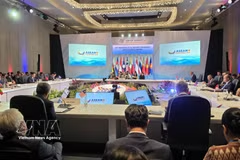
India, ASEAN talk changes for trade in goods agreement ảnh 1Delegates at the meeting of the AITIGA in New Delhi. (Photo: pib.gov.in)

New Delhi (VNA) – The ASEAN-India Trade in GoodsAgreement (AITIGA) Joint Committee held its third meeting from February 16-19in New Delhi to review and discuss changes to the agreement.

The AITIGA was signed in 2009.  In September 2022, both sides tasked theAITIGA Joint Committee to undertake the review to make the agreement moretrade-facilitative and mutually beneficial.

A total of eight sub-committees have been constituted underthe AITIGA Joint Committee for undertaking negotiations on different policyareas related to the agreement.

The first two meetings of the Joint Committeewere held in May and August 2023.

At its third meeting, the committee held detailed discussionsand took stock of the progress in the negotiations.  The sub-committees reported the progress andoutcome of their discussions related to market access, rules of origin andstandards, technical regulations and conformity assessment procedures to thejoint committee.

After discussions, the committee outlined the focus areas forfurther deliberations and updated the work programme for the review whileproviding necessary guidance to the sub-committees to carry forward thenegotiations.

India-ASEAN trade has grown to 131.58 billion USD in the2022-23 fiscal year. The review of AITIGA will facilitate further expansion oftrade between the two sides in a balanced and sustainable manner. Both sidesare aiming to conclude the review in 2025. The 4th meeting of the AITIGA JointCommittee is planned to be held in Kuala Lumpur, Malaysia in May 2024./.
VNA

See more

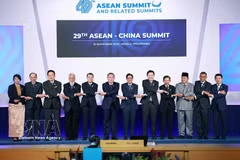
Prime Minister Le Minh Hung (fifth, left) and other ASEAN leaders and Chinese Premier Li Qiang at the 29th ASEAN-China Summit (Photo: VNA)

PM suggests priorities for elevating, deepening ASEAN-China cooperation

First, Prime Minister Le Minh Hung stressed that the two sides should continuously strengthen strategic trust and maintain an environment of peace and stability. The PM called for expanded exchanges and cooperation, stronger coordination in responding to emerging non-traditional challenges, and enhanced cooperation at the United Nations and other multilateral forums.

An overview of the dialogue between ASEAN leaders and the ASEAN Business Advisory Council (ASEAN-BAC) in Manila on November 15 (Photo: VNA)

Vietnam puts forward priorities to advance ASEAN cooperation

Appreciating ASEAN-BAC’s report and recommendations, Deputy Minister of Foreign Affairs Dang Hoang Giang, head of Vietnam’s ASEAN Senior Officials’ Meeting (SOM) delegation, called for simplifying procedures, reducing costs, accelerating digitalisation, upgrading the ASEAN Single Window (ASW) and effectively implementing the ASEAN Digital Economy Framework Agreement (DEFA) to make the regional market more accessible.

An overview of the ASEAN Leaders’ Interface with Representatives of the ASEAN Inter-Parliamentary Assembly (AIPA) in Manila on November 15 (Photo: VNA)

Vietnam proposes three key directions for ASEAN-AIPA cooperation

Prime Minister Le Minh Hung affirmed that close and effective coordination between the governments and parliaments of member states is a foundation and important driving force for ASEAN to realise its vision of a united, resilient, dynamic and people-centred community.

ASEAN signs Digital Economy Framework Agreement

ASEAN signs Digital Economy Framework Agreement

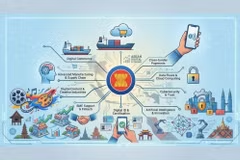
The Digital Economy Framework Agreement (DEFA), the bloc’s first standalone and legally binding digital economy agreement, establishes common rules covering digital trade, cross-border data flows, electronic payments, cyber security and artificial intelligence (AI).

An overview of the ASEAN Foreign Ministers’ Meeting on November 14, 2026 (Photo: VNA)

Vietnam backs ASEAN culture of consultation, dialogue, preventive diplomacy

Deputy Minister of Foreign Affairs Dang Hoang Giang stressed that amid conflicts and instability in various parts of the world, ASEAN should give top priority to strengthening the foundations of peace and stability, uphold the rule of law and promote the bloc’s principles and norms of conduct, particularly the Treaty of Amity and Cooperation in Southeast Asia (TAC).

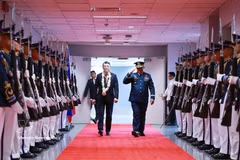
The welcome ceremony for Prime Minister Le Minh Hung at Ninoy Aquino International Airport on November 14 afternoon (Photo: VNA)

Vietnamese PM arrives in Philippines for 49th ASEAN Summit

PM Le Minh Hung’s attendance underscores Vietnam's sustained commitment to the bloc, which aligns consistently with the foreign policy set forth by the 14th National Party Congress, which defines ASEAN as a bloc of strategic importance and a top priority in Vietnam’s external relations.

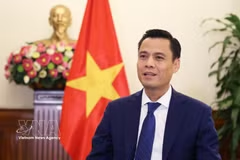
Deputy Minister of Foreign Affairs Dang Hoang Giang. Photo: VNA

Vietnam aims to promote ASEAN unity, resilience and practical cooperation: Deputy FM

Prime Minister Le Minh Hung's attendance at the 49th ASEAN Summit and related summits in Manila, the Philippines, from November 14-17 aims to concretise Vietnam's foreign policy of independence, self-reliance, resilience, multilateralisation and diversification, and reaffirm ASEAN's position as Vietnam's foremost strategic priority in its foreign policy.

A road is under construction in Dong Nai city, Vietnam. (Photo: VNA)

ADB: Southeast Asia needs 7.1 trillion USD in infrastructure investment by 2040

ADB estimates that the region will need an average of 476 billion USD in infrastructure investment annually during 2026–2040, equivalent to 8.7% of GDP. However, at current investment levels, government budget resources would cover only around 45% of this demand, leaving an annual financing gap of 264 billion USD.

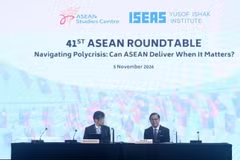
Thai Deputy Prime Minister and Minister of Foreign Affairs Sihasak Phuangketkeow (R) takes part in the Q&A session at the 41st ASEAN Roundtable. (Photo: VNA)

Thailand calls on ASEAN to proactively address polycrisis

Thai Deputy Prime Minister and Minister of Foreign Affairs Sihasak Phuangketkeow noted that no single member state could tackle challenges ranging from major-power competition and economic fragmentation to climate change and energy and food security on its own. Regional cooperation is therefore a strategic imperative, enabling ASEAN not only to overcome crises but also to sustain its development momentum.