Indonesia returns 42 detained Vietnamese fishermen

The Vietnamese Embassy in Indonesia in collaboration with local authorities have completed paperwork for the repatriation of 42 Vietnamese fishermen.
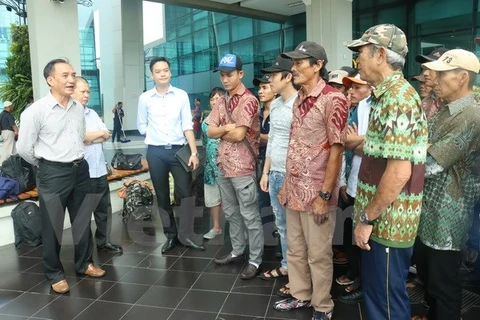
Indonesia returns 42 detained Vietnamese fishermen ảnh 1Vietnamese Ambassador to Indonesia Pham Vinh Quang talks to the Vietnamese fishermen (Photo: VNA)

Jakarta (VNA) – TheVietnamese Embassy in Indonesia in collaboration with local authorities havecompleted paperwork for the repatriation of 42 Vietnamese fishermen.

Vietnamese Ambassador to IndonesiaPham Vinh Quang said the arrest and detainment of the fishermen in Indonesia isa warning for them about the risks of not understanding, or lacking informationon, Vietnam’s and Indonesia’s laws and regulations.

According to the diplomat, theVietnamese Embassy worked closely with relevant Indonesian agencies to verifyinformation on the case. Efforts had been made to reduce the detainees’difficulties during their captivity, as well as have the Indonesian side returnthem.

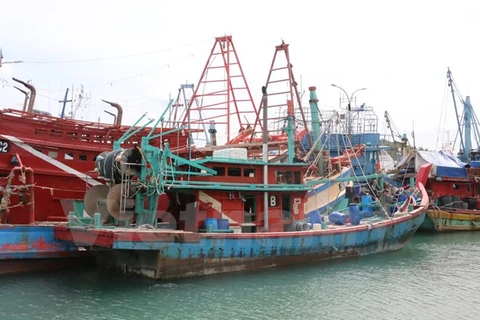
Those arrested, working on fivefishing vessels, had been kept in the Natuna islands since April this year.Most of them, born in the Vietnamese provinces of Ba Ria-Vung Tau, Kien Giang,Tien Giang, and Ben Tre, were hired for fishing and seafood processing.

The majority of them said theywere simply following the orders they were hired for, without any priorknowledge about Indonesian territorial waters.

Some had also stated that uponreturning home, they were to stop sailing due to health issues and old age.

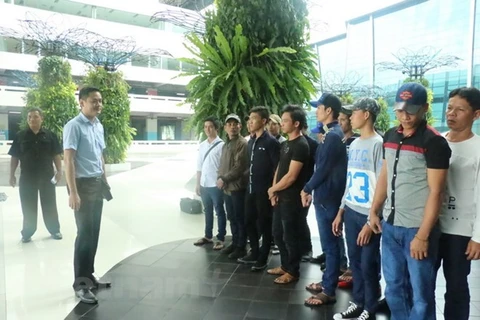
The detainees were set to flyhome from the Soekarno Hatta International Airport in Jakarta.

Five captains and 10 witnesses ofthe five vessels are still detained and are awaiting trial by the Indonesianauthorities.-VNA 
VNA
See more

The copyright crackdown is broadly viewed as an inevitable step in Vietnam’s cultural industry development. (Illustrative photo: VNA)

Healthy digital content market in the making

The sharper crackdown is rapidly redrawing how online entertainment is distributed and consumed, while gradually reshaping public awareness and responsibility toward copyright protection.

A view of Place Ho Chi Minh in Persan, France. (Photo: VNA)

Place preserving memories of President Ho Chi Minh in France

Although there is little publicly available documentation confirming exactly when Place Ho Chi Minh was established, French urban historians suggest that most streets and public spaces named after the Vietnamese leader in France emerged between the 1960s and 1980s, during the height of anti-war movements and solidarity campaigns supporting Vietnam across working-class towns and left-leaning suburbs around Paris.

Vietnamese Ambassador to Bangladesh Nguyen Manh Cuong speaks at the seminar. (Photo: VNA)

President Ho Chi Minh’s thought on national unity remains relevant today

President Ho Chi Minh's ideology of national unity continues to carry profound significance amid growing global challenges, including conflicts, social divisions and economic instability. His message of solidarity, consensus and placing national interests above sectional differences remains a valuable lesson for many developing nations.

Assoc. Prof. Dr. Nguyen Duc Son presents the decision establishing the Vietnamese Language Proficiency Test Council in Japan to a representative of the Vietnam Studies Centre in Japan. (Photo: VNA)

Japan hosts first standardised Vietnamese language proficiency test

As bilateral ties between Vietnam and Japan continue to expand, demand for Vietnamese language learning in Japan has also grown rapidly among OVs, educational institutions, businesses and Japanese people interested in Vietnam. Against this backdrop, the introduction of a standardised proficiency test is expected to provide an official and widely recognised benchmark for Vietnamese language skills.

The “I Love My Fatherland" Journey 2026 kicks off in Nghe An province on May 16. (Photo: VNA)

"I Love My Fatherland” journey features diverse activities

The “I Love My Fatherland” journey will span seven stages across historical and cultural sites and “red addresses” nationwide. There will be a combination of education on traditions, field-based programmes, and digital communications.