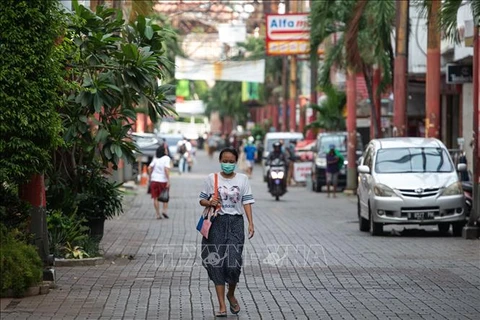
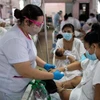
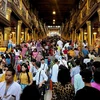
People wear face masks in Jakarta, Indonesia (Photo: Xinhua/VNA)
 Jakarta (VNA) - The Indonesian government is ramping up efforts to carry out mass, rapid polymerase chain reaction (PCR) testing amid concerns the world’s fourth-most populous nation lags behind other nations in testing people for COVID-19.
The country’s Health Ministry recently issued a circular allowing public hospital laboratories, public and private clinical laboratories, as well as state-owned virology laboratories and university research laboratories to conduct PCR testing as long as they meet level-two biosafety (BSL-2) standards for testing SARS-CoV-2 that causes COVID-19, and have the necessary equipment and facilities.
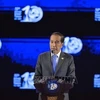
The decision came after Indonesian President Joko Widodo called on the Health Ministry and the COVID-19 task force to improve and accelerate PCR testing, which scientists say is crucial in the battle against the deadly pandemic.
According to pandemic data site Worldometer, Indonesia is ranked among the lowest in COVID-19 testing with only 52 tests for every million people as of April 8. By comparison, among neighbouring countries, Singapore has tested 11,110 for every million people, Malaysia 1,717 and Thailand 1,030.
As of April 8, Indonesia had only tested 14,571 people using the PCR method.
Indonesian government’s spokesperson for COVID-19 affairs Achmad Yurianto said that the country’s labs had the capacity to test more than 500 a day and the figure is expected to increase in the next few days.
In addition to relaxing the regulations on testing, Indonesia has imported two automatic RNA extractors and 18 PCR detectors, which will be distributed to 12 provinces.
The machines could boost the country’s testing capacity to between 5,000 to 10,000 tests per day, reaching as many as 300,000 tests within a month.The Health Ministry said that the country currently had only 200,000 reagents for the labs./.
The country’s Health Ministry recently issued a circular allowing public hospital laboratories, public and private clinical laboratories, as well as state-owned virology laboratories and university research laboratories to conduct PCR testing as long as they meet level-two biosafety (BSL-2) standards for testing SARS-CoV-2 that causes COVID-19, and have the necessary equipment and facilities.
The decision came after Indonesian President Joko Widodo called on the Health Ministry and the COVID-19 task force to improve and accelerate PCR testing, which scientists say is crucial in the battle against the deadly pandemic.
According to pandemic data site Worldometer, Indonesia is ranked among the lowest in COVID-19 testing with only 52 tests for every million people as of April 8. By comparison, among neighbouring countries, Singapore has tested 11,110 for every million people, Malaysia 1,717 and Thailand 1,030.
As of April 8, Indonesia had only tested 14,571 people using the PCR method.
Indonesian government’s spokesperson for COVID-19 affairs Achmad Yurianto said that the country’s labs had the capacity to test more than 500 a day and the figure is expected to increase in the next few days.
In addition to relaxing the regulations on testing, Indonesia has imported two automatic RNA extractors and 18 PCR detectors, which will be distributed to 12 provinces.
The machines could boost the country’s testing capacity to between 5,000 to 10,000 tests per day, reaching as many as 300,000 tests within a month.The Health Ministry said that the country currently had only 200,000 reagents for the labs./.
VNA