Industrial growth slow, labour productivity low: Party official

Vietnam’s industry is developing too slowly and is still reliant on many foreign-invested enterprises, said Nguyen Van Binh, head of the Party Central Committee’s Commission for Economic Affairs.
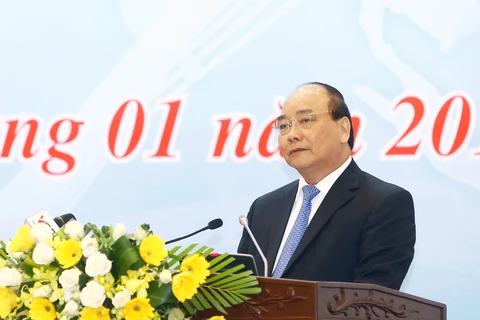
Industrial growth slow, labour productivity low: Party official ảnh 1Vietnam’s industry is developing too slowly and is still reliant on many foreign-invested enterprises, says Nguyen Van Binh, head of the Party Central Committee’s Commission of Economic Affairs (Photo: enternews.vn)

Hanoi (VNA) - Vietnam’s industry isdeveloping too slowly and is still reliant on many foreign-investedenterprises, said NguyenVan Binh, head of the Party CentralCommittee’s Commission for Economic Affairs.

He was speaking at a conferenceheld in Hanoi late last week on national industrial development policies until2025 with a vision to 2035.

Between 2006 and 2015, the country’s total industrial productionvalue rose 3.42 times, while the industrial portion of the GDP remained stableat 31-32 percent.

While this has created jobs and contributed to socio-economicdevelopment, “industrial production growth has been weak andunsustainable; and industrial labour productivity, especially in the processingand manufacturing industries, has been low,” Binh said.

But the growth of average labour productivityin the industrial sector, especially in manufacturing, has been at a low levelof 2.4 percent a year, lower than that of the economic growth rate of 3.9 percentin the 2006-15 period, he noted.

In comparison with othercountries in the region, Vietnam’s industrial productivity lags behind,Malaysia’s and Thailand’s is 6.4 times greater, and that of the Philippines is3.4 times higher. 

Binh stressed the need to develop a comprehensiveindustrial policy framework to promote and improve the quality of nationalindustrialisation and modernisation during the 2016-25 period.

Nguyen Duc Kien, vice chairman of the National Assembly’s Economic Committee, agreed. “It is time tochange the thinking and create a favourable investment environment for alleconomic sectors to develop industries,” Kien said.

Deputy Minister of Industry and Trade Do Thang Hai said Vietnam should continue to update its mechanisms and policies to createa favourable environment for attracting investment.

“Furthermore, the country must clearly definethe role of economic components in industrial development to appropriatelyorient development policies, promote the application of new technologies,facilitate labour restructuring, improve the quality of industrial humanresources and diversify financial resources for industrial development,” Hai added.

Experts also discussed experiences in developing industrial policies incountries such as Japan, the Republic of Korea and Thailand, as well asidentifying opportunities and challenges for industrial development.

Participants proposed several orientations forindustrial development policy, including adjusting the investment structure,selecting key sectors to set investment priorities, facilitating supportingindustry development and protecting domestic production with technicalbarriers.-VNA


VNA
See more

Can Gio protective forest spans four communes — Can Gio, Binh Khanh, An Thoi Dong and Thanh An of Ho Chi Minh City - creating potential for the development of the carbon credit market. (Photo: VNA)

Ho Chi Minh City businesses eye opportunities from carbon market

Deputy Minister of Agriculture and Environment Le Cong Thanh said Vietnam is shifting from policy development and refinement to the implementation and operation of the carbon market. The domestic carbon exchange began pilot operations on June 29, 2026, providing a platform for trading greenhouse gas emission allowances and carbon credits.

Visitors learn about a robot model designed to care for the elderly at Qualcomm’s booth. (Photo: VNA)

Ho Chi Minh City hosts International Innovation Forum and Exhibition 2026

InnoEx 2026 focuses on major shifts reshaping the global economy, including artificial intelligence (AI), data, automation, green transition, international trade and new business models. It also provides a platform connecting businesses, startups, investors and solution providers, facilitating partnerships, investment and access to knowledge and technologies.

Vietjet launches a series of new routes connecting Vietnam with Cebu and Clark (Philippines), Chiang Mai (Thailand), and Osaka (Japan). (Photo: Vietjet)

Vietjet expands flight network in Philippines, Thailand

To celebrate these new services, from August 18 to 20, 2026, passengers can enjoy the opportunity to book Eco tickets from 0 VND (excluding taxes and fees), along with 20% off SkyBoss and Deluxe tickets using promo code HIVJ20, opening the door to exciting destinations across Asia.

Vietnamese manufacturers’ production capacity, product quality and reliability are helping strengthen their position in US retail supply chains (Illustrative image, Source: VNA)

US retailers widen sourcing drive in Vietnam

Despite tariff changes and major shifts in global supply chains, US buyers continue to value Vietnamese suppliers. In the first seven months of this year, the US remained Vietnam’s largest export market, with export turnover reaching 104.7 billion USD, up 23% year-on-year.

Vinachem affirms its position as a leading chemical enterprise at the Autumn Fair 2025 (Photo: VNA)

Vietnamese enterprises renew growth model to move up global value chains

The resolution identifies enterprises as the centre of the renewal process, urging them to shift from cost-based competition to productivity, technology, quality and market responsiveness; from operating independently to joining industrial ecosystems; and from participating in value chains to mastering and eventually leading them.

Key export sectors such as textiles – garments, footwear and furniture, along with many signature products of Da Nang, have strong potential to expand their markets through online export channels. (Photo: VNA)

Da Nang seeks to boost online exports

To help businesses go global, Da Nang is shifting from supporting individual online activities to developing an integrated ecosystem covering products, branding, platforms, payments, logistics, legal issues and market information. This is also part of the city’s e-commerce development orientation for 2026-2030, which identifies e-commerce as an important component of the digital economy.

Deputy Minister of Foreign Affairs Le Thi Thu Hang receives Rolf Mutzenich, a member of the Foreign Affairs Committee of the German Bundestag, in Hanoi on August 18. (Photo: baoquocte.vn)

Vietnam welcomes German firms’ expansion

Vietnam welcomes and stands ready to create favourable conditions for German businesses to expand their investment and operations in the country, particularly in infrastructure, smart seaports, renewable energy, high-speed railways, science and technology, and high-quality human resource training.

Khanh Hoa province has the largest sheep population in Vietnam, with around 100,000 individuals. (Photo: VNA)

Khanh Hoa province explores Halal ecosystem development

Khanh Hoa aims to estabish itself as a Halal-friendly destination while supporting businesses in expanding export markets, attracting strategic partners and investors, and drawing projects from countries with strong Halal logistics, tourism, manufacturing, processing and agriculture sectors.

The proportion of Vietnamese goods remains high at supermarkets. (Photo: VNA)

Vietnamese brands win over domestic consumers to go global

Amid increasingly fierce global competition, the goal is no longer simply to increase domestic consumption of Vietnamese goods, but to develop strong Vietnamese brands capable of winning consumers through quality, innovation and added value, thereby creating a stepping stone for expansion into international markets.

Illustrative image (Photo: VNA)

Automated VAT refunds to be rolled out from December

As of August 11, VAT refunds rose 32% from a year earlier, reaching 64.4% of the full-year estimate. Tax authorities issued 11,627 refund decisions totaling 111.726 trillion VND (4.26 billion USD), up 9% by volume. The payouts improved cash flow for companies and supported production, trade and exports.