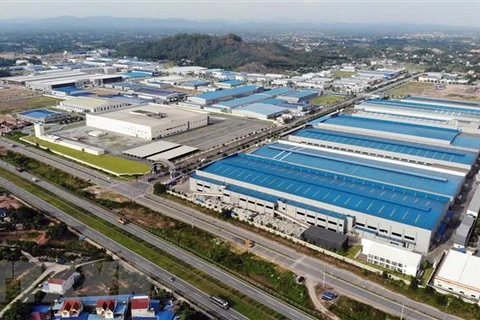
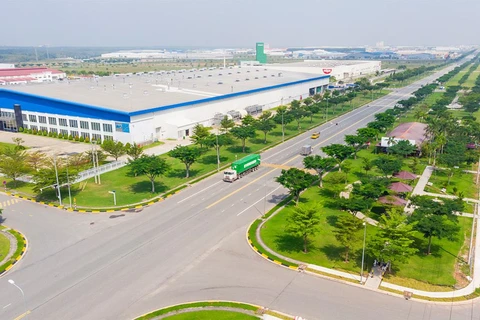
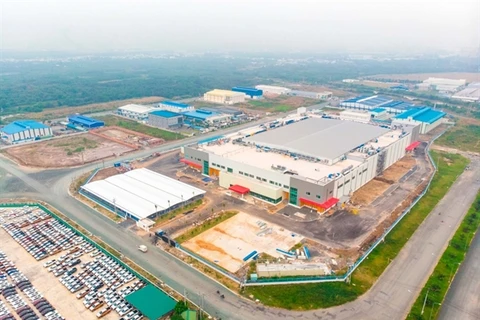
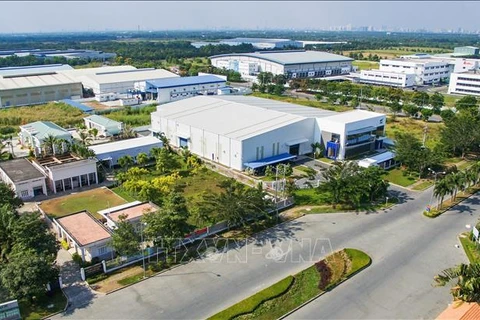
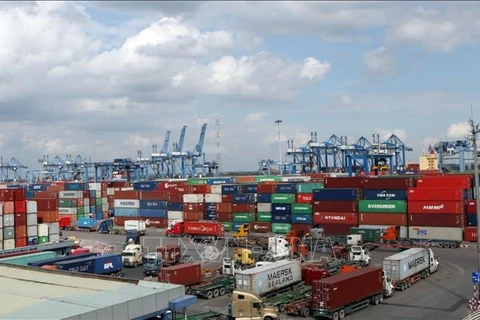
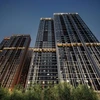
Dong Mai Industrial Park in Quang Ninh province. (Photo: VNA)
 Energy price uncertainty due to geopolitical issues and concerns on economic growth, China’s persistence in pursuing a zero COVID-19 policy coupled with a global trade slowdown have been fueling the disruption and diversification, they added.
In Vietnam, industrial real estate leasing has seen a hike in demand and rental prices, especially for logistics and warehousing.
According to CBRE Vietnam, a commercial real estate services and investment firm, in the third quarter, its industrial leasing enquiries are improving in both quantity and sizes. Land acquisition enjoyed 10% year-on-year growth so far this year and 7% growth for ready-built factories/warehouses.
The average size required by tenants of all CBRE’s enquiries was 9.4 ha in the first half of 2022 compared to 9.2 ha last year for land and 6,700 sq.m in the first half compared with 6,100 sq.m in 2021 for ready-built factories/warehouses.
Vietnam continues to be an appealing destination for industrial real estate investors, according to global real estate services firm Cushman and Wakefield.
It attributed this to the country’s stable growth rate, an export-oriented economy, a rise in free trade agreements, a young labour force, investment incentives and strategic location.
With favourable government incentives, competitive labour costs, a stable political environment, a positive economic outlook and free trade agreements, the Southeast Asian country has become popular for foreign investors moving out of China.
To seize this opportunity, the north-eastern province of Quang Ninh has emerged as a vibrant industrial property market as the province is transforming its rural tourism-based economy and industrialising to attract foreign investment.
Speaking at a recent conference to promote investment in Quang Ninh, Chau Thanh Hung, deputy head of the Quang Ninh Economic Zone Authority, said the province has a strategic geographical location as a gateway connecting China and Southeast Asia.
It has extensive transport infrastructure with an international airport, seaports, the Mong Cai international border gate and modern facilities.
It is home to major economic zones such as Quang Yen, Van Don and Mong Cai and 15 industrial parks (IPs).
Hung said the province was developing seaport-IP complexes starting with the Bac Tien Phong Industrial Zone and Nam Tien Phong Industrial Zone in the Quang Yen Coastal Economic Zone.
These port-IP eco-systems would help reduce logistics costs for manufacturers.
It just issued investment licences to Indochina Kajima Development for its 23.9 million USD Core5 Quang Ninh ready-built factory project.
As of the end of June, it had 150 foreign direct investment (FDI) projects worth 8.26 billion USD by investors from 20 countries and territories.
Vietnam lured more than 14 billion USD of FDI in the first half, of which the Northern region attracted 6.7 billion USD, slightly higher than the Southern region with 6.5 billion USD.
The Northern region currently has about 63,500 ha of planned land for 238 industrial zones and clusters which are operational or in the process of site clearance and construction, according to a report by the Ministry of Industry and Trade./.
VNA