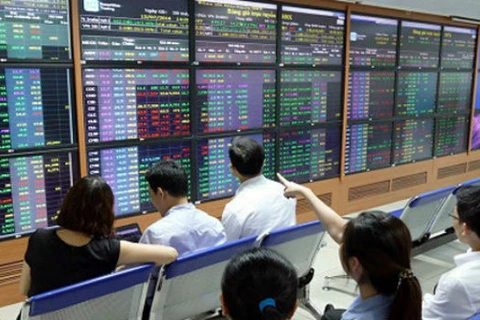
An investor watches stocks on his computer. (Photo: vnreview)
 Hanoi (VNA) - Increasing internet and mobile network coverage has changed the way Tran Van Toan, a stock investor with 15 years’ experience in Hanoi, does business.
Toan said the sight of people flocking to stock exchanges to place orders every day was rare. It had been replaced with online transactions, which have many advantages.
“We investors can read corporate financial reports and world news on our smartphones anywhere before making investment decisions,” Toan said.
Toan is one of many investors taking advantages of the fourth industrial revolution (Industry 4.0), which is changing Vietnam’s economy, including the stock market.
Investors now conduct transactions online and brokerages can share information with their customers through Facebook, Zalo and Viber, instead of meeting clients in person.
However, insiders said that although Industry 4.0 helps investors easily access corporate information, it doesn’t mean it’s easy to earn money.
Investor Nguyen Van Ngoc said there was now a lot of information for investors, but it was not always accurate – requiring investors to filter information from various sources. “The more advanced technology, the more spam.”
“Stock investment is a long-term business. The investors need to evaluate the situation before investing. If we invest in a company whose information has been already published, it comes to nothing,” Ngoc said.
There are many excellent investors who have experience and financial knowledge on the stock market, seeing investing as a profession.
Ngoc said investors previously earned a lot of money from the stock market because many people did not know much about the market but still invested.
Today, there are many stocks available, but also many investors, creating fierce competition."
The competition means that brokers too have to up their game.
According to Nguyen Duy Dinh, a customer service employee at the MB Securities Company, information between brokers and investors had been shared quickly thanks to new technology, however, brokers would have to be more active in seeking, searching and filtering information for investors.
“The brokerage requires intelligence, which is key to competing with other companies,” Dinh said.
In Vietnam, investors are heading to securities companies which have modern technology and giving preferential policies on transaction fees.
There are about 80 securities companies operating in the country, of which the 10 largest occupy 70 percent of the market.
Nguyen Xuan Truong, deputy head of the product management division at the Tan Viet Securities JSC, said Industry 4.0 had created many challenges requiring securities companies to change. They needed to catch up with and take advantage of modern technologies, like artificial intelligence, Big Data and Internet of Things.
In the online environment, Truong said information security must be a priority. In addition, the securities companies had to prepare financial and human resources to modernise and digitalise their operations.
Insiders said that Industry 4.0 helped securities companies cut costs and have more opportunities for investment, however it also meant brokers and analysts could be replaced with computers and robots.
“If Industry 4.0 is applied soon, it will help companies gain considerable advantages in the market,” Truong added./.
VNA