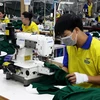
There are three main challenges that small and medium-sized enterprises in Vietnam face with the advent of the fourth industrial revolution, a senior member of the US-ASEAN Business Council has said. (Source: baodauthau.vn)
 HCM City (VNA) - The fourth Industrial Revolution (Industry 4.0) is providing numerous challenges, besides opportunities, to small- and medium-sized enterprises (SMEs) in joining global value chain, heard a workshop in Ho Chi Minh City on October 23.
The workshop, organised by the Vietnam Chamber of Commerce and Industry (VCCI) and the US-ASEAN Business Council, was meant to be a platform for SMEs, business groups and organisations to discuss opportunities and challenges for small firms in Vietnam.
There are three main challenges that SMEs in Vietnam face with the advent of the fourth Industrial Revolution, said Michael Michalak, Senior Vice President of the council.
They are greater access to domestic and international markets to be a part of the global supply chain, access to technology and information communication tools, and access to finance, he added.
Tran Vinh Tuyen, Vice Chairman of the HCM City People’s Committee, said though SMEs are the backbone of Vietnam’s economy -- with around 97 percent of Vietnamese firms being small or medium-sized -- they still face many challenges with respect to management, human resources training, commercialisation and adoption of new technologies.
US Ambassador to Vietnam Ted Osius, said: “SMEs, not SOEs, will grow Vietnam’s economy. That’s why it is important to help SMEs.”
He said to do so three things must be achieved. The first, he said, is for the Government to create an enabling environment.
“Bureaucracy must help enhance transparency, reduce the amount of red tape, the number of approval steps, the number of formal and informal fees and the amount of time it takes to register a business.”
If this is achieved, companies could spend more time to create new products and new jobs to bring prosperity, he said.
Second is reforming the education system to provide companies with innovative graduates and creative thinkers.
The last thing is to think creatively and think big.
“SMEs must understand their market includes not just Vietnam¸ but the broader world."
To help SMEs enhance their competiveness and capacity, the US-ASEAN Business Council works with local ASEAN SMEs support organisations such as VCCI in Vietnam to organise seminars on topics that Vietnamese SMEs are interested in, according to Michalak.
Some of the chosen topics are technology assistance, business planning skills and basic accounting, he said.
The council helped establish the ASEAN SME Academy in May 2016 to put all the training materials online where SME entrepreneurs can access and learn anywhere and anytime using computers, smart phones and tablets.
The online gateway also helps SMEs find networking opportunities and gain access to region-specific information to further grow their business.
However, not every business can easily access or benefit from it due to technological disadvantages, especially women-owned SMEs.
Mai Thi Dieu Huyen of the VCCI’s Vietnam Women Entrepreneurs Council said from her experience working with women entrepreneurs, women-owned SMEs face even more challenges than men-owned ones due to gender issues.
“We have talked a lot about challenges faced by SMEs, but not specifically women-owned SMEs.”
Some of the common challenges are lack of market information, business knowledge and skills and technology, she said. Women in remote areas who have limited access to high-speed internet cannot easily access online training courses, she said.
What is needed is greater support for SMEs in remote areas to help them grow together with those in urban areas where internet infrastructure is good, she said, adding that it would also help the country achieve its goal of inclusive economic growth.-VNA
They are greater access to domestic and international markets to be a part of the global supply chain, access to technology and information communication tools, and access to finance, he added.
Tran Vinh Tuyen, Vice Chairman of the HCM City People’s Committee, said though SMEs are the backbone of Vietnam’s economy -- with around 97 percent of Vietnamese firms being small or medium-sized -- they still face many challenges with respect to management, human resources training, commercialisation and adoption of new technologies.
US Ambassador to Vietnam Ted Osius, said: “SMEs, not SOEs, will grow Vietnam’s economy. That’s why it is important to help SMEs.”
He said to do so three things must be achieved. The first, he said, is for the Government to create an enabling environment.
“Bureaucracy must help enhance transparency, reduce the amount of red tape, the number of approval steps, the number of formal and informal fees and the amount of time it takes to register a business.”
If this is achieved, companies could spend more time to create new products and new jobs to bring prosperity, he said.
Second is reforming the education system to provide companies with innovative graduates and creative thinkers.
The last thing is to think creatively and think big.
“SMEs must understand their market includes not just Vietnam¸ but the broader world."
To help SMEs enhance their competiveness and capacity, the US-ASEAN Business Council works with local ASEAN SMEs support organisations such as VCCI in Vietnam to organise seminars on topics that Vietnamese SMEs are interested in, according to Michalak.
Some of the chosen topics are technology assistance, business planning skills and basic accounting, he said.
The council helped establish the ASEAN SME Academy in May 2016 to put all the training materials online where SME entrepreneurs can access and learn anywhere and anytime using computers, smart phones and tablets.
The online gateway also helps SMEs find networking opportunities and gain access to region-specific information to further grow their business.
However, not every business can easily access or benefit from it due to technological disadvantages, especially women-owned SMEs.
Mai Thi Dieu Huyen of the VCCI’s Vietnam Women Entrepreneurs Council said from her experience working with women entrepreneurs, women-owned SMEs face even more challenges than men-owned ones due to gender issues.
“We have talked a lot about challenges faced by SMEs, but not specifically women-owned SMEs.”
Some of the common challenges are lack of market information, business knowledge and skills and technology, she said. Women in remote areas who have limited access to high-speed internet cannot easily access online training courses, she said.
What is needed is greater support for SMEs in remote areas to help them grow together with those in urban areas where internet infrastructure is good, she said, adding that it would also help the country achieve its goal of inclusive economic growth.-VNA
VNA