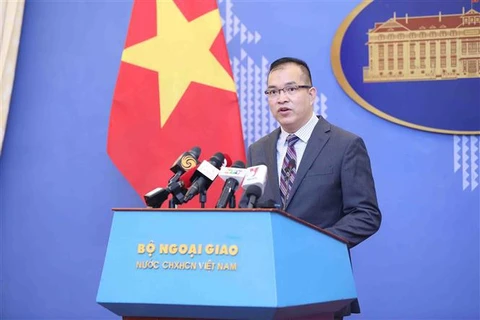
IOM Chief of Mission Park Mihyung (Photo: VNA)
 Hanoi (VNA) – The International Organisation for Mirgration (IOM) is ready to help the Vietnamese Government accelerate the goal of eliminating the trafficking in persons in Vietnam, IOM Chief of Mission Park Mihyung has said. Following is the full text of her interview to the Vietnam News Agency on the occasion of the World Day Against Trafficking in Persons and the National Day Against Human Trafficking (July 30).
Q: Could you please provide some comments on the effort of Vietnam in combating human trafficking in the last few years, given the TIP law was enacted since 2011?
A: In the last few years, Vietnam has been making serious efforts to take action against human trafficking, create a transparent migration environment, and protect the legal rights and interests of migrants. One example is the implementation of the National Human Trafficking Prevention and Control Programme for 2021-2025, with a vision for 2030, which includes new solutions and tasks to prevent and fight human trafficking in all areas.
What is encouraging for me is how Vietnam has heightened attention towards investigating and identifying various forms of trafficking. The Government has also paid close attention to disaggregate data on trafficking in persons to provide a better understanding of how serious this situation is in the country. In recent years, the definition of human trafficking has been expanded, as the crime is not only about sexual exploitation and forced marriage but also about domestic trafficking and forced labor. I also know that Vietnam has paid close attention to tackling fetus trafficking as well.
In the past, we used to think that human trafficking only involved moving, traveling, or transporting a person across state or national borders. However, human trafficking can occur within the borders of any country, including Vietnam. Victims of human trafficking can be recruited and trafficked in their hometowns, even within their own homes.
Also, we tend to believe that contracted migrant workers face no risk. But Vietnamese contracted workers can be vulnerable to labor exploitation. Therefore, the Law on Contract-Based Vietnamese Overseas Workers (or Law 69) which came into effect from 1st January 2022, plays a pivotal role in better ensuring the protection of Vietnamese migrant workers and their rights, promising more practices for fair recruitment and creation of a safe migration environment.
The Vietnamese Government has also dedicated itself to streamlining inter-agency coordination and referrals through standardized procedures. One example is the initiative undertaken by the MOLISA, which enabled the Inter-ministerial Coordination Regulation on Reception, Protection, and Support for Trafficked Victims that came into force in August 2022, applicable to the four Line Ministries of MFA, MPS, MOLISA, and MND.
The increased identification and assistance to Victims of Trafficking (VoTs) has been shown through the significant number of VoTs assisted in 2022. I was very proud of IOM’s recent effort to collaborate with the Border Guard and the Ministry of Public Security to identify and prosecute the traffickers of human trafficking cases and provide protection for the victims of forced labor on fishing boats.
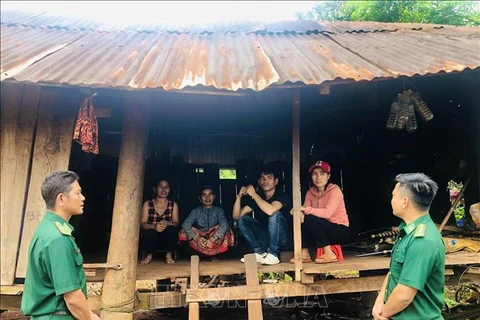
 A border guard in Nghe An popularises law in Ky Son border district (Photo: VNA)
Q: Could you please provide some of the collaboration between IOM and the Government of Vietnam to combat this crime?
A: In Vietnam, as a leading UN agency for migration, IOM has been working closely with government agencies, civil society, private sectors, and migrants to find solutions to migration issues, provide humanitarian assistance to migrants in need, and promote cooperation in dealing with migration-related challenges.
To support Vietnam’s commitment under the Human Trafficking Prevention and Control Programme for 2021-2025, with orientations toward 2030, under the support of the UK Home Office, IOM has collaborated with both Government agencies and local actors to realize their potential to reduce individual and community vulnerabilities to human trafficking through behavior change communication, strengthened access to justice and victim-centered rehabilitation and reintegration support. Between 2018 and 2022, the project capacitated more than 1,700 counter-trafficking actors, raised the awareness of over 2.93 million people about human trafficking prevention and safe migration, and helped 1,680 people gain access to local employment opportunities and common labor migration pathways.
IOM is proud of our work on improving access of low-skilled workers to essential skills such as digital, soft, job application, and entrepreneurship skills, helping their employment transformation in a digital working environment while boosting their adaptation and resilience to change. For this initiative, IOM, in partnership with the Vietnam General Confederation of Labour, the General Directorate of Vocational Training, and Microsoft, has developed and promoted the e-learning platform congdanso.edu.vn. After nearly two years, the e-learning platform has benefitted over 13,000 Vietnamese learners (approximately 51% women), especially internal migrant workers.
We also work on advocating for ethical recruitment to ensure the rights of labor migrants, improving the health of migrants, and areas related to climate induced migration. Soon, we hope to assist Vietnam to enhance a database on trafficking in persons and international migration. At the same time, we work with our government counterparts to improve the migration governance legal framework towards aligning with international standards, contributing to promoting safe, orderly, and regular migration.
At the same time, IOM supported the capacity building of law enforcement agencies at central and provincial levels in the fight against human trafficking and people smuggling and provided reintegration support to the provinces and ministries, and increased expertise, resources, and personnel to roll out and implement these legal policies related to supporting human trafficking victims. For example, through IOM’s “Training for Frontline Border Guards in Border Areas of Vietnam” project, funded by the Bureau of International Narcotics and Law Enforcement Affairs (INL) of the United States Department of State, a Training Curriculum on Counter-Trafficking and Victim Protection for frontline Border Guard officers was developed. It received the endorsement of the Ministry of Defence and was used in training for 436 frontline officers in 12 border provinces, equipping them with the necessary knowledge and skills to combat trafficking effectively.
IOM has also provided technical assistance to the Department of Social Vices Prevention and Combat of MOLISA to roll out a standardized screening and referral process to enhance victim identification and strengthen inter-sectoral coordination at the central and local levels to enable statutory protection of victims. The reintegration handbook and toolkit developed with IOM’s technical assistance were able to help improve local officers’ capacities in exploring more community-based reintegration support models to reach more victims while maximising available resources.
Q: There are a lot of discussions around revising the Law on Human Trafficking Prevention and Control to adapt to the new tactics of traffickers and to enhance the effectiveness of human trafficking prevention and control. What do you think about this issue? Does IOM have some recommendations for Vietnam to make the law more effective and protect more people?
A: After 10 years of implementing the Law on Trafficking in Persons Prevention and Combat (or TIP Law), it is the right time for reviewing and amending the law. This is an essential step to ensure Vietnam is equipped to respond to emerging trends and risks of trafficking in persons, which disproportionally affect everybody, including men, women, elders, boys and girls.
Effectively addressing human trafficking requires up-to-date and reliable data to empirically ground policy, programs, and support for the victims. Therefore, the law revision should look at institutionalising establishment of a centralised trafficking database that also includes victims’ data and their support needs. In this regard, IOM stands ready to support Vietnam to be able to collect, update, analyse, and use such data to inform its work.
Human trafficking is a complex issue, and it evolves quickly. Therefore, it is crucial for the counter-trafficking community to find an innovative way to identify emerging trends, especially crimes that happen in cyberspace, provide comprehensive support to the victims, and seeks timely and viable solution to meet the new evolving challenges of human trafficking.
The participation of the private sector in the fight against TiP needs to be encouraged. As such, enhancing engagement of the private sector and advocating for them to adopt responsible business practices and supply change transparency will help prevent accidental involvement in human trafficking as well as utilise their contribution to the victim support. It is time to bring the tech companies and owners of social media channels to the table. More joint conversations between the Government, international organisations, the technology sector, civil society, and law enforcement are critical to detect traffickers’ evolved tactics and develop innovative solutions to tackle the issue.
On the other hand, we need to increase the penalties for trafficking offenses, especially traffickers in cyberspace, to deter traffickers from crime and send a strong message that this is a serious crime and must be stopped. To do so, we must strengthen mechanisms to effectively investigate, prosecute, and convict traffickers, including specialised training for law enforcement officials and prosecutors dealing with trafficking cases and ensuring coherent implementation and enforcement at central and local levels. The revision of the law should also look at enhancing policies to support and level of assistance to VoTs to help them sustainably integrate into the community and build up a better life.
We also recommend Vietnam to standardised victim screening form that aligns with the international one. We hope to continue cooperating closely with MOLISA, MPS, and the Border Guards in this field and hope these efforts will bring good results soon.
Last but not least, the fight against trafficking in persons is not the sole responsibility of any agency. Therefore, we need to improve legal frameworks to foster interagency cooperation, expedited and inclusive processes involving consultation with all relevant stakeholders, including non-profit, civil society organisations, and the VoTs, to identify potential challenges in identifying and assisting VoTs. Most importantly, we must listen to the victims, hear their stories.
With all of those objectives in mind, IOM stands ready to support the Government of Vietnam and other partners to accelerate the goal of eliminating the trafficking of persons in Vietnam./.