IP protection boosts growth: experts

Vietnam will work to raise the quantity as well as quality of applications for inventions in the coming years, delegates said at a seminar in Ho Chi Minh City on October 23. ​
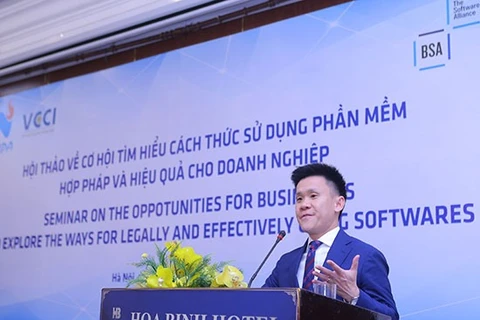
IP protection boosts growth: experts ảnh 1Vietnam will work to raise the quantity as well as quality of applications for inventions in the coming years. (Photo: baodaklak.vn)

HCM City (VNA) - Vietnam will work to raise the quantity as well as quality of applications for inventions in the coming years, delegates said at a seminar in Ho Chi Minh City on October 23.
Nguyen Thi Thu Hien, head of the National Office of Intellectual Property’s information department, said that NOIP had received about 500-600 invention applications annually in recent years from Vietnamese individuals, enterprises, research institutes, universities and others, accounting for about 10 per cent of the total invention applications.
However, invention patents from Vietnamese accounted for only 6 percent of total invention patents granted in Vietnam, with the number of patents granted for inventions from individuals and businesses increasing significantly compared to those from universities and research institutes.
Nguyen Thi Thanh Ha from NOIP said the number of Vietnamese invention applications had increased by 20.2 percent in recent years, but it remained very modest compared to that in ASEAN countries.
In addition, the quality of invention applications was low as the majority of applications had not met requisite standards of an invention, only utility solution standards, she said.
Research and development activities at research institutes and universities was less effective because of a lack of awareness of or trust in benefits that IP protection can bring, in addition to inadequate rewards for inventors.
In addition, many people have an unclear understanding about invention application procedures, Hien said, adding that many inventors were afraid of leaking their technical secrets if they applied for patent.
Nguyen Quang Tuan, Deputy Director of the National Institute for Science and Technology Policy and Strategy Studies, said that technology transfer from science and technology organisations to businesses was very modest.
Most Vietnamese companies are small- and medium-sized, and even super-small (micro), and have low awareness about the role of intellectual property rights.
They also have limited financial capacity and technological capacity, and have no demand for buying patented inventions.
On the other hand, the number of Vietnamese patents was still modest, with many not fitting businesses’ demands, offering limited options for buyers, Hien said.
Ha said Vietnam had set a target to increase the number of invention applications by 30 percent per year on average in the 2020-30 period, with those from research institutes and universities to increase by more than 50 percent.
Delegates at the seminar suggested measures to boost the transfer of patented inventions and encourage the creation of inventions.
This would include incentive policies on taxes, capital and insurance for transferees, and assistance in helping them choose the appropriate technologies.
To boost IP creation, the Government should give priority to sponsoring projects for developing invention patents, and subsidise fees for registering them in Vietnam and abroad, Hien said.
Offering inventors appropriate rewards and supporting them in commercialising the invention would also be helpful, she added.
Training activities to raise awareness about IP rights at research institutes, universities and businesses are also important.
Similarity, Tuan said that Vietnam needs to fully tap its policies on intellectual property and encourage businesses to pay more attention to the field.
Le Ngoc Lam, NOIP’s deputy director, said IP rights had long been known as an important driving force for socio-economic development.
IP protection gives inventors opportunities to increase their income and provides good momentum to continue innovation.
Under the impact of the fourth industrial revolution, many countries have focused on development of science and technology and innovation, and Vietnam is no exception.
IP rights will become a tool that determines the competitive strength of technology for all stakeholders, so every organisation and business should find ways to create, acquire and own intellectual property, he said.
With support from the World Intellectual Property Organization, the NOIP is developing a National Intellectual Property Strategy to submit to the Prime Minister for approval.-VNA
VNA

See more

Vietnamese youths learn about AI application scenarios at the China-ASEAN AI Application Cooperation Centre in Guangxi. (Photo: VNA)

China’s Guangxi fosters AI cooperation with Vietnamese localities

During his visit to China and Guangxi in April, General Secretary of the Communist Party of Vietnam (CPV) Central Committee and President To Lam expressed a desire to further expand cooperation between Vietnam, particularly border localities, and Guangxi in areas including AI.

Hanoi Market Surveillance officers inspect products showing signs of violations of regulations on product labelling, advertising and intellectual property. (Photo published by VNA)

Positive progress recorded in tackling intellectual property rights infringements

To raise public and business awareness while improving the effectiveness of preventing and dealing with infringements, the Ministry of Science and Technology will continue working with other ministries, sectors and localities to strengthen intellectual property protection and enforcement on a regular, continuous and sustained basis, with no prohibited areas or exceptions.

Delegates visit exhibition stands at the 2026 national quality and productivity forum in Ho Chi Minh City. (Photo: VNA)

Enabling institutions needed for science-technology to generate new productivity

The Government should shift from providing funding to creating enabling conditions by developing infrastructure, platforms, standards and markets, while coordinating the innovation ecosystem. Innovation and technology diffusion should also go hand in hand, particularly by bringing AI, digital and green technologies to small- and medium-sized enterprises as well as traditional sectors.

Prof. Dr. Nguyen Van Tam, Chair of the Department of Computer Science, Data and Artificial Intelligence at the Polytechnic Institute of Paris (IP Paris) (Photo: VNA)

Expert proposes global Vietnamese intellectual ecosystem to boost AI development

Prof. Dr. Nguyen Van Tam, Chair of the Department of Computer Science, Data and Artificial Intelligence at IP Paris, said the Political Bureau’s Resolution No. 23-NQ/TW, which elevates overseas Vietnamese to one of the country's important strategic resources, should be translated into practical mechanisms for deeper participation of OVs in the country’s scientific and technological development, particularly in artificial intelligence (AI).

The strategy pivots Vietnam toward AI research and development tied to economy-wide transformation. (Illustrative photo: VNA)

Vietnam approves AI strategy targeting regional hub status by 2030

The strategy pivots Vietnam toward AI research and development tied to economy-wide transformation. Instead of retrofitting AI into existing products and processes, the plan treats AI as a core capability from problem identification through design, organisation and operations.

A student at Thang Long Primary School in Hanoi attend an online class. (Photo: VNA)

Vietnam alliance steps up efforts to promote online safety, digital trust

Since its establishment, the Digital Trust Alliance (DTA) has expanded its membership and activities, with hundreds of applications to join recorded in the first six months of 2026. It aims to establish Digital Trust Clubs in all 34 provinces and cities and bring together around 1,000 members nationwide.

Hi-tech shrimp farming and wind power development in Thanh Hai commune, Vinh Long province (Photo: VNA)

Vietnam targets productivity-driven growth over cheap labour

A development model based on productivity, knowledge and technology requires long-term capital, a skilled workforce, innovation capacity, technology absorption and incentives for long-term invest. Therefore, Vietnam’s greatest challenge is moving from cost-based advantages to ones based on productivity, technology and added value.

Vietcombank is one of the leading banks in digital transformation. (Photo: VNA)

Banking industry in AI era: When data becomes competitive advantage

In just a few years, AI has evolved from an experimental technology into an “assistant” for many banks, supporting everything from customer service, credit approval, and fraud detection to risk management. However, as the technological gap between institutions narrows, a new question is emerging: What will determine banks' competitive advantage in the AI era?

3.5 billion-USD AI data centre complex proposed in Tay Ninh

3.5 billion-USD AI data centre complex proposed in Tay Ninh

The project is designed for a total IT load capacity of 200 MW. In the first phase, the consortium plans to invest 3.5 billion USD in a 100MW facility, targeting groundbreaking in the fourth quarter of 2026 and commercial operation in 2027.

At the first Vietnam-Singapore Strategic Dialogue (Photo: VNA)

Vietnam, Singapore seek to make technology a strategic cooperation pillar

The Joint Statement on the Technology Connectivity Strategy issued after the first Vietnam-Singapore Strategic Dialogue reaffirmed the shared interest in deepening cooperation in science and technology, innovation, connectivity and the digital economy. The two sides shared a vision of making Vietnam and Singapore leading strategic technology partners in Southeast Asia, with both countries becoming more technologically self-reliant through cooperation and connectivity.

Delegates at the regular press briefing on August 28 hosted by Ministry of Science and Technology (Photo: mst.gov.vn.webp)

2026 Make in Vietnam Digital Product Awards launched

Launched in 2020, the Make in Vietnam Digital Technology Product Awards are the official annual awards in the digital technology sector organised by the Ministry of Science and Technology. Over six editions, the awards attracted nearly 1,500 entries, with 299 outstanding digital technology products honoured.

A area showcasing products at AI Day 2026 held in Hanoi on April 5, 2026 (Photo: VNA)

Vietnam targets top-three ASEAN ranking in AI by 2030

By 2030, Vietnam aims for 60% of businesses using AI to improve efficiency, all civil servants using AI in their work weekly, and 60% of administrative decisions supported by data and AI. The satisfaction rate for AI-supported public services is expected to rise by at least 30%.

VNPT’s data centre (IDC) at Hoa Lac Hi-Tech Park, the largest of its kind in Vietnam, is equipped with state-of-the-art technologies and fully meets international technical standards. (Photo: VNA)

Vietnam’s data centre race draws multibillion-dollar investment

Ho Chi Minh City currently has 20 operational data centres and nine proposed projects, according to the municipal Department of Science and Technology. New projects are moving beyond traditional data centres toward large complexes integrating AI and other digital infrastructure.

A mini autonomous bus undergoing testing in Hanoi (Photo: Phenikaa-X)

Hanoi allows 24-month trial of autonomous vehicles at Hoa Lac

The project aims to assess the safety, reliability and readiness of autonomous vehicles under real traffic conditions, as well as the effectiveness of autonomous public transport and compatibility with existing systems. Its results will contribute to developing technical standards, operating procedures and management models suited to Hanoi’s traffic conditions.

Aquaculture rafts on the Rang river in Long Son commune, Ho Chi Minh City, have benefited greatly from expanded digital connectivity, using technology in farming and selling their products online. (Photo: VNA)

Resolution 57 opens digital door to drive marine economic development

Through persistent, hands-on efforts and a determination to “leave no one behind”, the Ho Chi Minh City authorities are working to ensure that every resident has the opportunity to access and benefit from digital transformation under Politburo Resolution No. 57-NQ/TW

Professor Vu Minh Khuong of the National University of Singapore. (Photo: VNA)

Singapore’s experience suggests solutions to Vietnam’s human resources challenge in AI era

As Vietnam accelerates digital transformation and high-tech development, Singapore’s experience and the engagement of global technology companies demonstrate that human resources preparation must stay ahead of the curve. The ability to filter knowledge, collaborate, innovate and effectively use AI will increasingly become essential to helping workers adapt to a changing labour market and strengthening the competitiveness of Vietnam’s economy in the new era.