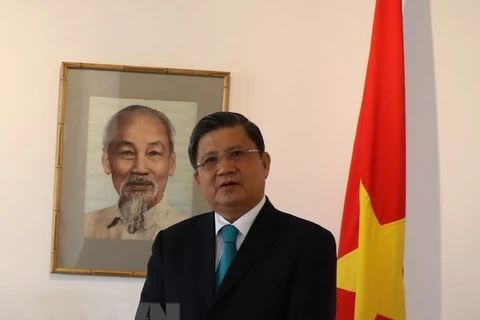
Vietnamese Ambassador to Japan Vu Hong Nam (Photo: VNA)
 Tokyo (VNS/VNA) - Vietnamese Ambassador to Japan Vu Hong Nam talks to Vietnam News Agency about Japan’s visa policy for Vietnamese guest workers.
What are the benefits that Vietnamese guest workers will enjoy from Japan’s new policy on visas for Vietnamese guest workers?
The Vietnamese labour force is young and energetic. At present we have about 580,000 Vietnamese guest workers working in 40 countries and territories with official contracts.
In addition, we also have 150,000 Vietnamese people working in Japan under agreements signed between the two Governments or agencies. Their average wage is about 24 million VND per month (1,100 USD). In addition, we have 80,000 students who are now studying the Japanese language there. Each student is allowed to work 28 hours/week with an average wage of 6.5 USD per hour.
In my opinion, the new visa policy will offer better wages for Vietnamese people working or studying in Japan, plus better working conditions. It is projected that in the next five years, Japan will receive up to 345,500 Vietnamese guest workers who will work in 14 different professions.
This is a good opportunity for our workers to seek jobs requiring high labour skills with good salaries. This is also a good opportunity for the workers themselves and their families in Vietnam.
For those with lower labour skills, the new policy will also offer them up to a five-year stay to work in Japan. Of course, the experiences they will gain while working and living in Japan will help them to find jobs with Japanese firms when they return to Vietnam with higher salaries than their peers.
Last but not least, at present some 200,000 Vietnamese students and trainees are studying in Japan. This is set to become an elite Vietnamese labour force for Japan in the near future.
Will you please further elaborate on the two Japanese new types of labour skills?
In the past, most Vietnamese people went to Japan were under the title of Vietnamese guest workers or students. These people were allowed to work limited hours per week. However, under the new visa system, they will enjoy more benefits as follows:
For those who have a good command of the Japanese language or labour skills will be able to sit exams. If they pass they will be granted a higher level visa. Those who have completed three-year work contracts or achieved a Japanese diploma at N4 level will not have to sit the exam.
People with high labour skills including engineers, senior technicians and registered nurses can apply for permanent visas if they meet all the requirements.
The Vietnamese and Japanese governments will sign a labour agreement detailing all the requirements and procedures to recruit candidates for the above mentioned visas.
What are the opportunities and challenges that Vietnamese guest workers will face if they want to stay in Japan under these two types of visa?
First, let’s talk about the advantages. Vietnamese workers are intelligent and hard working. So with clear instructions and requirements, they will prepare themselves more carefully for the tests. On the other hand, I should say that many Vietnamese people have met the requirements for the Visa type 1.
Of course, Japan will review carefully visas for citizens from countries that have many people illegally living and working there or people with criminal records.
Some industrial parks in Vietnam are facing labour shortages. Do you think that sending more workers to Japan will have negative impacts on the country?
No! I don’t think there are any negative impacts on the recruitment at Vietnamese industrial parks. On the other hand, Japanese companies operating in Vietnam will be the landing place for skilled Vietnamese workers returning home. At present, Vietnam has an abundant labour force, but most of them are unskilled and not many want to work in industrial parks.
Vietnam has become a destination for many Japanese enterprises to invest in, so the returning Vietnamese students and workers in the last decade have become an important labour force for many Japanese enterprises. Some of them have held high positions in Japanese enterprises.
Last but not least, it is an opportunity for Việt Nam to restructure our labour market abroad for the benefit of guest workers.-VNS/VNA
VNA