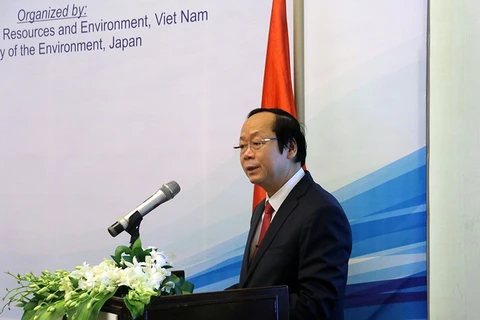
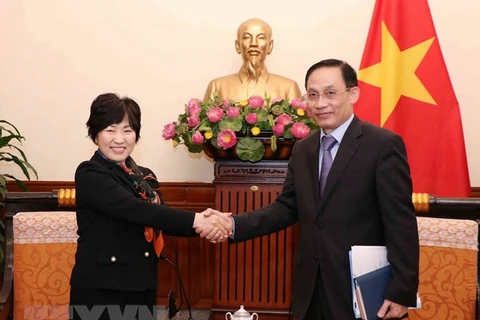
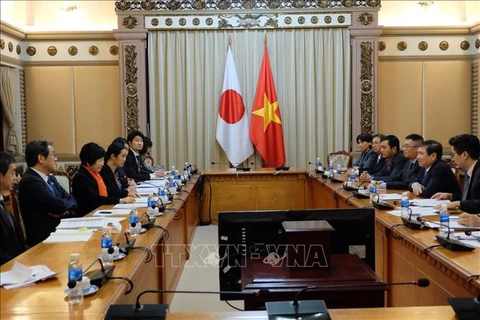
Deputy Prime Minister Trinh Dinh Dung (R) receives Kaoru Iwasa, Senior Managing Executive Officer at Japan’s Marubeni Corporation (Photo: VNA)
 Hanoi (VNA) – Deputy Prime Minister Trinh Dinh Dung asserted that Vietnam extremely values its economic cooperation with Japan while hailing efforts of the Government and businesses of Japan in maintaining their country’s position as the top investor in Vietnam in 2017 and 2018.
He made the statement while hosting a reception for Kaoru Iwasa, Senior Managing Executive Officer at Japan’s Marubeni Corporation, in Hanoi on January 24.
He said the Vietnam-Japan friendship and cooperation are enjoying sound, practical and comprehensive developments in all spheres, with high political trust, describing Japan as Vietnam’s top economic, trade and investment partner.
In 2018, the two nations organised more than 200 exchange activities to celebrate the 45th anniversary of diplomatic ties, helping promote mutual understanding, trust, economic cooperation and people-to-people exchange.
In the year, Japan’s investment in Vietnam hit 8.59 billion USD, accounting for 24.2 percent of total investment.
Dung added that Japanese businesses operating in Vietnam have greatly contributed to the country’s socio-economic development.
In the coming time, he said he expects the Japanese firms would bolster investment and technology transfer in the fields of infrastructure, energy, electronics, agricultural machinery, agro-fishery product processing, high-tech agriculture, and the environment.
He pledged that the Vietnamese Government will continue measures to improve the business climate, thereby further facilitating successful operation of foreign investors in Vietnam, including those from Japan.
He also voiced his hope that the Japanese firms and Marubeni Corporation in particular will take advantage of new opportunities from the Comprehensive and Progressive Agreement for Trans-Pacific Partnership (CPTPP) and free trade agreements to boost investment and expand business in the Vietnamese market.
For his part, Iwasa thanked the Vietnamese Government and competent agencies for creating optimal conditions for the operation of Marubeni Corporation in Vietnam, notably its large-scale energy projects.
He said the corporation hopes to continue long-term investment in Vietnam in the time ahead, notably in power supply, liquefied natural gas projects, water for daily activities, and wastewater treatment, among others.
Marubeni also seeks cooperation with Vietnamese partners in numerous spheres, Iwasa noted.
The Japanese corporation specialises in exports-imports and infrastructure development. Marubeni joined in the construction of 11 thermal power plants in Vietnam with total capacity of 4,000 MW, along with other industrial plants, foodstuff processing and garment-textile factories. -VNA
He made the statement while hosting a reception for Kaoru Iwasa, Senior Managing Executive Officer at Japan’s Marubeni Corporation, in Hanoi on January 24.
He said the Vietnam-Japan friendship and cooperation are enjoying sound, practical and comprehensive developments in all spheres, with high political trust, describing Japan as Vietnam’s top economic, trade and investment partner.
In 2018, the two nations organised more than 200 exchange activities to celebrate the 45th anniversary of diplomatic ties, helping promote mutual understanding, trust, economic cooperation and people-to-people exchange.
In the year, Japan’s investment in Vietnam hit 8.59 billion USD, accounting for 24.2 percent of total investment.
Dung added that Japanese businesses operating in Vietnam have greatly contributed to the country’s socio-economic development.
In the coming time, he said he expects the Japanese firms would bolster investment and technology transfer in the fields of infrastructure, energy, electronics, agricultural machinery, agro-fishery product processing, high-tech agriculture, and the environment.
He pledged that the Vietnamese Government will continue measures to improve the business climate, thereby further facilitating successful operation of foreign investors in Vietnam, including those from Japan.
He also voiced his hope that the Japanese firms and Marubeni Corporation in particular will take advantage of new opportunities from the Comprehensive and Progressive Agreement for Trans-Pacific Partnership (CPTPP) and free trade agreements to boost investment and expand business in the Vietnamese market.
For his part, Iwasa thanked the Vietnamese Government and competent agencies for creating optimal conditions for the operation of Marubeni Corporation in Vietnam, notably its large-scale energy projects.
He said the corporation hopes to continue long-term investment in Vietnam in the time ahead, notably in power supply, liquefied natural gas projects, water for daily activities, and wastewater treatment, among others.
Marubeni also seeks cooperation with Vietnamese partners in numerous spheres, Iwasa noted.
The Japanese corporation specialises in exports-imports and infrastructure development. Marubeni joined in the construction of 11 thermal power plants in Vietnam with total capacity of 4,000 MW, along with other industrial plants, foodstuff processing and garment-textile factories. -VNA
VNA