Japan pioneers in promoting ratification of CPTPP

The Cabinet of Japanese Prime Minister Shinzo Abe approved bills to ratify the Comprehensive and Progressive Agreement for Trans-Pacific Partnership (CPTPP) on March 27 to bring the long-promised multilateral trade pact close to enforcement.
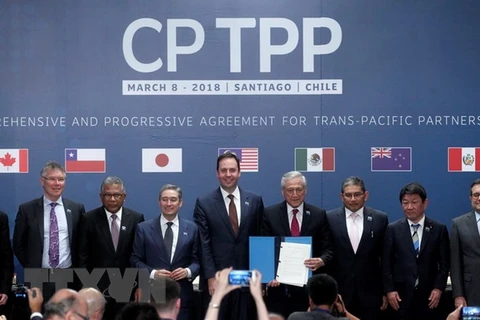
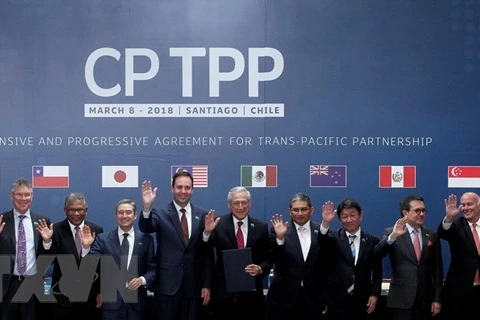
Japan pioneers in promoting ratification of CPTPP ảnh 1Representatives of countries joining the signing ceremony of the CPTPP in Chile in March 2018 (Photo: VNA)

Hanoi (VNA)
– The Cabinet of JapanesePrime Minister Shinzo Abe approved bills to ratify the Comprehensive andProgressive Agreement for Trans-Pacific Partnership (CPTPP) on March 27 tobring the long-promised multilateral trade pact close to enforcement.

The Japanese government will present the set ofbills during the current Diet session which runs through June 20 with the hopeof pioneering in promoting necessary domestic procedures and building momentumtoward ratification of the agreement in other countries.

The CPTPP will enter into force 60 days after atleast six countries complete domestic procedures. 

To bring the CPTPP into force in Japan, a totalof 10 laws need to be domestically revised to include new rules and protectionsagainst changes to be brought by the free trade accord.

The 11 CPTPPmembers are Australia, Brunei, Canada, Chile, Japan, Malaysia, Mexico, NewZealand, Peru, Singapore and Vietnam.

The agreement,the successor to the Trans-Pacific Partnership, covers 13 percent of theworld's gross domestic product.

Japan and the10 countries taking part in the deal after the US’s withdrawal in January 2017aim to put the pact into force possibly by the end of 2018 after they signed itin Chile earlier this month.-VNA

VNA

See more

Malaysia considers establishing strategic petroleum reserve

Malaysia considers establishing strategic petroleum reserve

Malaysia, which was previously a net exporter, has now become a net importer due to declining domestic production and rising consumption, with demand estimated at around 800,000 barrels per day compared to production of about 400,000 barrels per day.

Indonesia to halt diesel imports from July

Indonesia to halt diesel imports from July

The move is part of the Indonesian Government’s efforts to strengthen national energy independence by utilising palm oil as an alternative fuel, said Agriculture Minister Andi Amran Sulaiman.

Malaysia’s growing microplastics crisis is largely self-inflicted, driven by domestic waste, weak recycling practices and everyday plastic use, said experts. (Photo: New Straits Times)

Malaysia seeks solutions to microplastic crisis

Microplastics originating from domestic waste and wastewater are increasingly entering the food chain, posing serious threats to seafood safety and the livelihoods of coastal communities.

The new mass emergency alert system SG Alert, which will be used during emergencies such as major fires, chemical or terror incidents, seen on an Apple and Android device on Apr 17, 2026. (Photo: CNA)

Singapore launches new national emergency alert system

SG Alert in Singapore uses cell broadcast technology, enabling alerts to be delivered within seconds without requiring mobile data or collecting personal information. Unlike conventional SMS, which may be delayed during network congestion or depend on internet connectivity, the system ensures fast and reliable message delivery. Alerts can be sent islandwide or targeted to specific affected areas.

Malaysia establishes ‘war room’ to ensure water security

Malaysia establishes ‘war room’ to ensure water security

The establishment of the war room reflects the Malaysian government’s commitment to shift from a reactive approach to a more proactive, data-driven one in managing national water challenges, particularly amid increasingly unpredictable weather conditions caused by global climate change