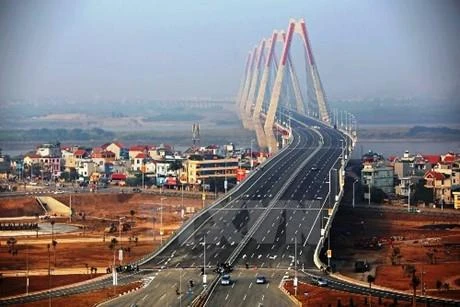
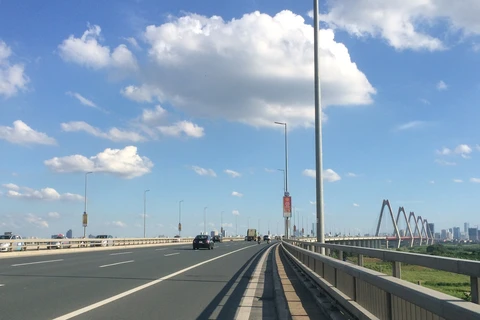
Nhat Tan Bridge, one of the major infrastructure projects using Japan's ODA loans (Source: VNA)
 Hanoi (VNA) – Many key transportation projects in Vietnam using Japan’s official development assistance (ODA) have been put into action over the past 45 years since the two countries established their diplomatic ties. The projects have helped complete local infrastructure demand, serving the country’s rapid growth.
Launched in 1986, Vietnam’s Doi Moi (reform) policy has geared the country towards modernisation, building a market-based economy and speeding up integration with the international community. The progress spurred development demand, particularly for transport infrastructure construction.
In November 1992, Japan resumed its ODA to Vietnam. Since then, Japan has continuously been the biggest ODA provider to Vietnam, contributing greatly to the improvement of Vietnamese traffic infrastructure. According to the Japan International Cooperation Agency (JICA), as of 2013, Japan’s ODA had supported Vietnam to develop a total of 3,309km of roads and 287 bridges. In particular, the country helped Vietnam build a total of 650km of national roads and about 70 percent of the total length of Vietnam’s four-lane national highways.
Among these constructions, the Nhat Tan Bridge, Hai Van tunnel, and the Tan Vu-Lach Huyen port are among those that have left the strongest impression and helped significantly propel the local economy forward.
Nhat Tan: the Vietnam-Japan Friendship Bridge
Nhat Tan Bridge, a gateway to the capital city and one of the longest cable suspension bridges in Vietnam, has been named the “Vietnam-Japan Friendship Bridge” as an acknowledgement of its support from Japan.
Considered a gift from the Japanese Government, presented to Hanoi on the occasion of its 60th Liberation Day, the eight-lane bridge is 3.75km long and 33.2m wide, with access roads at each end totalling 5.17km. It links Phu Thuong ward in Tay Ho district and Nam Hong commune in Dong Anh district on the way to the Noi Bai International Airport.
The project was approved by the Ministry of Transport in 2006 with a total investment of more than 13.6 trillion VND (647.6 million USD), of which a large proportion was provided as ODA from the Japanese Government. It was opened to traffic in 2015.
Nguyen Le Minh, head of the project’s executive board, said the Vietnamese side gained valuable knowledge from Japanese experts during its construction. Both sides jointly devised a number of building methods to overcome challenges and ensure the project’s progress and quality.
Tojuro Nishi, the project director in charge of building the main bridge and the northern access road, said he is proud to have helped Vietnamese engineers in building this historical bridge.
Hai Van Tunnel curbs traffic accidents, spurs central growth
 The entrance of Hai Van Tunnel from Da Nang to Hue (Photo: VNA)
 As part of its assistance for the Vietnamese Ministry of Transport, JICA helped the country tackle a hotbed of road accidents, facilitate traffic flow, and spur the development of the central region with the construction of the Hai Van Tunnel.
Situated on the National Highway No.1, a north-south trunk line for the transport of people and goods, the Hai Van mountain pass connects the central economic hub of Da Nang with the tourist city of Hue. Reaching a peak altitude of 496m with windy roads that are prone to falling rocks during the rainy season, the road section over the pass was a danger zone for traffic accidents, hindering smooth transportation on the highway, as well as growth in the central region.
Between 1997 and 2002, JICA provided loans worth more than 18.85 billion JPY (166 million USD) for the country to construct the Hai Van Tunnel as well as an approaching road and nearby bridges (including Lang Co Bridge) to ensure efficient transport and traffic safety along the section. The funding was also allocated to building infrastructures at the location where some 72 families were to be relocated for the project.
Construction began in August 2000, with costs amounting to 150 million USD and involving over 2,000 labourers. The tunnel segment was split into two parts, the 4km southern portion, constructed by Japanese construction company Hazama, and the 2km northern portion, constructed by a joint venture between Vietnam and the Republic of Korea.
Hai Van Tunnel was completed in June 2005, spanning about 6.28km in length, which at that time made it the longest of its kind in Southeast Asia. It shortened the travelling time of crossing the Hai Van mountain pass from more than one hour to just 15 minutes, expanding the traffic network in the central area and improving goods distribution between Hanoi in the north and Ho Chi Minh City in the south.
Lach Huyen International Port: first Vietnam-Japan PPP project
 Lach Huyen International Port in Hai Phong City (Photo courtesy of JICA)
 The Lach Huyen International Port Infrastructure Construction Project was opened in May this year. It was the first public-private partnership project between Japan and Vietnam, with the public portion financed by Japan’s ODA, while the private one invested by a joint venture of Japanese and Vietnamese partners.
Considered one of the most important Japanese ODA projects in Vietnam, it received 114.12 billion JPY (over 1 billion USD) and Japanese construction technologies from JICA between 2011 and 2018. Of the total funding, the port component accounted for 65.252 billion JPY and the bridge and road component 48.885 billion yen.
The project has answered the demand of higher cargo volumes and of handling larger vessels by building a new international deep-sea port and related basic infrastructure in Lach Huyen area in the eastern part of Hai Phong City, thereby contributing to Vietnam’s economic development and greater competitiveness in the international market.
Under the project, the Dinh Vu Bridge, which spans 5.44km and is the longest sea-crossing bridge in Vietnam, opened to traffic in 2017.
As Vietnam and Japan witness their extensive strategic partnership for peace and prosperity in Asia growing across all fields, JICA’s commitment to financing important transport infrastructure projects in the Southeast Asian country continues to be a strong pillar of their win-win cooperation. –VNA