JICA wants to speed up water-related projects in Dong Nai

The Japan International Cooperation Agency (JICA) met with leaders of southern Dong Nai province on July 10 to work on the progress of Japan-funded water supply and drainage projects.

Dong Nai (VNA) – The Japan International Cooperation Agency (JICA) met with leaders of southern Dong Nai province on July 10 to work on the progress of Japan-funded water supply and drainage projects.

Phase I of the Nhon Trach water supply project, using Japan’s ODA loan, became operational in 2014, generating 100,000 cu.m. of water per day.

Dong Nai is carrying out phase II of the project, funded with nearly 15 billion JPY (131.3 million USD) loaned by JICA, to raise the daily capacity to 200,000 cu.m. of water.

The provincial People’s Committee said procedures are being processed for the construction of phase II. Consultation and design activities, carried out by some Japanese businesses, are expected to finish by the end of 2017. Later, the construction package deal will be put out to tender.

Shu Kitamura, a representative of the JICA Vietnam Office, said phase II of the Nhon Trach project will pilot high-quality technologies. Hence, JICA wants all steps of the project, from consultation, design, to construction must meet all requirements.

Meanwhile, the water drainage and wastewater treatment project in Bien Hoa city costs more than 30 billion JPY in total, including 24.7 billion JPY funded through Japan’s ODA.

Shu Kitamura said the loan agreement for this project will be signed in late July 2017. JICA wants Dong Nai province to accelerate the selection of consultancies and design partners, as well as necessary procedures, so that the project will be carried out soon.

The management board for projects in Dong Nai said the consultancy short-listing process for the Bien Hoa project is set to complete in mid-October.

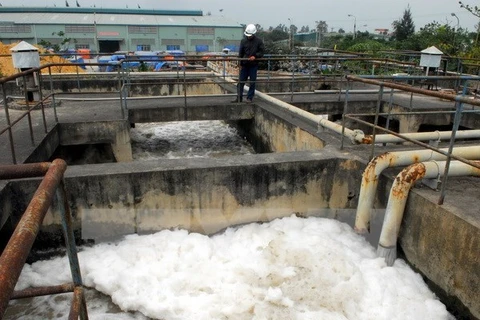
Bien Hoa city hasn’t had a wastewater treatment system. All daily wastewater is still directly released into the Dong Nai River, which is a source of water supply for some 20 million people. Flooding is also becoming more and more serious in the city.-VNA
VNA

See more

A young volunteer donates blood during the 2026 Red Sunday programme. (Photo: VNA)

Nearly 5,000 people join blood donation campaign in Ho Chi Minh City

According to health authorities, Vietnam collected nearly 1.75 million units of blood in 2025, with 98% from volunteer donors, equivalent to around 1.75% of the population participating in blood donation. Large-scale campaigns such as Red Sunday have played a key role in achieving these results.

More than 30 kilogrammes of various drugs trafficked from Cambodia to HCM City were seized in a police operation in March 2025. (Photo: VNA)

Ho Chi Minh City aims to become drug free by 2030

Every commune, ward or residential area in Ho Chi Minh City is expected to meet official drug-free standards by the end of 2029, while schools, hospitals, government offices, businesses and social organisations across the city are to remain free of drug activity.

Military forces take a resident from a flooded area. Photo: VNA

Da Nang, Oxfam join hands to support flood victims

In the coming time, the Da Nang Red Cross Society will continue to coordinate with Oxfam to implement support activities in Nong Son commune, helping residents overcome difficulties and stabilise their livelihoods.

Training on response to reservoir incidents (Photo: VNA)

Central Civil Defence Fund established to bolster disaster response

The Central Civil Defence Fund is authorised to receive, manage and use voluntary contributions from domestic and foreign entities and individuals, plus transfers from provincial civil defence funds in line with the PM’s decisions and allocations from relevant state financial sources outside the state budget, all earmarked for incident and disaster response and recovery efforts.

Vietnamese women shine in the traditional Ao dai (Photo: VNA)

March shines with elegance of “Ao dai”

In early March, scenes of women in flowing Ao dai taking spring photos by lakes, parks, offices, temples and historical sites have become a familiar sight on the streets of Hanoi. Social media is also filled with images and stories surrounding the elegant attire, which has become a symbolic signal of the season dedicated to honouring women.

Hanoi voters learn about candidates’ biographies and action programmes. (Photo: VNA)

Hanoi thoroughly prepares for NA, People’s Council election

According to the municipal Election Committee, the capital city has established election committees in 126 communes and wards. In addition, 11 electoral boards for National Assembly deputies, 31 electoral boards for the city-level People’s Council, 831 commune-level electoral boards and more than 4,000 polling teams have been set up to serve the election process.

Artisan Vu Van Vinh from Chuyen My commune introduces to visitors a set of mother of pearl inlaid lacquer furniture including a platform bed, tea cabinet, and lacquered horizontal boards and parallel sentences made by his family, worth more than 3 billion VND. (Photo: VNA)

Four Hanoi craft villages join global creative crafts network

The recognition is not only a source of pride for the capital but also creates opportunities to promote these craft villages globally, strengthen international connections, and support their sustainable development in the process of global integration.

Vietnamese women affirm growing role in national economy

Vietnamese women affirm growing role in national economy

Vietnamese women have long been an indispensable force in the country’s socio-economic development. Today, they are present across a wide spectrum of economic activities, from production, trade and small-scale services to innovative start-ups, collective economic development, the digital economy, green growth, the circular economy and financial inclusion.

Voters study information of candidates to the 16th National Assembly and People’s Councils at all levels in the 2026-2031 tenure. (Photo published by VNA)

K’Ho ethnic minority group in Lam Dong province looks forward to Election Day

Lac Duong commune is a remote locality largely inhabited by the K’Ho ethnic minority in Lam Dong. The commune has 15 villages with more than 14,000 residents in 3,119 households and 8,799 registered voters. Given that residents live scattered along National Highway 27C and that the area’s mountainous terrain makes travel difficult, local authorities have prepared plans to organise the election smoothly.