Joint efforts needed for sustainable development of rice farming in Mekong Delta

The Vietnamese agricultural sector is calling on all parties to join in the sustainable development of 1 million ha of low-emission high-quality rice production in the Mekong Delta so as to improve the quality and efficiency of the rice industry.
Joint efforts needed for sustainable development of rice farming in Mekong Delta ảnh 1The Mekong Delta is working to sustainably develop 1 million ha of specialised and low-emission farming zones of high-quality rice. (Photo: VNA)
HCM City (VNA) – The Vietnamese agriculturalsector is calling on all parties to join in the sustainable development of 1million ha of low-emission high-quality rice production in theMekong Delta so as to improve the quality and efficiency of the rice industry.

So said Le Thanh Tung, DeputyDirector of the Crop Production Department under the Ministry of Agricultureand Rural Development, at a workshop held in Ho Chi Minh City on October 2 todiscuss the role of the public - private partnership in the implementation of aproject on sustainably developing 1 million ha of low-emissionhigh-quality rice production in association with green growth in the MekongDelta by 2030.

Tung said that as the rice bowl of Vietnam, the Mekong Delta not only helps guarantee nationalfood security but also substantially contributes to annual rice exports.

The project was built amid the factthat over the past years, the agricultural sector has carried out theGovernment’s Decree No 120/NQ-CP on the sustainable development of thisregion, but there remain certain shortcomings in rice production.

Production efficiency, farmers’income, and the quality and competitiveness of export rice are still modest. Whilerice cultivation has yet to be truly sustainable amid climate change, thereduction of greenhouse gas emissions has fallen short of expectations, Tung pointedout.

The project looks to cut productioncosts by 20% (equivalent to 9.5 trillion VND, or 389.4 million USD, over anoutput of 13 million tonnes of unmilled rice by 2030) and raise unmilled riceprices by 10% compared to the grain produced by traditional methods. With anaverage price of 5.1 million VND per tonne of unmilled rice, the 10% price increasewill boost annual revenue from 1 million ha or 13 million tonnes by 7 trillionVND, thus raising profit from 1 million ha to over 16 trillion VND.

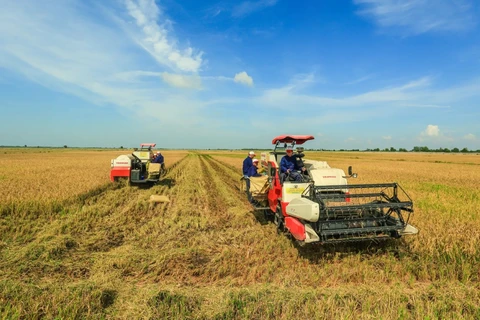
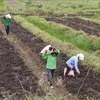
Joint efforts needed for sustainable development of rice farming in Mekong Delta ảnh 2Harvesting rice in the Mekong Delta (Photo: VNA)
However, the official added there are numerous difficulties in the project implementation,and one of the challenges is how to attract investment.

The agricultural sector is calling onall parties, from cooperatives and businesses to international organisations,domestic and foreign experts, to engage in this project so as to mobilise allresources in society, including experience, technique and finance, forimproving the quality and efficiency of the rice industry, he went on.

Tran Thanh Nam, Deputy Minister of Agriculture and Rural Development, saidforming specialised zones of low-emission and high-quality rice in theMekong Delta is a breakthrough project expected to help promote the added valuethroughout the entire rice production chain, raise farmers’ income, ensuresustainable development amid worsening climate change, contribute to greengrowth, and realise the Government’s commitments made at the 26th UNClimate Change Conference (COP26), including the target of net zero emissionsby 2050.

The project will help production in high-qualityrice farming zones be reorganised in value chains that better connect farmers,cooperatives, input suppliers, and rice purchasing companies. As a result, farmerswill not only benefit from rice’s added value but also create sustainablecultivation processes, cut greenhouse gas emissions, save resources, recycleby-products of rice farming, raise the value of the Vietnamese rice brand inthe market, according to the Deputy Minister./.
VNA
See more

Customers purchase petrol at Station No. 03 (Petrolimex Hung Yen) on Quang Trung Street, Tran Hung Dao ward, Hung Yen province. (Photo: VNA)

Hung Yen takes measures to curb speculation, stabilise fuel market

Petrolimex Hung Yen maintains regular reserves of about 5,500 cubic metres at directly managed outlets and roughly 2,000 cubic metres at franchised stations. The provincial Department of Industry and Trade has ordered closer monitoring of supply and demand and retail prices to detect shortages or unjustified price hikes.

The automobile assembly line of the Honda Phuc Yen factory in Phu Tho province (Photo: VNA)

Honda Vietnam sees decline in motorcycle, car sales

Sales of both motorcycles and automobiles by Honda Vietnam declined in February, dropping 19.6% and 41.8% year-on-year, respectively, according to the company’s latest business results released on March 11.

Team 2 of the Hanoi Market Surveillance Sub-department inspects operations of a Petrolimex petrol station on Tran Quang Khai street (Photo: VNA)

Hanoi maintains stable supply of petrol, LPG

The Hanoi Market Surveillance Sub-department said petrol and LPG trading activities across the city remain stable, with supply largely meeting demand despite volatility in global energy prices.

A Qatar Airways aircraft is seen at Noi Bai International Airport in Hanoi. (Photo: VNA)

Qatar Airways cancels 13 more flights amid Middle East conflicts

Statistics show that airspace across the Middle East has yet to return to normal operations, with multiple FIRs still imposing restrictions or partial closures. As a result, international flight operations through the region continue to face disruptions and route adjustments.

New FDI registrations remained robust in the first two months of 2026, with 620 newly licensed projects worth 3.54 billion USD, up 20.2% in the project number and 61.5% in registered capital compared to the same period last year. (Photo: VNA)

FDI attraction in 2026: Vietnam adapts to new global investment standards

To further enhance FDI attraction amid rising global and regional competition, Deputy Minister of Finance Tran Quoc Phuong said the ministry is drafting new strategies on foreign-invested economic development and next-generation FDI attraction, focusing on more open, transparent and competitive institutional frameworks.

Prime Minister Pham Minh Chinh speaks at the conference. (Photo: VNA)

PM highlights 'silver economy' as sustainable growth driver

The PM stressed that population ageing is an inevitable part of development, and the key challenge is not to avoid it but to respond proactively with sound policies and decisive action to turn the "silver economy" into a new driver of growth, innovation and sustainable development.

The first EU – Vietnam Global Gateway Business and Investment Forum is scheduled to take place in Hanoi on March 24, 2026. (Photo: vneconomy.vn)

EU – Vietnam Global Gateway business forum to be held in Hanoi

Key discussions will centre on sectors viewed as catalysts for Vietnam’s sustainable growth such as sustainable transport, energy transition, infrastructure connectivity, green and digital transformation, and the adoption of ESG standards in investment and business practices.

Vietnamese Ambassador to France Trinh Duc Hai meets with representatives of FPT at its office in the La Défense area of Paris on March 10. (Photo: VNA)

Vietnamese tech firm FPT expands footprint in France

According to Dang Tran Phuong, Deputy CEO of FPT Software in charge of the European and Middle Eastern markets, FPT considers France one of its key markets in Europe. Since opening its first office there in 2008, the company has built a solid presence with offices in Paris, Lyon, Toulouse and Marseille.

The authority also proposed allowing airlines to apply a fuel surcharge on domestic airfares, with a flexible adjustment mechanism based on fluctuations in Jet A-1 fuel prices. (Photo baochinhphu.vn)

CAAV proposes tax cuts, financial support for airlines

These include a proposal to exempt 100% of the environmental protection tax on aviation fuel until the end of May this year, and to add aviation fuel to the list of goods eligible for a reduced value-added tax (VAT) from 10% to a lower appropriate rate.