Khmer community treasures traditional Ngo boat race

Ngo boat race is not only a sports activity for the Khmer community but also holds special cultural and spiritual significance to the ethnic minority group.
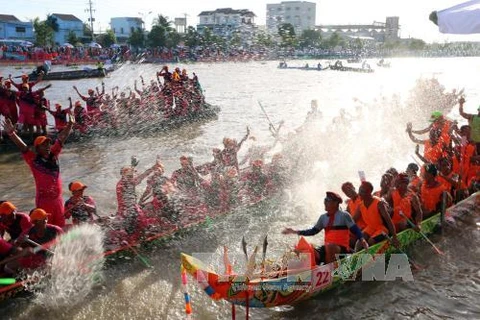
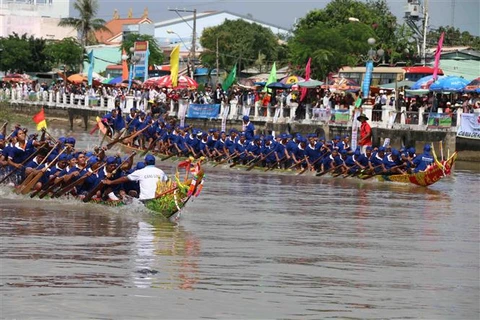
Khmer community treasures traditional Ngo boat race ảnh 1The Ngo boat race is an enticing cultural activity of the Khmer ethnic minority people. (Photo: VNA)

Hanoi (VNA) – The recent recognition of the Khmer ethnic minority people’s Ngo boat race in the Mekong Delta province of Soc Trang as a national intangible heritage is expected to assist the community in maintaining and promoting their unique cultural tradition.

The race is the most enticing part of the Ook Om Bok – also called the Festival of Worshipping the Moon, which is one of the three biggest Khmer events, alongside the traditional New Year Festival Chol Chnam Thmay and the Sene Dolta, for remembering ancestors.

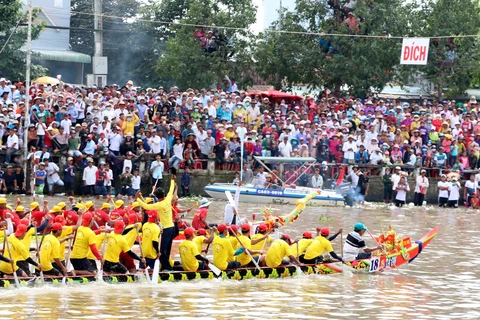
Racing activities take place on both land and water, with the latter being a magnet for both local residents and tourists.

Ngo boats (Ghe Ngo) are considered sacred objects to the ethnic Khmer people. The special boat is made of wood by Khmer Buddhist monks, representing one or more Khmer villages. It is decorated with images of dragons, tigers, elephants, lions and peacocks to show its power. Victory in the race means honour to the pagoda and the locality it represents.

In the past, the boat was a canoe, made by hollowing out a large and long tree trunk. However nowadays it is very difficult to find a suitable trunk, so Khmer people make Ngo boats by joining planks together.

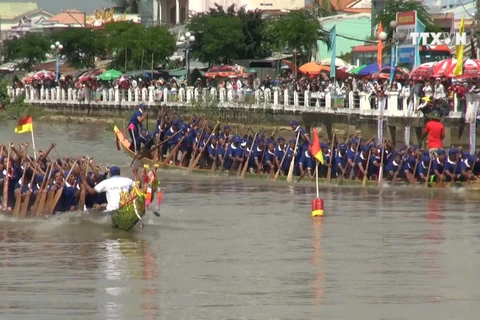
With a shape like a snake, boats are about 25 to 30m in length, and both ends are bent. Each vessel must accommodate between 40 to 60 racers. No matter how many people are aboard, each boat has three leaders – one sitting at the bow in charge of spiritual and technical activities; the other two sitting in the middle and at the stern to blow their whistles encouraging the racers and correct their technique.

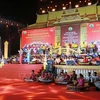
Khmer community treasures traditional Ngo boat race ảnh 2A Ngo boat race to mark the Ook Om Bok festival. (Photo: VNA)

Each boat has a specific symbol that is related to a destination or a tradition of a pagoda. The symbol represents an organisation in association with its power.

Another interesting fact about the boat is the spiritual beliefs that go with it. Local people believe that each has its god that generates its power and keeps the entire crew safe during the race.

The boat, considered a sacred object, is only used for racing. Every activity it is involved in needs a prayer ceremony. People often hold ceremonies to ask the wood for its trees to make the boat, to kick off the building of the boat and to mark its completion, among others.

About one week before a race, pagodas, following the tradition, hold a launch ceremony for their boats, which features a special offering named "sla tho" and a tray of fruits, cakes, and food according to the need of each pagoda. The offering is made from a coconut or banana tree trunk, with incense and candles placed on it.

Before and after each race, there is a ceremony with its own regulations on offerings, rites, celebrants, and attendees. For example, in the past, several pagodas did not allow women to approach or step over the top of the boat, as they consider such acts to bring about bad luck. However, this belief has changed significantly. Women now can even be on board to participate in the race.

Ngo boat racing has become a common festival of the three ethnic groups, Kinh, Khmer and Hoa, making the relationship between different ethnic communities in the southwest region increasingly interconnected.

The Khmer people in Soc Trang organise the race as a good custom and a great festival for everyone to have fun and to join in healthy competition. It constitutes a typical cultural feature of the river region that deserves to be preserved for generations to come./.

VNA

See more

The gong culture in the Central Highlands of Vietnam, recognised as a Masterpiece of the Intangible Heritage of Humanity by UNESCO in 2005, is a pride of Gia Lai. (Photo: VNA)

Gia Lai province to host National Tourism Year 2026

The province proposes the theme “Gia Lai – Convergence of Identity, Spreading Green” to underline its fusion of coastal and highland landscapes, as well as the blend of cultural heritage and nature, its connection between the central region and the rest of the country, and its commitment to sustainable development and international integration.

Ancient Vietnamese costumes have been making their way back into modern life and performing arts thanks to the efforts made by groups of young people. (Photo: VNA)

Resolution No. 57-NQ/TW: Driving cultural innovation, showcasing traditional values

In the cultural and art sectors, enhancing cultural industries through effective innovation and creativity is a crucial step in implementing Resolution No. 57-NQ/TW on breakthroughs in science, technology, innovation, and national digital transformation, thus boosting economic growth and elevate Vietnamese culture on the global innovation landscape

Vietnam concludes the 16th World Bodybuilding & Physique Sports Championship 2025 with three runner-up titles (Photo: https://nld.com.vn/)

Vietnam wins triple runner-up titles at world bodybuilding championships

With 10 golds, five silvers, and two bronzes, Vietnam equaled its 2024 medal count but failed to retain its ranking amid fierce competition from other leading nations. Vietnam achieved a trio of runner-up finishes, placing second in the men’s team, women’s team, and overall ranking.

A Vovinam performance - Illustrative image (Photo: VNA)

Vovinam strengthens role as "cultural ambassador" in Europe

The two-day programme featured master-level exams, qualifying and final rounds, technical demonstrations and exchanges within the federation. Performances and bouts were praised for their technical quality, sportsmanship and adherence to the philosophy of “Sportsmanship – Solidarity – Honesty – Nobility – Progress.”

The Vietnam – Japan Buddhist cultural exchange festival is held at the Tam Chuc National Tourist Complex in Ninh Binh province from November 15 to 16. (Photo: VNA)

Ninh Binh hosts Vietnam – Japan Buddhist cultural exchange festival

This year’s festival featured a variety of traditional Vietnamese and Japanese rituals and artistic activities, including sutra chanting at the Tam The Hall of Tam Chuc pagoda, Xam folk singing, flower-offering and Buddha recitation ceremonies (Pure Land Buddhism), sutra writing (Japanese Buddhist tradition), a lantern night, morning meditation sessions, and a Buddha offering ceremony at Ba Sao Pagoda.

At the Japanese-language speech and presentation contest held as part of the 4th Kanagawa Festival in Da Nang on November 13. (Photo: baodautu.vn)

Da Nang hosts fourth consecutive Kanagawa festival

The event vividly illustrates the friendly and cooperative relationship between the two localities, reflecting Kanagawa’s goodwill and attention toward Da Nang. It also serves as a foundation for the two sides to continue promoting cooperation in potential fields that align with their development orientations.

At the show (Photo: VNA)

Indian rock band Parikrama starts Dak Lak tour

Formed in 1991, veteran rock band Parikrama ranks among India’s longest-running and most respected rock bands, with more than 3,500 global shows at venues like the Kennedy Centre in the US, Download Festival and Brixton Academy.

Craft heritage of ancient capitals meet at Temple of Literature

Craft heritage of ancient capitals meet at Temple of Literature

As part of the Thang Long – Hanoi Festival 2025, the Temple of Literature has become a major highlight, hosting a series of cultural and educational events celebrating Vietnam’s age-old tradition of learning and showcasing the capital’s most iconic heritage.

By 2025, Lam Dong province’s tea cultivation area shrinks to about 12,000 ha of raw material zones. (Photo: VNA)

Four records set as Vietnam hosts first-ever world tea fest 2025

The World Tea Fest 2025, Vietnam’s first international-scale tea festival, features four remarkable records: a mass tea-brewing performance by 1,111 artisans; the preservation of a 100-year-old tea factory; the participation of beauty queens from 80 countries; and the display of 1,000 ancient tea trees, each several centuries old.

Vietnam to host first Asian Esports Championships (Photo: VNA)

Vietnam to host Asian Esports Championships for the first time

Vietnam will host the Asian Esports Championships (ECA 2025) for the first time from November 19–22 in the Mekong Delta city of Can Tho, marking a milestone in the country’s growing presence on the global esports stage, the Vietnam Recreational and Electronic Sports Association (VIRESA) has announced.