Kien Giang applies advanced technologies in large-scale shrimp farming

The Mekong Delta province of Kien Giang will promote the application of advanced technologies in shrimp farming on large scale under its master plan on shrimp development until 2025.
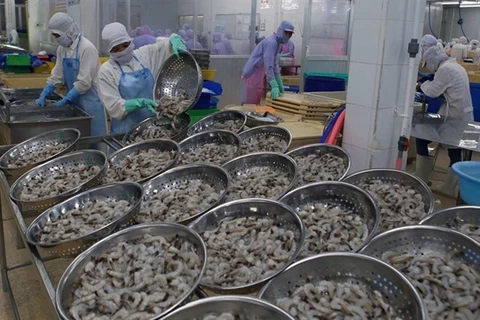
Kien Giang applies advanced technologies in large-scale shrimp farming ảnh 1The Mekong Delta province of Kien Giang will promote the application of advanced technologies in shrimp farming on large scale until 2025. (Photo: VNA)

Kien Giang (VNA) – The Mekong Delta province of Kien Giang willpromote the application of advanced technologies in shrimp farming on largescale under its master plan on shrimp development until 2025.

Accordingly, the province will shift 5,000 hectares of extensive culture ofshrimp to industrial and semi-industrial shrimp farming by 2020, of which 4,700hectares are in the Long Xuyen Quadruple and 300 hectares in U Minh Thuong.

Automatic water environment monitoring stations will be set up serving both aquacultureand environmental protection in this period.

Thetotal area of brackish water shrimp farming is projected at 127,850 ha in 2020.

Meanwhile, the 2021-2025 period will see the formation of a high-tech shrimpindustry along with the development of shrimp-rice farming model andlarge-scale extensive shrimp cultivation. Total shrimp farming area will beexpanded to 129,450 ha.

Advanced technologies will continue to be applied on a large scale to reducechemicals and antibiotics during the entire shrimp production. Besides, theshrimp industry will be developed into a complete value chain, helping increaseadded value of the local staple.

More than 20,000 hectares of rice cultivation in areas hit by saline intrusionduring dry season in U Minh Thuong and Tu Giac Long Xuyen will be switched toshrimp-rice farming.

The province will invest heavily in technical infrastructure to improvebreeding production.

Kien Giang earned 213 million USD from the export of aquaticproducts in 2018.-VNA 
VNA

See more

Toy production at a Hong Kong-invested factory (Photo: VNA)

Vietnam targets deeper market penetration in Hong Kong in 2026

Vietnam-Hong Kong trade hit 62.3 billion USD in the first 11 months of 2025, soaring 73.1% annually. Vietnamese exports to Hong Kong amounted to 36.8 billion USD, a 90.6% hike, ranking fourth among Hong Kong’s import sources, while imports from Hong Kong stood at 25.5 billion USD, up 52.9% and ranking third.

Vietnam’s start-up market enters restructuring phase

Vietnam’s start-up market enters restructuring phase

In 2026, venture capital inflows into Vietnam’s start-up ecosystem are expected to recover gradually, though in a more selective manner. VinVentures forecasts that capital will focus on start-ups that have survived the rigorous screening of 2024–2025, possess clear business models, strong commercialisation capacity, and the ability to generate real cash flows.

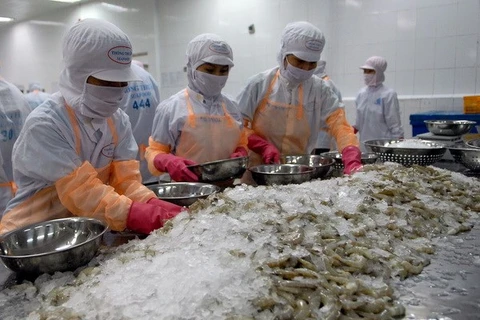
Workers process tra (pangasius) for export (Photo: VNA)

Vietnam–Singapore trade continues to thrive

For the year as a whole, Vietnam retained its position as Singapore’s 10th largest trading partner. Bilateral trade reached a record high of nearly 40 billion SGD, up 26.2% from the previous peak of 31.67 billion SGD recorded in 2024.

Eric Van Vaerenbergh, an energy expert and lecturer at the Brussels Engineering School (ECAM) (Photo: VNA)

Belgian expert optimistic about Vietnam’s economic outlook

Vietnam should move from a growth model based mainly on expanding capital and labour to one driven by productivity improvements. He said that this requires enhancing the quality of the workforce, particularly engineers, technicians, and managers in industrial sectors.

Workers at the VSIP Hai Phong industrial and urban complex, which specialises in producing electronic components for office equipment. (Photo: VNA)

Roadmap aims to improve business climate and boost competitiveness

By the end of 2026, Vietnam aims to rank among the world’s top 50 performers in the United Nations Sustainable Development Goals, advance at least three places in the International Property Rights Index, and climb at least one position in the Global Innovation Index.

Vietnam is strengthening its position in the technology value chain, becoming a major manufacturing hub for complete consumer electronics products. (Photo: VNA)

ESG standards offer opportunities to reposition Vietnam’s electronics firms

The 2025-2027 period will be a critical turning point, as exporters to the European market will be required to strictly comply with ESG standards, including net-zero emissions roadmaps, labour standards, corporate governance and transparency requirements. As a key export sector, the electronics industry is being directly and strongly affected by this shift.

A production line for camera modules and electronic components at the factory of MCNEX VINA Co. Ltd, a Republic of Korean-invested company in Phuc Son Industrial Park, Ninh Binh province. (Photo: VNA)

Science, technology, innovation as engines of economic growth

To ensure that science and technology truly act as a powerful growth engine, experts emphasised the need for the Government to put in place supportive mechanisms and policies that encourage enterprises to invest in research and development, while strengthening cooperation among the State, research institutions and the business sector.

The headquarters of the Ministry of Industry and Trade in Hanoi (Photo: VNA)

PM updates lead roles to drive UKVFTA forward

The Ministry of Industry and Trade (MoIT) is named the lead agency, with overall responsibility for the agreement’s general goals and definitions, trade remedies, non-tariff barriers to trade and investment in renewable energy, competition policies, State-owned enterprises, enterprises with special or exclusive rights and those with designated monopolies, as well as institutional, general and final terms.