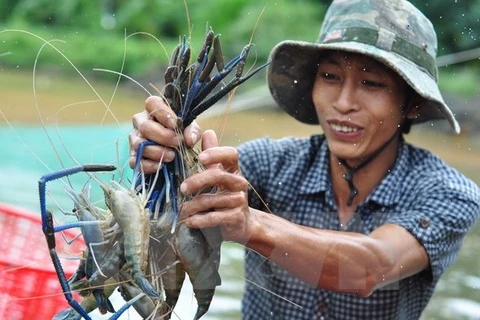
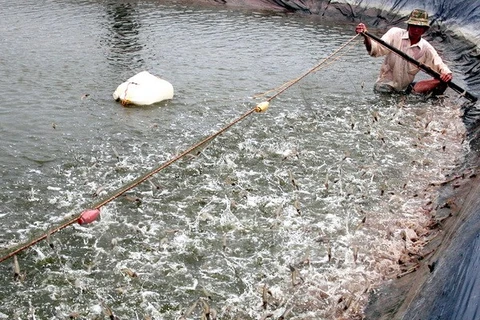
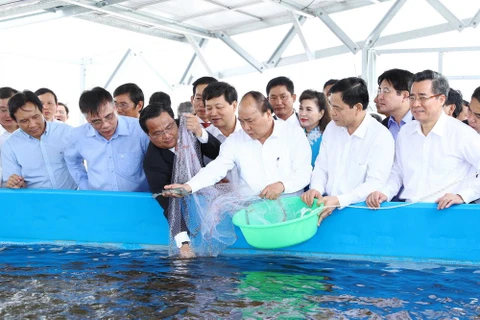
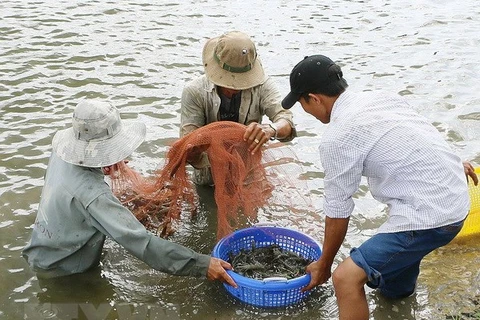
Farmers harvest giant river prawns in Kien Giang Province’s Vinh Thuan district. (Source: VNA)
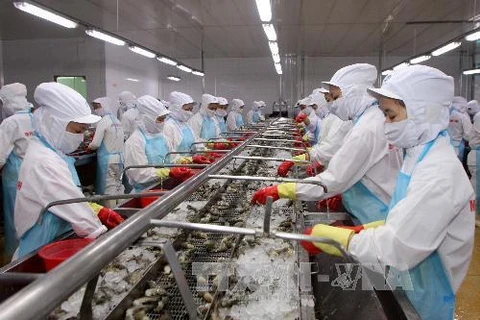
Kien Giang (VNS/VNA) - The Mekong Delta province of Kien Giang will expand various sustainable shrimp farming models to meet its target of producing 76,000 tonnes this year, slightly up from last year, according to its Department of Agriculture and Rural Development.
Farmers and companies in the province, which is one of the delta’s largest shrimp producers, use models like industrial and semi-industrial farming, advanced extensive farming, shrimp – rice farming, and shrimp – forest farming.
The province plans to carry out industrial and semi-industrial farming on 3,100ha this year, mostly in the Long Xuyen Quadrangle and U Minh Thuong district, compared to 2,590ha last year.
Farmers are breeding shrimp, mostly white-legged shrimp, under the industrial farming model on an area of 150ha so far, according to the department. Companies have registered for more than 1,000ha of farms.
The province has created favourable conditions for companies to tie up with farmers to establish shrimp production chains that ensure steady prices and improve farmers’ incomes.
Do Minh Nhut, deputy director of the department, said the industrial and semi-industrial models have been developed in recent times.
The use of advanced farming techniques that are sustainable and carry few risks has been expanded and contributed to increasing the province’s shrimp output, he said.
The advanced techniques include using nets to protect shrimp ponds from the sun, plastic sheets to cover pond beds and fans and pumps to generate oxygen for the water.
To help farmers and companies farm sustainably, the department and other relevant agencies will carefully monitor the environment, control shrimp diseases and instruct breeders in Vietnamese good agricultural practices (VietGAP).
The province needs about 10 billion shrimp broodstock this year but can only produce around half of that number, according to the department.
To manage the quality of broodstock bought in other provinces and cities, the Animal Health and Husbandry Sub-department has set up inspection stations on main roads entering the province since early this year.
The sub-department stops vehicles transporting the broodstock and takes samples for checking when necessary.
Nguyen Thanh Duc, head of the sub-department, said it would continue, free of charge, to do tests for two diseases that affect fry for farmers and provide chlorine to disinfect ponds against diseases.
The diseases are white spot disease and acute hepatopancreatic necrosis disease, also known as early mortality syndrome.
The department has instructed breeders to release brackish water shrimp fry in accordance with the recommended schedule between December and May depending on conditions in each area.
The schedule of releasing shrimp fry in U Minh Thuong district, for instance, is between December and April and in Hon Dat district, between February and May.
The province has estimated a total of 123,000ha of brackish water shrimp will be farmed under various models this year, according to the department.
Nguyen Van Hoa, who began farming shrimp in his rice field in An Minh district in early January, said he had harvested his rice crop early and started the shrimp crop early.
He had a bumper rice harvest and the field has plenty of rice stalks, offering good conditions for breeding shrimp, he said.
“I hope the shrimp crop will be successful. I can get a good price by harvesting the shrimp crop early.”
The model of planting rice in the rainy season and raising shrimp in the dry season in the same rice field is sustainable and will enable the province to adapt to climate change.
The province has around 80,000ha of shrimp-rice farms, the largest area in the delta.
The breeding of giant river prawns under the shrimp-rice farming model fetched farmers large incomes in their recent harvest.
Many farmers in U Minh Thuong district earned 30-35 million VND (1,280 – 1,500 USD) per hectare.
Kien Giang has successfully bred the spotted scat and black-tiger shrimp in the same pond in Hon Dat district’s Son Binh commune, offering farmers in coastal areas a new model.
In October 2017, the provincial Department of Science and Technology and the district got two local households to implement the model on 2ha each.
At first they released 120,000 black tiger shrimp fry in the ponds. One and half months later they released 1.6 tonnes of spotted scat fry.
The total production cost was 280 million VND (12,000 USD), of which 64 million VND (2,750 USD) came in the form of a subsidy from the authorities.
The two households harvested six tonnes of spotted scats and 2.8 tonnes of black-tiger shrimp after six months.
Le Van Vung, a member of one of the households, said he had earned around 140 million VND (6,000 USD) in six months and still had shrimp and fish left in the pond.
Nguyen Van Phuong, Chairman of the Son Binh Commune People’s Committee, said this model has a lower production cost than others and is suitable for local farmers. The commune would expand it to more farmers, he said.
The model is friendly to the environment because the fish eat all the residue food meant for the shrimp and alga in the pond, which helps prevent shrimp diseases.
Nguyen Xuan Niem, Deputy Director of the provincial Department of Science and Technology, said the department would transfer the technique to the Agriculture Extension Centre for it to expand the model to other coastal districts.
The department is also reproducing spotted scat artificially and will transfer the reproduction techniques to farmers so that they can ensure a steady supply of broodstock.-VNS/VNA
VNA