Lack of knowledge behind organ donor shortage

​Hanoi, December 28 (VNA) - The lack of knowledge about organ donation is one of the main reasons leading to the shortage of organ donation sources, according to medical experts.
Lack of knowledge behind organ donor shortage ảnh 1Health Minister Nguyen Thi Kim Tien gives organ tissue donation cards to registered donors (Photo: VNA)
Hanoi (VNA) - The lack of knowledge about organ donation is one ofthe main reasons leading to the shortage of organ donation sources, accordingto medical experts.

Public awareness oforgan donation remained limited, even amongst medical workers, said DeputyDirector of the National Co-ordination Centre for Organ Transplant Dong Van He.

A survey on medicalworkers’ knowledge about brain-dead patients carried out in 2015 at somehospitals in the northern mountainous localities found that more than 70 percent of medical workers said brain-dead patients could recover.

Particularly, 44 percent of students of the Hanoi Medical University also said that brain-deadpatients could be saved.

This misunderstanding ofbrain-dead patients would have a great impact on encouraging and raising publicawareness of organ donation from brain-dead patients, He told Suc khoeva Doi song (Health and Life) Newspaper.

“Brain-dead patientscannot be saved,” he said.

The Ministry of Healthrecently held a media campaign to raise awareness amongst both people andmedical workers about organ donation, stating that donations from brain-deadpatients are a valuable source.

Doctor Ly Van Lien fromBao Yen Hospital in the northern mountainous province of Lao Cai said hehimself was not well aware of organ donation and brain-death.

“After attending thecampaign ceremony, I was updated with a lot of knowledge. I will register todonate organs after death. In the worst case, a part of my body could help saveothers. This is the most meaningful thing that I can feel,” he told thenewspaper.

“I am from Dao ethnicgroup and people in my locality are very afraid of donating organs. Now Iunderstand and will explain and encourage people in my locality to register todonate their organs after death,” he said.

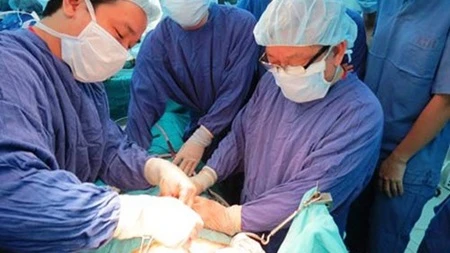
Organ donation from abrain-dead patient could save the lives of many people who need organtransplants and in many cases, organ transplant was the only cure, according toHe.

Paradoxically, thenumber of brain-dead patients due to traffic accidents amounted to tens ofthousands each year but the number of donors was limited, he said.

The Hanoi-based Viet Duc(Vietnam-Germany) Hospital, one of the 17 facilities qualified to performtransplants, reported around 1,000 brain dead patients every year. However,only 26 donated their organs between 2011 and 2015.

If one person agrees todonate his or her organs, four or five lives can be saved. However, fewfamilies of brain-dead individuals agree to make the donation, often forspiritual reasons.

Organ donation is anurgent need to meet increasing demand in the current context. Over 16,000patients suffer from heart, kidney, liver and lung diseases and more than 6,000blind people await eye donations, according to the health ministry.

Doctors here haveconducted 1,281 kidney transplants, 54 liver transplants, 16 heart transplantsand eight bone marrow transplants since 1992, according to the latestfigures.-VNA
VNA

See more

The number of foreign tourists coming to Ho Chi Minh City for travel combined with medical check-ups is increasing. (Photo: VNA)

Vietnam looks to unlock medical tourism potential with national strategy

The draft strategy aims to position Vietnam as a trusted healthcare destination in Southeast Asia by 2030 and eventually among Asia's leading medical tourism hubs. The plan marks a shift from viewing medical tourism as an untapped opportunity to making it a national development priority.

Delegates at the conference. (Photo: VNA)

Vietnam to produce first homegrown next-generation vaccines from 2028

Under the agreement, Sanofi will transfer technology to VNVC to manufacture selected high-demand vaccines for children and adults at VNVC Vaccine and Bioproduct Plant. The first next-generation vaccines produced in Vietnam are expected to roll off production lines in 2028.

Eric and Alysha joyfully welcome their baby through Mini IVF after more than 10 years of waiting. (Photo: Hong Ngoc Phuc Truong Minh General Hospital)

Vietnam - a destination for journeys to parenthood

An increasing number of international families are choosing Vietnam for infertility treatment, embarking on journeys to parenthood that transcend geographical distance and differences in nationality.

Prime Minister Le Minh Hung delivers remarks at the inauguration ceremony for Viet Duc University Hospital's second campus in Ninh Binh province. (Photo: VNA)

PM urges modern restructuring of healthcare network

The PM stressed that throughout the country’s development process, people have consistently been regarded as the centre, the driving force, the objective and the most important resource for national development. Sustainable and rapid development requires not only a healthy, knowledgeable and skilled population but also a modern, equitable, efficient, sustainable and accessible healthcare system.

Thu Duc General Hospital, with a capacity of 1,000 beds, was inaugurated and put into operation in April 2025 (Photo: VNA)

Ho Chi Minh City moves to expand robotic surgery to gateway hospitals

According to the municipal Department of Health, developing gateway hospitals is a key pillar of the city's strategy to establish a regional specialised healthcare system. The network is designed to permanently relieve overcrowding at major downtown hospitals while strengthening strong inter-regional emergency care and treatment network.

Doctors conduct health screenings for children in Tru Van Tho commune, Ho Chi Minh City. (Photo :VNA)

Ho Chi Minh City moves closer to universal health check-ups

Achieving universal health check-ups in 2026 will lay the foundation for a new healthcare model in which every resident has an electronic health record, receives regular screenings, benefits from lifelong health management and gains access to early intervention through primary healthcare services.

Illustrative photo: Internet

Dengue cases rise, outbreaks become more unpredictable

Vo Hai Son, Deputy Director of the ministry's Administration of Disease Prevention, said dengue fever is no longer following previous epidemiological trends. In 2025, infections remained elevated through November and December rather than declining at the end of the year as had traditionally been the case, indicating a shortening outbreak cycle.