Lam Dong farmers go high tech

The Central Highlands province of Lam Dong is leading the country in high-tech agriculture. It grows crops on nearly 50,000ha under hi-tech agricultural methods.
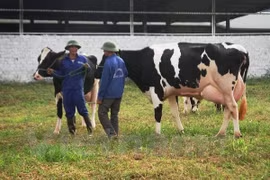
Lam Dong farmers go high tech ảnh 1Red chili garden of farmer Nguyen Xuan Hoi in Da Lat city (Source: VNA)
Lam Dong (VNS/VNA) -The Central Highlands province of Lam Dong is leading the country in high-techagriculture. It grows crops on nearly 50,000ha under hi-tech agriculturalmethods. This amounts to 18 percent of the province’s land under production.

According to the provincial Department of Agriculture and RuralDevelopment, the high-quality vegetable production model yields 400 million VNDto 500 million VND (17,400-21,700 USD) per hectare each year.

Flower production reaps up to 1.2 billion VND (52,200 USD) per hectare eachyear, while tea and coffee yield 250 million VND (10,870 USD) per hectareannually.

The record productivity is helped by high technology aquaculture, with 8billion VND to 9 billion VND (347,800-391,300 USD) per hectare a year.

The modern farming has set an example for other localities. However, thehigh-tech scene, especially small-scale models, faces several handicaps.

Nguyen Xuan Hoi is the owner of a 3,000 sq.m technology-based farm whichcultivates flowers, mini cucumbers and chili in Da Lat city. Being aware thatplanting clean vegetables is the best way to protect the health of consumers,for years, he nurtured the desire to farm without using chemicals. However, itwas not until a year ago that he obtained the financial resources to realisehis dream.

He invested more than 1 billion VND (43,500 USD) on green houses, autoirrigation systems and imported chemical-free fertilisers, which he called“hi-tech agriculture”.

“The biggest difficulty when I started was raising 1 billion VND in capital. Ihad to borrow from a bank and apply for mortgage. The bank preferentialinterest rate is low at only 1.1 percent,” he said.

Having more than 3,000sq.m of land, Tran Van Phuoc, a farmer in Da Nghich village,Lat commune, Lac Duong district, decided to invest in a greenhouse.

However, he could not borrow the 560 million VND (24,400 USD) needed, as theloan limit was only 70 million VND without collateral.

Tran Van Tan, deputy head of the State Bank of Vietnam’s Credit Department,said that lending for hi-tech agriculture involved a lot of risks and lackedagricultural insurance policies.

The investment capital for hi-tech agriculture projects is enormous. In fact,in Lam Dong province, greenhouse investment is worth 1.3 billion VND to 3billion VND (56,500-130,400 USD) per hectare. However, most of the products donot have stable markets, so investment efficiency remains limited, according toTan.

Even hi-tech agriculture enterprises face challenges. According to theregulations, properties listed as high technology must be attached to land.However, green houses and net houses have not been granted property ownershiprights on agricultural land, and so a limited number apply for mortgages.

The owners of small-scale high-tech farms, such as Hoi, who receive littlesupport from local authorities, are struggling to find markets. Hoi musthimself find companies to sell his products.

“I signed a contract with Cau Dat Farm Company. Every week, they come to buy myplants, but the price is unstable,” he said.

“My farm is on agricultural land which lies in a forestry area. The pathleading to my farm is so muddy that vehicles entering my farm can transportonly two tonnes of vegetables and fruits at the most. This reduces productionefficiency,” Hoi said, adding that farmers like him hoped the local authoritieswould help them upgrade the road to facilitate their farming.

Nguyen Van Son, Director of the provincial Department of Agriculture and RuralDevelopment, said that the province had taken some land accumulation measuresto support hi-tech farming.

After land clearance, the State acquires farmers’ land, builds infrastructureon the land and then lends it to enterprises.

Another way is that enterprises implement their projects first. The localauthorities will then approve the projects and assign land to domestic andforeign enterprises for rent within 20 to 50 years. Enterprises can evennegotiate to purchase or hire farmers’ land. The State will support them withland compensation and land clearance.

The provincial authorities consider hi-tech agriculture as the key to developthe local economy and are always creating favourable conditions for thissection, along with supportive policies from the Government.

According to the provincial Department of Agriculture and Rural Development,private farms and farming households play an important role in the developmentof local hi-tech agriculture, because these farms account for large productionarea and primary capital (86.2 percent of area and 64.5 percent of capital).

The province values the role of farmers and hopes to promote production andconsumption by helping producers network with enterprises and cooperatives tostabilise markets, the department said.

Da Lat city and neighbouring zones will run a trial “green village” model. Thepolicy will also waive the tax on imported equipment and materials, which Vietnamis unable to manufacture, to build green houses and net houses.

In Lac Duong district, a leading locality for hi-tech agriculture in Lam Dong province,the district authorities, in collaboration with enterprises, have startedtraining courses for farmers on farming techniques. This helps enterprises keepemployees, farmers get jobs and learn effective means to produce on their ownland. The farmers’ attitudes towards high-tech farming have changed, and theyhave reaped more profits.

Lâm Dong province’s authorities are also paying attention to technologyadvancement, a key aspect.

Vo Thi Hao, Director of the provincial Department of Science and Technology,said that 60 percent of the province’s investment in science and technology wasspent on promoting hi-tech agricultural application, such as seed selection andproducing seedlings.

“The state management’s role and research roles of the departments have beenseparated. The research is assigned to institutes and educational facilities.The provincial agencies ask these institutes and facilities to conduct theresearch, and then apply them in practice,” she said.

“By doing this, we can connect research with local practice, as well asencourage management agencies to use the research results.”-VNA
VNA
See more

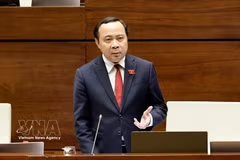
Vietnamese Deputy Minister of Science and Technology Tran Trung Tinh speaks at the event. (Photo: Published by VNA)

Vietnam, RoK seek to expand cooperation in AI and semiconductor sectors

Vietnamese Deputy Minister of Science and Technology Tran Trung Tinh stressed that the Politburo's Resolution No. 57-NQ/TW identifies science and technology, innovation and digital transformation as leading breakthroughs and key drivers of rapid and sustainable development. Semiconductors and artificial intelligence (AI) are among the strategic technologies prioritised for development.

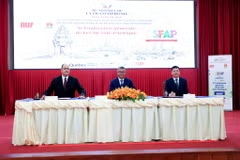
Representatives of Cambodia’s Ministry of Education, Youth and Sport (MoEYS), the Agence Universitaire de la Francophonie (AUF) and Viettel Cambodia (Metfone) sign a tripartite agreement to strengthen cooperation and accelerate digital transformation in Cambodia’s higher education sector. (Photo: khmertimeskh.com)

Vietnamese company joins Cambodia’s digital transformation efforts

The agreement establishes a cooperation framework to modernise higher education through digital governance, digital learning, artificial intelligence (AI) applications, and capacity building through training and knowledge sharing. It also aims to expand internship, employment and scholarship opportunities for students.

USTH students access modern equipment (Photo: VNA)

Vietnam’s AI ambition runs into talent wall

AI is becoming a foundational technology, cutting across industrial production, healthcare, education, finance, governance and public service delivery. But turning technological potential into practical value requires a workforce able to study, master and apply AI to Vietnam’s real-world problems.

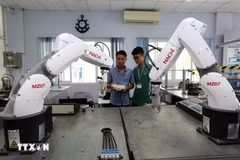
Trainees practise programming and operating robots at the Ho Chi Minh City High-Tech Park Training Centre. (Photo: VNA)

Vietnam, Malaysia hold potential for cooperation in robotics industry

Businesses from both countries should lead joint research and field-testing projects in areas such as electronic component inspection, warehouse transport, agricultural monitoring and medical logistics, said Samirul Ariff Othman, a policy, economic and business analyst at Global Asia Consulting and visiting lecturer at Universiti Teknologi PETRONAS.

Illustrative image (Photo: SGGP)

Ericsson establishes R&D capability in Vietnam

This initiative builds on Ericsson’s growing software engineering and testing capabilities in the country, and will further strengthen Vietnam’s contribution to Ericsson’s global technology development.

An AI-powered robot at the 2026 Seoul AI Conference. (Photo: VNA)

RoK’s AI robotics drive opens cooperation opportunities with Vietnam

Dao Tuan Hung, President of the Business Association of Vietnamese in Korea (BAVIK), said Vietnam should adopt a practical approach by prioritising specialised robots, including autonomous mobile robots (AMR/AGV), collaborative robots and machine vision systems, in sectors such as agro-fishery processing, textiles and garments, electronics and logistics.

Russian survey vessel Akademik M.A. Lavrentyev (Photo: VNA)

Russian survey vessel docks in Hai Phong

This is the third joint marine scientific survey in Vietnamese waters, running from November 4 - December 12, and one of the opening field activities under the Vietnam–Russia roadmap for marine scientific research cooperation for 2026-2035.

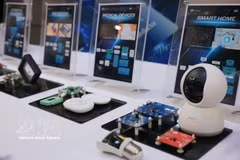
Smart products, chips and semiconductor materials are displayed at the launch ceremony of the national semiconductor chip prototyping support centre in Hanoi on June 26, 2026. (Photo: VNA)

Vietnam-Japan semiconductor cooperation paves the way for high-tech investment

The two countries are implementing five semiconductor research projects involving leading universities, with funding agreements signed in July. The projects cover three-dimensional integrated circuits, advanced semiconductor materials, secure artificial intelligence (AI) chips and power electronic components.

An exhibition space at the “Da Nang Semiconductors and High-Tech 2026” conference, organised by the Da Nang People’s Committee. (Illustrative photo: VNA)

Mobilising international resources to drive Vietnam’s technology development

Vietnam previously focused mainly on attracting overseas experts and intellectuals to work in the country over the long term, but this approach encountered certain difficulties. Cooperation methods are now shifting towards greater flexibility, allowing experts to take part in conferences and scientific seminars, contribute to addressing major national challenges, or participate in short-term training and research programmes.

Assoc. Prof. Dr. Dinh Ngoc Thach, lecturer and researcher in automatic control theory and robotics at the French National Conservatory of Arts and Crafts (Cnam) (Photo: VNA)

Core technologies key to sustainable robotics development in Vietnam: expert

Vietnam should select suitable robotic platforms and gradually build capacity in core technologies, including sensing, environmental perception, positioning, state estimation, AI, control and system integration. This will help develop technologies applicable across multiple sectors while avoiding fragmented investment and dependence on a single product category.

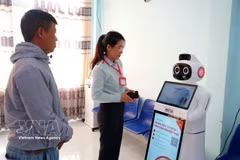
AI robots have become effective assistants in providing administrative services and reducing the workload of officials in Lam Dong province (Photo: VNA)

AI robots help streamline administrative procedures

Operating around the clock, AI robots provide information on administrative procedures, required documents, processing times, fees and relevant regulations, complementing assistance from civil servants.