Land erosion worsens in the Mekong Delta

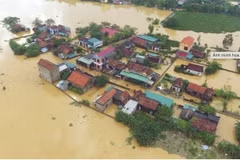
The damage caused by landslides in the Mekong Delta provinces has been increasing yearly.
Landslides on the Ca Mau peninsula have become increasingly worse. (Photo: sggp.org.vn)

HCM City (VNS/VNA)
- The damage caused by landslides in the Mekong Delta provinces has been increasing yearly.

Localities such as Ca Mau, Dong Thap, An Giang, Tien Giang, and Bac Lieu have declared a state of emergency because of landslides. Solutions to limit the damage caused by landslides in the Mekong Delta are now a top priority.

The Mekong Delta was formed by sand and alluvial soil over the last 6,000 years. In that process, it was natural to see one side of a riverbank wider than the other side. However, according to scientists, since 2005 there have been more landslides than land accretion in the Mekong River Delta provinces.

The Mekong Delta region loses about 50 metres of land each year, causing a serious threat to people living along the riverbanks in the region.

Nguyen Huu Thien, an independent expert on Mekong Delta ecology, told Sai Gon Giai Phong (Liberated Sai Gon) newspaper that landslides are caused mostly by a shortage of sand, the blockage of alluvial soil by many hydropower dams, and the mass exploitation of sand along the Mekong River.

The most serious problem is the massive illegal sand mining occurring in Cambodia and Vietnam, Thien said.

According to statistics from the International Commission of Mekong Sub Region, between 1992 and 2014, the total volume of alluvial soil of the Mekong River dropped by 50 percent – from 160 million tonnes down to 85 million tonnes.

Scientists warn that the lack of alluvial soil could cause the number of landslides to increase rapidly in the next five to 10 years.

In recent years, the coast of the Mekong Delta has lost about 500 ha of land annually, but it could begin losing thousands of hectares of land each year in the next 10 years.

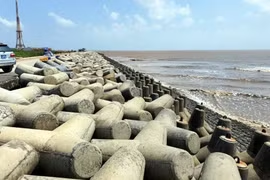
Over the past few years, the Government has invested trillions of dong to build landslide prevention works in Mekong Delta provinces.

Many provinces have asked for support from the government to fund landslide prevention and relocate people living in areas at high risk of landslides.

However, according to Thien, what should be done now is to take action to minimise the losses or damage to local people.

There are three actions – first, build projects in weak soil areas with a high population and in villages living along the riverbanks. For people living in the countryside along the riverbanks, the local authorities should develop plans to persuade them to move to safer places. And thirdly, authorities should develop more plans to prevent illegal sand exploitation.

The Mekong Delta has more than 500 areas with riverbank erosion with a total length of 520km, and over 50 areas of coastal erosion with a total length of 266km, according to the Vietnam Disaster Management Authority

More than 28,000 ha of forests have been lost in the last 20 years./.
VNA
See more

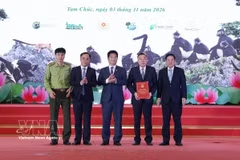
Representatives of the People’s Committee of Ninh Bình province present the decision to establish the Kim Bang Delacour's Langur Species and Habitat Conservation Area. (Photo: VNA)

Ninh Binh establishes world's largest Delacour's langur sanctuary

The establishment of the Kim Bang Delacour's Langur Species and Habitat Conservation Area in Ninh Binh province provides a solid legal and scientific foundation for completing the dossier to seek UNESCO recognition of the Van Long–Kim Bang–Tam Chuc Cultural and Ecological Landscape Complex as a World Heritage Site.

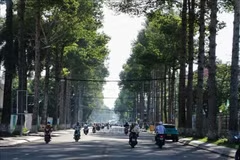
Trees planted along Vo Truong Toan street in Cao Lanh ward, Dong Thap province. Urban tree species capable of reducing fine particulate matter will be planted to reduce air pollution. (Photo: VNA)

Urban trees capable of reducing fine dust to be planted

The Forestry and Forest Protection Department (FFPD) will lead the component on identifying crop and planting structures that help reduce air pollution, while also participating in the design of urban public-space landscapes.

Professor Yucheng Lin, an Assistant Professor at City University of Hong Kong (CityUHK). (Photo: VNA)

Hong Kong expert offers solutions to help Vietnam tackle sea-level rise

In an interview with the Vietnam News Agency’s correspondents in Hong Kong (China), Lin, an expert specialising in sea-level change and climate risk assessment, said Vietnam shared global drivers of sea-level rise with China’s coastal regions, but local conditions could lead to significant differences in the overall risks.

Typhoon Yagi caused severe losses in many provinces in Vietnam in 2024. (Photo: VNA)

Vietnam could face super typhoon like Yagi every seven years

If global average temperatures rise by two degrees Celsius, Vietnam could experience such a super typhoon once every 13 years on average. The frequency would increase to once every nine years under the three-degree warming scenario and once every seven years if temperatures rise by four degrees.

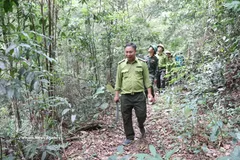
Six of the newly recorded species are of conservation significance, representing four orders and five families. (Photo published by VNA)

Dakrong Nature Reserve records 35 new bird species

Dakrong Nature Reserve in the central province of Quang Tri has recorded 35 bird species not previously documented, including several endangered and rare species listed on the International Union for Conservation of Nature (IUCN) Red List.

An overview of Soc Son waste-to-energy plant in the Nam Son Waste Treatment Complex, in Hanoi (Photo: VNA)

Hanoi targets collection and treatment of all industrial solid waste

Hanoi aims to ensure that all industrial solid waste from its hi-tech parks, industrial parks and industrial clusters is collected and treated in line with regulations under a new plan to strengthen waste management and tighten control on scrap collection, storage and recycling facilities across the capital.

UNICEF Representative in Vietnam Silvia Danailov (first, right) honours first winners of the teaching materials competition. (Photo: VNA)

Deputy minister urges early action on disaster risks

Rapidly shifting climate conditions and increasingly overlapping hazards mean disaster risk reduction can no longer stand alone; it must sit at the heart of sustainable development, tightly integrated with climate response, water security, social welfare and economic growth.

General Secretary of the Communist Party of Vietnam Central Committee and President To Lam speaks at the groundbreaking ceremony for a project to upgrade the Bac Hung Hai irrigation system. (Photo: VNA)

Hung Yen: Project to modernise Bac Hung Hai irrigation system launched

General Secretary of the Communist Party of Vietnam Central Committee and President To Lam stressed that the development of Bac Hung Hai must be integrated into broader efforts to ensure water security, protect the environment and promote sustainable development in the Red River Delta.

Illustrative image (Source: VNA)

Northern region to experience cold spell

The cold air is forecast to reach northeastern Vietnam from the evening and night of October 4 before spreading to other parts of the north and the area from Thanh Hoa to Hue. Winds will shift to the northeast at levels 2-3 inland and levels 3-4 along coastal areas.