Lao localities seek more cooperation with Dien Bien

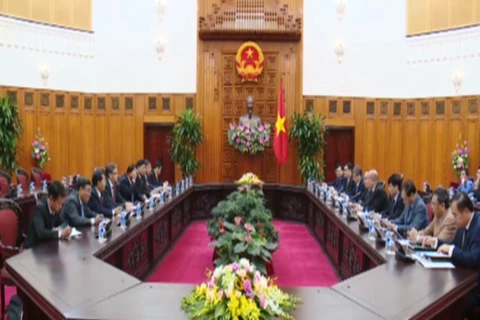
A delegation from three Lao provinces – Phongsali, Oudomxay, Luang Prabang – visited the northern mountainous province of Dien Bien from November 1-5 to strengthen the friendship.
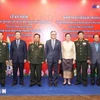
Lao localities seek more cooperation with Dien Bien ảnh 1Leaders of Vietnam's Dien Bien province and Laos' Luang Prabang province signed a MoU on cooperation. (Source: VNA)

Dien Bien (VNA) – A delegation from three Lao provinces – Phongsali, Oudomxay, Luang Prabang – visited the northern mountainous province of Dien Bien from November 1-5 to strengthen the friendship and comprehensive cooperation between the sides.

At the meetings, officials of Dien Bien and the Lao provinces accessed the implementation of a memorandum of understanding the localities signed in 2014 and agreed on orientations for their collaboration in 2017 and in the 2018-2020 period.

They also agreed to boost cooperation in effectively implementing the Vietnam-Laos Trade Agreement and facilitating trade and export-import activities through the simplification of administrative procedures.

The sides will consider building border market pairs under the plan while promoting affiliations in agriculture, education-training, health, and socio-culture.
They will coordinate in ensuring defence-security and managing border areas and border gates.

During the meetings, Dien Bien province signed another MoU with the three Lao provinces to enhance their special friendship and comprehensive cooperation.-VNA
VNA

See more

Tourists in Hue city. (Photo: VNA)

Hue advances heritage city vision, global cultural tourism profile

By 2030, Hue aims to become a distinctive heritage city of Vietnam, while emerging as one of Southeast Asia’s leading and unique centres for culture, tourism and specialised healthcare. It also aspires to be among the country’s major hubs for science and technology, as well as for high-quality, multi-disciplinary education and training.

General Secretary of the Communist Party of Vietnam To Lam presents the report at the 14th National Party Congress. (Photo: VNA)

13th Party Central Committee's report on documents submitted to 14th Party National Congress

At the opening session, on behalf of the 13th Party Central Committee, General Secretary To Lam, Head of the Document Subcommittee, presented the 13th Party Central Committee’s Report on the documents submitted to the 14th Party National Congress, emphasising some key contents and new points of the draft documents for the Congress to consider, discuss and decide upon.

Party General Secretary To Lam presents the 13th Party Central Committee's report on the documents submitted to the 14th National Congress (Photo: VNA)

14th National Party Congress’s opening: Great aspirations, steady steps

Party General Secretary To Lam, head of the Documents Subcommittee, on behalf of the 13th Party Central Committee, on January 20 presented its report on the documents submitted to the 14th National Congress, highlighting key issues and new points in the draft documents for the congress to consider, discuss and decide upon.

Politburo member and State President Luong Cuong delivers the opening remarks of the 14th National Party Congress on January 20, 2026. (Photo: VNA)

Opening remarks of 14th National Party Congress

The 14th National Party Congress is a momentous event for the country and a historic turning point toward the 100th founding anniversary of the Party (February 3, 1930-2030), concentrating the will, aspirations, and determination of our entire Party, people, and armed forces with the spirit of strategic self-reliance, self-strengthening, and confidence to advance strongly into a new era, for a peaceful, independent, democratic, prosperous, civilised, and happy Vietnam steadily progressing towards socialism.

Deputy Minister of Foreign Affairs Le Thi Thu Hang and non-resident foreign ambassadors at the meeting (Photo: VNA)

Deputy FM hosts non-resident ambassadors attending 14th National Party Congress

The 14th National Party Congress is a milestone in Vietnam’s development, as it not only reviews and assesses 40 years of Doi moi (Renewal), but also sets out orientations for national development in the 2026–2030 period, with a vision to 2045, through strong and right decisions to guide the country into a new era of development.