Laos temporarily bans activities in broken dam’s vicinity

The vicinity of the Sepien-Senamnoi hydropower dam project in Attapeu province is a temporarily prohibited area, and no organisations or individuals are allowed to enter this area without permissions from the government or local administration, the Lao Prime Minister’s Office announced on August 3.
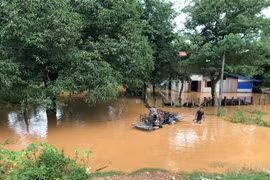
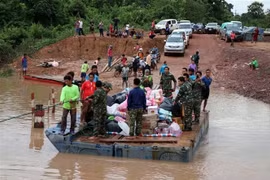
Laos temporarily bans activities in broken dam’s vicinity ảnh 1People evacuate from a flooded area after the dam in Attapeu province broke (Photo: Xinhua/VNA)

Vientiane (VNA) –The vicinity of the Sepien-Senamnoi hydropower dam project in Attapeu province isa temporarily prohibited area, and no organisations or individuals are allowedto enter this area without permissions from the government or localadministration, the Lao Prime Minister’s Office announced on August 3.

The announcement also said that Attapeu andneighbouring Champasak province are responsible for monitoring, examining andtemporarily prohibiting all activities until the investigation and settlementof the dam collapse finish.

Additionally, the Ministry of Energy and Minesof Laos was requested to coordinate with relevant sides to promptly considerand propose the establishment of a board for probing into the cause and impactof the incident and seeking settlement measures.

At about 8pm of July 23, the Sepien-Senamnoihydropower dam burst, flooding 10 villages in downstream areas and completelyisolating Sanamxay district, where it is located. The collapse has affectedmore than 1,300 families with 6,600 people and made many others missing.

The Lao Government is coordinating with domesticand foreign working groups to address the aftermath and support affected residents.–VNA
VNA

See more

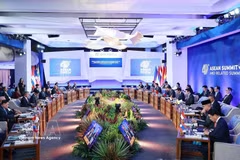
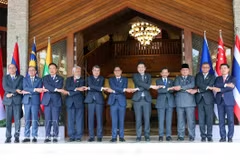
An overview of the ASEAN Leaders’ Interface with Representatives of the ASEAN Inter-Parliamentary Assembly (AIPA) in Manila on November 15 (Photo: VNA)

Vietnam proposes three key directions for ASEAN-AIPA cooperation

Prime Minister Le Minh Hung affirmed that close and effective coordination between the governments and parliaments of member states is a foundation and important driving force for ASEAN to realise its vision of a united, resilient, dynamic and people-centred community.

ASEAN signs Digital Economy Framework Agreement

ASEAN signs Digital Economy Framework Agreement

The Digital Economy Framework Agreement (DEFA), the bloc’s first standalone and legally binding digital economy agreement, establishes common rules covering digital trade, cross-border data flows, electronic payments, cyber security and artificial intelligence (AI).

An overview of the ASEAN Foreign Ministers’ Meeting on November 14, 2026 (Photo: VNA)

Vietnam backs ASEAN culture of consultation, dialogue, preventive diplomacy

Deputy Minister of Foreign Affairs Dang Hoang Giang stressed that amid conflicts and instability in various parts of the world, ASEAN should give top priority to strengthening the foundations of peace and stability, uphold the rule of law and promote the bloc’s principles and norms of conduct, particularly the Treaty of Amity and Cooperation in Southeast Asia (TAC).

The welcome ceremony for Prime Minister Le Minh Hung at Ninoy Aquino International Airport on November 14 afternoon (Photo: VNA)

Vietnamese PM arrives in Philippines for 49th ASEAN Summit

PM Le Minh Hung’s attendance underscores Vietnam's sustained commitment to the bloc, which aligns consistently with the foreign policy set forth by the 14th National Party Congress, which defines ASEAN as a bloc of strategic importance and a top priority in Vietnam’s external relations.

Deputy Minister of Foreign Affairs Dang Hoang Giang. Photo: VNA

Vietnam aims to promote ASEAN unity, resilience and practical cooperation: Deputy FM

Prime Minister Le Minh Hung's attendance at the 49th ASEAN Summit and related summits in Manila, the Philippines, from November 14-17 aims to concretise Vietnam's foreign policy of independence, self-reliance, resilience, multilateralisation and diversification, and reaffirm ASEAN's position as Vietnam's foremost strategic priority in its foreign policy.

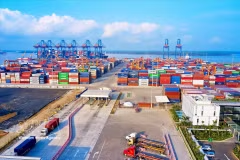
A road is under construction in Dong Nai city, Vietnam. (Photo: VNA)

ADB: Southeast Asia needs 7.1 trillion USD in infrastructure investment by 2040

ADB estimates that the region will need an average of 476 billion USD in infrastructure investment annually during 2026–2040, equivalent to 8.7% of GDP. However, at current investment levels, government budget resources would cover only around 45% of this demand, leaving an annual financing gap of 264 billion USD.

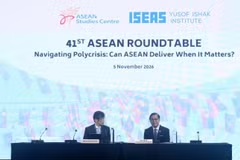
Thai Deputy Prime Minister and Minister of Foreign Affairs Sihasak Phuangketkeow (R) takes part in the Q&A session at the 41st ASEAN Roundtable. (Photo: VNA)

Thailand calls on ASEAN to proactively address polycrisis

Thai Deputy Prime Minister and Minister of Foreign Affairs Sihasak Phuangketkeow noted that no single member state could tackle challenges ranging from major-power competition and economic fragmentation to climate change and energy and food security on its own. Regional cooperation is therefore a strategic imperative, enabling ASEAN not only to overcome crises but also to sustain its development momentum.

Participants in the 22nd General Assembly of the ASEAN Confederation of Women’s Organisations pose for a group photo. (Photo: VNA)

Women play key role in building united, resilient, sustainable ASEAN Community

Hosted by the Vietnam Women’s Union (VWU), the 22nd ACWO General Assembly marked another milestone in ACWO’s cooperation and development, allowing ASEAN women’s organisations to strengthen solidarity and mutual trust, share experience and identify cooperation priorities for the region’s next stage of development.

Delegates sign an agreement admitting the Timor-Leste Women’s Network Rede Feto as ACWO’s 11th member. (Photo: VNA)

ASEAN Confederation of Women’s Organisations holds Board of Directors meeting in Hanoi

Amid ongoing regional and global changes, which bring both new opportunities and challenges for women, the role of the ASEAN Confederation of Women’s Organisations in connecting organisations and promoting collective action has become increasingly important. This requires continued innovation in its operating methods, stronger ties among members and greater promotion of women's voices and roles in building a united, resilient, inclusive and sustainable ASEAN Community.

Haze in Kuala Lumpur Airport, Malaysia (Photo: VNA)

ASEAN countries step up efforts to combat transboundary haze

ASEAN already has the ASEAN Specialised Meteorological Centre (ASMC), based in Singapore since 1993. The establishment of the ASEAN Coordinating Centre for Transboundary Haze Pollution Control is expected to complement this mechanism by strengthening cooperation among member states and improving the region's response to transboundary haze pollution.