Vietnamese incumbent and former leaders offered incense and laid wreaths at the Monument to War Heroes and Martyrs on July 27 - the National War Invalid and Martyrs Day.
The delegation included Party General Secretary Nguyen Phu Trong, former Party General Secretary Nong Duc Manh, President Truong Tan Sang, former President Tran Duc Luong, Prime Minister Nguyen Tan Dung, National Assembly Chairman Nguyen Sinh Hung, and former NA Chairman Nguyen Van An.
The leaders then paid tribute to President Ho Chi Minh at his Mausoleum.
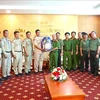
The same day, delegations from the Ministries of Defence, Public Security, and Labour, Invalids and Social Affairs, and the Hanoi People’s Committee and Party Committee, among others, also paid tribute to the heroic martyrs and President Ho Chi Minh on the occasion.
The National War Invalid and Martyrs Day is a chance for the whole nation to express gratitude to millions of people who sacrificed their youth and even their lives for the nation.
In 1947, just two years after President Ho Chi Minh delivered the declaration of independence, the first decree on preferential policies for war invalids and fallen soldiers was issued.
The same year, July 27 was designated as the national war invalids day, which was later renamed the National War Invalids and Martyrs Day, to call on the entire community to support war invalids and martyrs’ families in acknowledgement of their contributions to the nation.
Over the past 68 years, the Party and State have made great efforts to care for martyrs’ families, war invalids and revolution contributors through designing and completing preferential policies for them.
The search, gathering and repatriation of martyr remains have been enthusiastically implemented, together with the building and upgrade of martyrs’ cemeteries and monuments.-VNA
The delegation included Party General Secretary Nguyen Phu Trong, former Party General Secretary Nong Duc Manh, President Truong Tan Sang, former President Tran Duc Luong, Prime Minister Nguyen Tan Dung, National Assembly Chairman Nguyen Sinh Hung, and former NA Chairman Nguyen Van An.
The leaders then paid tribute to President Ho Chi Minh at his Mausoleum.
The same day, delegations from the Ministries of Defence, Public Security, and Labour, Invalids and Social Affairs, and the Hanoi People’s Committee and Party Committee, among others, also paid tribute to the heroic martyrs and President Ho Chi Minh on the occasion.
The National War Invalid and Martyrs Day is a chance for the whole nation to express gratitude to millions of people who sacrificed their youth and even their lives for the nation.
In 1947, just two years after President Ho Chi Minh delivered the declaration of independence, the first decree on preferential policies for war invalids and fallen soldiers was issued.
The same year, July 27 was designated as the national war invalids day, which was later renamed the National War Invalids and Martyrs Day, to call on the entire community to support war invalids and martyrs’ families in acknowledgement of their contributions to the nation.
Over the past 68 years, the Party and State have made great efforts to care for martyrs’ families, war invalids and revolution contributors through designing and completing preferential policies for them.
The search, gathering and repatriation of martyr remains have been enthusiastically implemented, together with the building and upgrade of martyrs’ cemeteries and monuments.-VNA