Less Mekong Delta fruit, higher prices

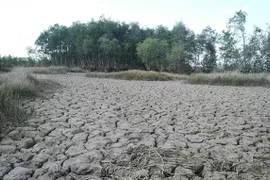
The price of fruit in the Mekong Delta has risen recently as the impact of drought and salt water intrusion has caused fruit output to decline while demand has increased.
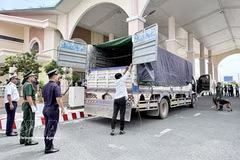
Less Mekong Delta fruit, higher prices ảnh 1Illustrative image (Source: VNA)

HCM City (VNA) - The price of fruit in the Mekong Delta has risen recently as the impact of drought and salt water intrusion has caused fruit output to decline while demand has increased.

Nguyen Van Thuc, Vice Chairman of the Hoa Loc Mango Co-operative in Tien Giang province’s Cai Be district, said his co-operative was buying Hoa Loc mango at a price of 50,000 – 60,000 VND (2.2 – 2.7 USD) a kilo, about 10,000 VND higher than the same period last year.

He said they did not have enough mangoes to export to Japan.

Similarly, the price of citrus fruits such as oranges, mandarins and grapefruit has increased significantly because of high demand and lower output.

Pham Van Lanh in Lai Vung district in Dong Thap province said at the end of last month his orchard had two tonnes of off-season sweet mandarins and a trader offered to buy them at a price of 28,000 VND a kilo.

“The price was attractive, and I agreed to sell my sweet mandarins,” he said.

However, the price of sweet mandarins rose to 30,000 VND a kilo and then to 36,000 VND a kilo a few days later, he said.

Traders now buy sweet mandarins at 36,000-40,000 VND a kilo, according to farmers.

Dang Van Nam, Director of the Ke Thanh Nam Roi Grapefruit in Soc Trang province’s Ke Sach district, said it is the off season for citrus fruits, so the yield has not been large, while the current demand for domestic consumption and exports is high.

Many grapefruit exports to Asia and Europe have halted because of the supply shortage, according to fruit enterprises in the delta.

The price of citrus fruits is expected to remain high in the coming months, they said.

Ongoing saltwater intrusion from rivers has affected fruit orchards in the delta’s coastal areas, causing many fruit trees to have their flowers and young fruits falling.

Do Van Tai, director of the Tan Thanh Fruit Co-operative in Cau Ke district’s An Phu Tan commune in Tra Vinh province, said that as of early this month, about 80 percent of 1,300ha of fruit orchards in the commune have been affected by saline intrusion.

“Besides the loss of fruits, farmers worry that their fruit trees could die in the coming time,” he said.

Ongoing drought and salination have been threatening more than 6,000 ha of green peel and pink flesh grapefruit trees in Ben Tre.

Many farmers who grow green-peel and pink-flesh grapefruits have decided to pick young grapefruit and use leaves or other materials to cover the roots of grapefruit trees in order to save them from drought and salination.

In Ben Tre province’s Cho Lach district, one of the delta’s largest fruit cultivation areas, many fruit orchards cannot bear fruit because of salination.

Bui Thanh Liem, head of the Cho Lach district Agriculture and Rural Development Bureau, said this was the first time the district’s fruit orchards had been severely affected by salination.

The bureau has set up three places to measure the salt content in water to help farmers who grow fruits and flowers, Liem said.

Every day, about 1,000 farmers take water samples to the sites to test the salt content, he said.

Officials at the three sites also offer advice on how to protect fruit orchards, including not using water with over 0.2 percent salt content to irrigate fruit trees, he said.

Tien Giang province authorities have also implemented several measures, including strictly monitoring the salt content of water and informing farmers to pump water into their ponds when there is fresh water, to protect the province’s more than 60,000 ha of fruits.

If fruit orchards are destroyed, it will take many years to recover them, according to Nguyen Thien Phap, head of the Tien Giang province Irrigation Sub-department.-VNA
VNA

See more

The MoU signing ceremony between the gency for Domestic Market Surveillance and Development and Procter & Gamble (P&G). (Photo: Ministry of Industry and Trade)

Vietnam steps up fight against counterfeits, IP violations

The renewed memorandum between Vietnam's domestic market surveillance force and Procter & Gamble (P&G) is expected to build on the results achieved since 2023, strengthen IP enforcement, safeguard the legitimate rights and interests of businesses and consumers, and contribute to a more transparent and fair business environment.

A Jatropha cultivation area of Star Japan Co., Ltd in My Son commune, Khanh Hoa province (Photo of Star Japan Co., Ltd)

Vietnam – a potential regional supply hub for Jatropha seed oil

Japan’s research on non-edible oil feedstocks showed that Jatropha is highly drought-tolerant and could grow well on wasteland, eroded sandy land and infertile soil. Given this, areas in central Vietnam, including Ninh Thuan, Binh Thuan and the Central Highlands, have climatic, sunlight and soil conditions suitable for achieving high seed yields and oil content.

Officials launch the Expo Platform on September 29. It will be officially put into use on October 20, two days before the opening of HCMC Export 2026. (Photo: VNA)

Technology opens new routes for Vietnamese exports

As global markets impose increasingly stringent requirements on standards, traceability, sustainability and green transformation, digitalising product data and bringing buyers closer to production sites can help Vietnamese businesses demonstrate their capabilities and meet market-specific requirements.

Phuong Dinh Anh, Deputy Chief of the Office of the Central Coordination Office for the National Target Programme, speaks at the event.( VNA)

Turning OCOP products into rural tourism experiences

Experts stressed that rural tourism can develop sustainably only when local communities actively participate and benefit from it. Investment in transport, accommodation and attractions must go hand in hand with clean water, waste treatment, hygiene, traditional craft preservation and environmental protection.

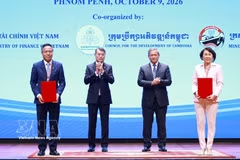
Prime Minister Le Minh Hung and his Cambodian counterpart Hun Manet witness the exchange of cooperation agreements between businesses of the two countries (Photo: VNA)

Vietnam, Cambodia look to elevate economic links

Prime Minister Le Minh Hung said that economic, trade and investment cooperation constitutes an important pillar of bilateral ties, which has achieved positive results. However, considerable room remains for further expansion to match the strong political ties and the potential of both countries.

An overview of the meeting (Photo: chinhphu.vn)

Deputy PM calls for tighter price management of essential goods

Deputy PM Thang, who is also head of the committee, urged ministries and agencies to coordinate closely to deliver effective fiscal and macroeconomic policies. The aim is to control inflation, stabilise the macroeconomy, ensure major economic balances, create room to support growth and bolster the economy’s resilience to external shocks.

 Khanh Binh International Land Border Gate in An Giang province.( Photo: VNA)

Vietnam-Cambodia trade gathers pace towards 20 billion USD target

After setting a record of more than 11.3 billion USD in 2025, bilateral trade reached about 8.7 billion USD in the first eight months of 2026, up 8.3% year on year. Vietnam is currently Cambodia’s third-largest trading partner, its second-largest source of imports and second-largest export market.

Vietnamese Ambassador to India Trinh Minh Manh discusses potential areas and strengths for cooperation between Vietnam and India’s Gujarat state. (Photo: VNA)

Vietnam, India’s Gujarat state seek to unlock cooperation potential

Vietnam attaches importance to strengthening cooperation with Indian states boasting strong economic potential, including Gujarat, to further advance the two countries’ Enhanced Comprehensive Strategic Partnership, particularly in the economy, trade and investment, said Ambassador Trinh Minh Manh.

At Nestlé Vietnam factory in Hung Yen province (Photo: VNA)

Vietnam seeks to build stronger ecosystem for FDI

The World Bank has stressed the need to connect global companies with domestic suppliers, improve the business climate and develop supply-chain finance solutions. Those steps will let domestic firms gradually meet requirements on quality, technology, costs and delivery times, and position them to become suppliers to multinational corporations.

Construction of technical infrastructure facilities serving APEC 2027 in Phu Quoc Special Zone, An Giang province. (Illustrative photo: VNA)

Vietnam enters investment grade credit rating category for first time

Vietnam has maintained robust growth, outperforming other Southeast Asian economies. Its ongoing government reforms aimed at streamlining the state apparatus, promoting the private sector, improving the institutional framework and developing capital markets will strengthen the country’s growth potential and economic resilience.