Local firms urged to exploit EU market

Vietnamese firms must draw up long-term business strategies to exploit opportunities in the European Union (EU), as the EU-Vietnam Free Trade Agreement (EVFTA) will come into force by 2018.
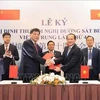
Local firms urged to exploit EU market ảnh 1Alibaba, OSB, VPBank and PTI sign an agreement to offer exporters access to the global market (Source: VNA)

Hanoi (VNA) - Vietnamese firms must draw up long-term business strategies to exploit opportunities in the European Union (EU), as the EU-Vietnam Free Trade Agreement (EVFTA) will come into force by 2018.

The EU, an open market with an integrated legal framework for all its members, can offer more export opportunities to local firms, experts told Vietnam News Agency correspondent.

In the past few years, trade between Vietnam and EU has been on a continuous rise. In the first half of this year, the total import-export turnover to EU touched 21.2 billion USD, posting a 9.05 percent year-on-year rise. Of this, Vietnam’s exports to EU were worth 16.2 billion USD and imports were 4.97 billion USD, both recording an 8.68 percent and 10.28 percent increase, respectively, from the same period last year.

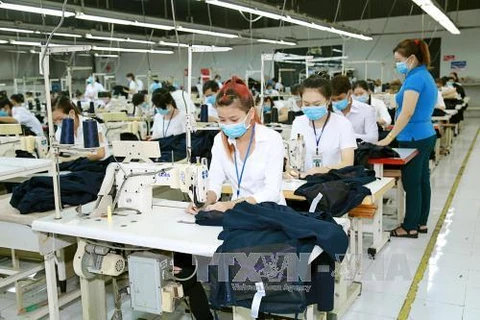
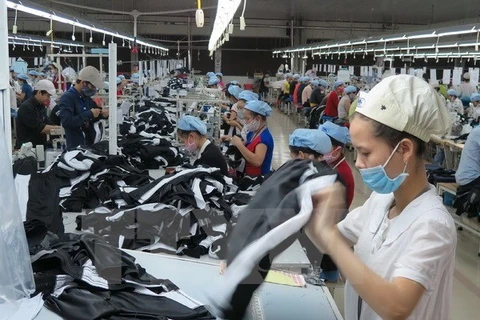
The annual growth rate of Vietnam’s export turnover to EU could be 4 to 6 percentage points higher once the EVFTA comes into effect. The trade pact can help Vietnam promote the export of key products such as garments and textiles, leather shoes and seafood to one of the most developed economic regions in the world.

Experts said Vietnamese companies had so far only been shipping raw materials, though EU had brought the biggest export turnover for the country. Made-in-Vietnam products are tough to find a place in big commercial centres in EU.

Businesses said they were concerned that their technology may not meet the requirements, so they were sticking to export raw products and letting EU firms package and label the products. This, however, means that Vietnamese products could lose their trademark if they did not register brand names and geographical location.

Dang Hoang Hai, director of the industry and trade ministry’s EU Market Department, said local businesses should know the tax cut roadmap under the EVFTA, make precise calculations for their products and draw up long-term export plans.

Bui Huy Son, Director of the ministry’s Vietnam Trade Promotion Agency (Vietrade), said the country had the ability to conquer the EU market once the EVFTA takes effect. Vietnam had two years to improve its capacity through reforms of mechanism and policies.

Truong Dinh Tuyen, former Minister of Commerce, said the EVFTA would mean greater export opportunities for Vietnamese firms as the EU market was bigger than the US and Japan in terms of marketshare and value.

However, the EU is a demanding market, and Vietnamese companies can face issues relating to assessment, retention, competition and domination of the market. Tuyen said under the World Trade Organisation principles, the importing companies have the right to initiate anti-dumping duty and impose sanitary and phytosanitary (SPS) non-tariff barriers and technical barriers to trade (TBT).

In addition, Vietnamese companies can be levied anti-dumping taxes if they focus on only one market. Domestic firms should come up with suitable policies to avoid concentrating on a certain market or a specific product.

Vietnam’s strength of offering inexpensive products may no longer be an advantage once the EVFTA commitments are applicable. Product quality and trademark will be the decisive factors in the market. It will be useful if local businesses develop items that are in low supply instead of trying to offer similar products at lower costs.

Valentin Tran, Exporting Director of Casino, said he was optimistic about Vietnam’s exports to the EU and that Vietnamese goods would benefit from zero tax. Firms should understand the market properly.

Vietnamese businesses should participate in exhibitions and fairs in the EU and visit its supermarket chains to understand consumption habits. The most important thing to promote export is to pay attention to the quality of goods and meet international standards, he said.-VNA
VNA

See more

Road leading to VSIP Can Tho at the intersection with National Highway 80 (Photo: VNA)

Green industry lures more FDI to Mekong Delta

The Mekong Delta region, having earned the monikers of the rice bowl, fruit and seafood basket of the country, and following the restructuring of administrative units, is now standing at the threshold of becoming a modern, sustainable industrial centre.

The codification of Resolution 42 into the law, effective from mid this month, is an important step, marking a key milestone in completing Vietnam’s NPL resolution process. (Photo: thoibaonganhang.vn)

Bad debt settlement fully benefits from new policy from H2 2026

Resolution 42, enacted in 2017 to pilot bad debt settlement for credit institutions, was introduced in response to a sharp rise in non-performing loans (NPLs). It empowered credit institutions to seize and liquidate collateral assets, expediting debt recovery. After more than six years of implementation, the resolution delivered certain results but expired last year.

The total retail sales of goods and consumer service revenue were estimated at 5.7 quadrillion VND for the first 10 months of the year. (Photo: VNA)

Retail sales growth remains stable over 10 months

With the current recovery momentum, the trade and services sector is expected to continue being a bright spot in Q4, driving GDP growth and ensuring a balance between domestic consumption and exports amid ongoing global economic fluctuations.

Delegates at the event (Photo: Ministry of Finance)

ASEAN meeting to drive regional cooperation, growth by removing barriers

Running from November 5–11, CCS 111 focuses on advancing service liberalisation and facilitation in ASEAN by removing barriers, enhancing transparency, reducing policy risks, and simplifying administrative procedures to enable businesses and service providers to operate more efficiently.

Goods at Hai Phong Port in northern port city of Hai Phong. (Photo: VNA)

Vietnam determined to build transparent global trade system

The Government of Vietnam on November 6 updated the World Trade Organisation (WTO)’s Committee on Rules of Origin (CRO) on adjustments to the agencies and organisations authorised to issue certificates of origin (C/O), as well as on the application of QR codes in the C/O issuance process.

SemiExpo Vietnam 2025, themed “Powering Vietnam’s Semiconductor Ambition,” brings together around 5,000 delegates and feature 200 booths from major global technology corporations (Photo: VNA)

Vietnam opens largest int’l semiconductor exhibition

SemiExpo Vietnam 2025, themed “Powering Vietnam’s Semiconductor Ambition,” brings together around 5,000 delegates and feature 200 booths from major global technology corporations such as Lam Research, Coherent, Qorvo, Amkor, GlobalFoundries, Micron, Tokyo Electron, KLA, STMicroelectronics, Soitec, and Siemens.

Consumers learn about Hanoi's OCOP products. (Photo: VNA)

Hanoi launches digital booths to promote e-commerce

Hanoi will open an online store showcasing Hanoi's products on the e-commerce platform Shopee. It will introduce digital tools such as electronic signatures, e-contracts, e-invoices, and product traceability systems for local producers and businesses participating in the booth.

Loading rice for export at a port in Vietnam (Photo: VNA)

Exports hit new records following strong momentum

Vietnamese enterprises have set records across multiple areas, demonstrating strong export momentum that not only expands trade but also reinforces Vietnam’s position in global supply chains.

Products are promoted at the event. (Photo: VNA)

Vietnam connects resources to boost innovation, sustainable development

The Vietnam Innovation Summit, an annual international forum organised by InnoLab Asia, not only discusses policy and trends but also serves as a global bridge, bringing knowledge, resources, and cooperation opportunities from advanced innovation ecosystems worldwide to Vietnam.