Logistics upgrade a must to integrate

International logistics cooperation is essential for Vietnam, especially in the context of global integration and ASEAN Economic Community.
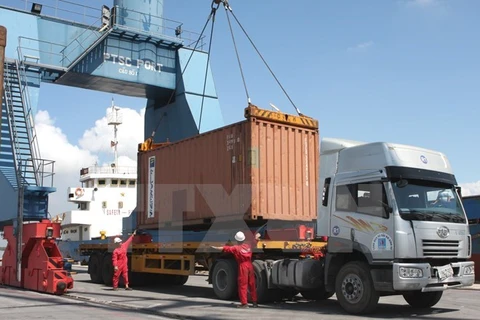
Logistics upgrade a must to integrate ảnh 1Illustrative photo (Source: vneconomy.vn)

HCM City (VNA) – International logistics cooperation is essential for Vietnam, especially in the context of global integration and ASEAN Economic Community (AEC), delegates heard at an international logistics conference held in HCM City on November 29.

"According to the World Bank's Logistics Performance Index, Vietnamese logistics ranks fourth in ASEAN and 48th in the world. The infrastructure index has improved in recent years," said Nguyen Nhat, Deputy Minister of the Ministry of Transport, at the conference.

"ASEAN logistics cooperation began in 2011, and this relationship should deepen in upcoming years so that we can take advantage of the AEC," he said.

To prepare for a more robust and competitive trade environment, the Government has been developing infrastructure for transport and logistics, including 18 national highways linked with ASEAN and a railway system connecting Laos and Cambodia. Local waterways between Thailand and Cambodia have also been improved.

"However, limited legal framework, poor human resources and weak connections among different means of transport, especially railway and sea, and unprofessional and small companies are all challenges for the logistics industry in Vietnam," he said.

To improve the situation, Nhat suggested that in the future Vietnam should deploy an infrastructure network for multi-modal transport, build an entrepot system at international ports, establish big multi-modal transport corporations and strengthen administrative reform to promote commodities circulation.

Speaking at the conference, Alvin Chua, Chairman of the ASEAN Federation of Forwarders Association (AFFA), presented an ASEAN master plan for achieving overall ASEAN Connectivity through enhanced physical infrastructure development (physical connectivity); effective institutions, mechanisms and processes (institutional connectivity); and empowered people (people-to-people connectivity).

"ASEAN governments must also address non-tariff barriers to facilitate intra-ASEAN trade and investment along with harmonising standards and achieving conformity of assessment procedures," he said.

In the future, the ASEAN master plan will need to upgrade existing infrastructure, build new infrastructure and logistics facilities and harmonise the regulatory framework as well as nurture an innovative culture.

"Vietnam must pro-actively participate in acceleration of AEC 2015 Integration into the ASEAN Economy," Stanley Lim, Chairman of the Singapore Logistics Association, said.

He suggested that ASEAN governments must concentrate on four key pillars: a single market, as trade barriers among nations fall to a minimum; a competitive economic region, fostering a culture of fair competition; equitable economic development by assisting the growth of SMEs, the backbone of ASEAN's economy; and deep integration into the global economy by deleting trade barriers.

"ASEAN logistics will support trade with efficient movement of goods with professionally skilled labour by efficient cross-border of goods through trade facilitation; a single window for speedy customs clearance; human resource development through training in competence logistics skill sets; and connectivity with multi-modal transport," he added.

According to the ministry of Industry and Trade's master plan for logistics, by 2020, the industry will contribute 10 percent to GDP at a growth of 25 percent each year and by 2030 the figure will be 15 percent and 35 percent, respectively.

"The master plan targets to reduce logistics costs by 0.5 – 1 percent of GDP every year, equivalent to 1-3 billion USD, with investment in logistics to grow by 25-30 percent annually and create jobs for 4-5 percent of the population," said Tran Chi Dung, Deputy Director of the Vietnam Logistics Institute.

The conference was organised by the Vietnam Logistics Association with participation of ASEAN top logistics experts from 10 nations, government officials and 150 local companies involved in import, export, logistics, forwarding, transport, airlines, ships, sea ports, insurance and consultancy.-VNA

VNA

See more

At the Vietnam- Myanmar Business Forum in Hanoi on September 6 (Photo: VNA)

Myanmar President pledges to facilitate Vietnamese investment

Myanmar calls for Vietnam's cooperation in digital infrastructure development, cybersecurity, digital transformation, public services, information technology, and digital payment systems, as well as in fostering an innovation-driven business environment.

Using AI to search and process legal information (Photo: VNA)

Legal profession reshaped in age of artificial intelligence

In Ho Chi Minh City, digital transformation in the legal profession is not simply about introducing more technology into professional practice. It must also create ways of working that ensure technology serves people, while lawyers retain control and responsibility for the quality of legal services. This is particularly important in a metropolis with a large-scale economy and diverse legal needs.

Activities in Chan May Bay, part of the Chan May–Lang Co Economic Zone in Hue city. (Photo: VNA)

Hue steps up investment drive in Chan May–Lang Co Economic Zone

Covering more than 27,000ha, the Chan May–Lang Co Economic Zone is emerging as a key economic, urban, industrial and eco-tourism centre in southeastern Hue, with functional areas dedicated to seaports, industry, non-tariff activities, urban development and tourism.

The Ministry of National Defence's inter-agency inspection team visits La Gi Fish Port in Phuoc Hoi ward, Lam Dong province. (Photo: VNA)

Lam Dong's IUU fishing prevention efforts inspected

According to the Lam Dong provincial IUU Fishing Prevention Steering Committee, all 8,177 fishing vessels measuring at least 6 metres in length have been registered and updated in the national fisheries database VNFishbase.

A member of Minh Quang Cooperative in Hung Yen province works on a farm. (Photo: VNA)

Vietnam aims to link half of farm cooperatives with enterprises by 2030

The Ministry of Agriculture and Environment will promote links between cooperatives, enterprises, science and technology organisations and other economic entities along with carrying out programmes to develop concentrated agricultural, forestry and fisheries raw material areas and enhance value chain production.

The night-time economy is increasingly seen as an important avenue for Vietnam’s tourism sector to extend visitors’ stays (Photo: VNA)

Revitalising growth momentum for night-time economy

The night-time economy has moved beyond being merely an add-on service to become a new growth driver for tourism. Night-time activities can “awaken” familiar heritage spaces and breathe new life into them. Art, light and music experiences after dark can create distinctive attractions while meeting the desire of middle- and high-end visitors to explore cultural depth.

A livestream session promotes green-skinned pomelos grown in Cho Lach commune, Vinh Long province. (Photo: VNA)

E-commerce reshapes rules of game

Once fixed fees, payment fees, infrastructure charges and service packages are included, sellers may have to spend around 24.5-27.6% of their revenue on platforms. The figure shows that the era of easy selling and low costs in e-commerce has officially come to an end.

Ho Chi Minh City targets third-quarter growth of over 11% (Photo: VNA)

Ho Chi Minh City targets third-quarter growth of over 11%

Ho Chi Minh City will continue to implement drastic measures to achieve double-digit growth, targeting GRDP growth of at least 11.07% in the third quarter of 2026, 9.43% in the first nine months and 12.3% in the fourth quarter, with a view to completing the full-year goal of 10% or more.

MM Mega Market An Phu supermarket in Ho Chi Minh City is brightly decorated for the National Day holiday. (Photo: VNA)

Domestic consumption up over 13%, tourism continues strong growth

The total retail sales of goods and consumer service revenues in August were estimated at 679.8 trillion VND (26 billion USD), up 1.6% from the previous month and 14.9% year-on-year. In the January-August period, the figure reached 5.24 quadrillion VND, representing a 13.3% increase year-on-year.

A production line of Onaga Co., Ltd. (Japan) at HANSSIP (Photo: nhandan.vn)

Hanoi moves to maintain appeal to FDI inflows

In the first eight months of 2026, the capital city attracted more than 3.7 billion USD in FDI, equivalent to 83% of the plan set for the year. Newly registered FDI exceeded 572 million USD across 450 projects, up 175.78% in project numbers and 209.46% in capital compared to the same period last year. Additional registered capital topped 492 million USD, while capital contributions and share purchases exceeded 2.6 billion USD.

Saigon Marina IFC is the first private-sector project contributing to realising the goal of developing the Vietnam International Financial Centre in Ho Chi Minh City. (Photo: VNA)

VIFC offers various opportunities to attract forein investment

Turning the VIFC into an effective channel for international capital will require clear rules, quality projects and strong connections between investors and domestic businesses. Meeting these requirements will be key to transforming investor interest into concrete capital flows and investment projects in Vietnam.