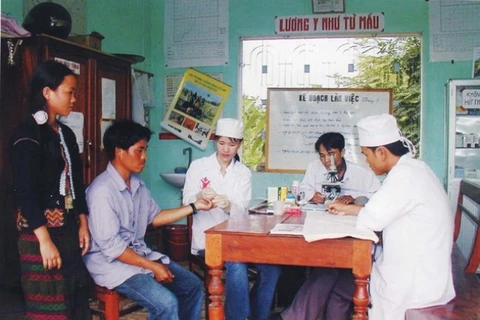
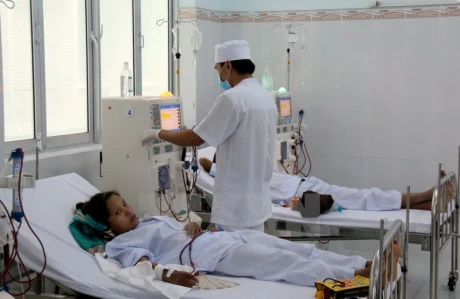
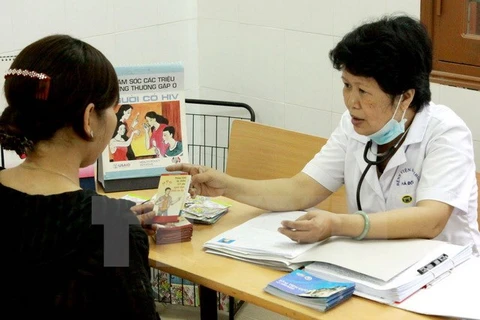
Illustration (Photo: VNA)
 Hanoi (VNA) - Only 3 percent of doctors in local health facilities correctly diagnose the five most common diseases in Vietnam, a recent study reveals.
The findings stem from interviews and observation of 1,000 doctors working at 78 district-level hospitals and 246 communal health stations. The Health Strategy and Policy Institute (HSPI) under the Ministry of Health, which led the 2015 research, randomly surveyed the doctors across six cities and provinces representative of different regions of the country.
The one-year study, the first of its kind in Vietnam striving to evaluate the quality of healthcare staff in local facilities, showed that only three percent of doctors managed to diagnose children’s diarrhea and pneumonia, tuberculosis, diabetes type 2 and hypertension.
The rate, however, rocketed to 36 and 48 percent, respectively, for doctors who correctly diagnosed three and four of the five diseases. There were still 11 percent who could only diagnose two diseases and two percent for one disease.
The researchers did not explain the low rate of diagnosis but their findings nonetheless indicate some of the problems involved.
They found that on average, doctors in local health facilities fail to ask about half the questions necessary to diagnose an illness. For example, they only asked patients three out of eight questions needed to diagnose hypertension and diabetes, five of 13 for tuberculosis, five of 11 for diarrhea and one-third of the questions to correctly identify pneumonia.
Doctors also only performed about half the necessary examinations.
“A patient with pneumonia is only asked whether he coughs, but is often not asked about phlegm or breathing troubles,” said HSPI head Khuong Anh Tuan.
Tuan also warned about inappropriate prescriptions resulting from this diagnosis failure.
“Nearly 48 percent of doctors prescribed incorrectly for children with pneumonia,” he said.
Some doctors also prescribed “harmful medicine”, according to the research, which showed that some 70 percent of doctors decided to give corticosteroidal medicine for pneumonia to children and approximately 34 and 47 percent to treat patients with hypertension and diabetes.
Former head of the Bach Mai Hospital Pediatrics Department, Dr Nguyen Tien Dung, said corticosteroids are effective but have many side effects and "should be restricted”.
“Corticosteroidal medicine gradually breaks down the children’s immune system while frequently causing osteoporosis or rickets in the children,” Dung said.
Deputy Minister of Health, Pham Le Tuan, acknowledged that the research clearly reflects the quality of local health facilities.
“It was easy to see that the healthcare services of local facilities are limited, resulting in a mass influx of patients to central-level hospitals in big cities due to doubts over their local health providers,” he said.
This, in turn, overloads big hospitals and the Ministry of Health is still struggling to resolve the problem, which many believe means improving the quality of local healthcare.
Earlier this month, Prime Minister Nguyen Xuan Phuc approved a master plan for developing a strong local-level healthcare system toward 2025, which will monitor the health of all residents where they live.
But the ambitious plan will take time to yield results. In the meantime, people will often have to travel dozens of kilometres to get proper treatment. – VNA
The findings stem from interviews and observation of 1,000 doctors working at 78 district-level hospitals and 246 communal health stations. The Health Strategy and Policy Institute (HSPI) under the Ministry of Health, which led the 2015 research, randomly surveyed the doctors across six cities and provinces representative of different regions of the country.
The one-year study, the first of its kind in Vietnam striving to evaluate the quality of healthcare staff in local facilities, showed that only three percent of doctors managed to diagnose children’s diarrhea and pneumonia, tuberculosis, diabetes type 2 and hypertension.
The rate, however, rocketed to 36 and 48 percent, respectively, for doctors who correctly diagnosed three and four of the five diseases. There were still 11 percent who could only diagnose two diseases and two percent for one disease.
The researchers did not explain the low rate of diagnosis but their findings nonetheless indicate some of the problems involved.
They found that on average, doctors in local health facilities fail to ask about half the questions necessary to diagnose an illness. For example, they only asked patients three out of eight questions needed to diagnose hypertension and diabetes, five of 13 for tuberculosis, five of 11 for diarrhea and one-third of the questions to correctly identify pneumonia.
Doctors also only performed about half the necessary examinations.
“A patient with pneumonia is only asked whether he coughs, but is often not asked about phlegm or breathing troubles,” said HSPI head Khuong Anh Tuan.
Tuan also warned about inappropriate prescriptions resulting from this diagnosis failure.
“Nearly 48 percent of doctors prescribed incorrectly for children with pneumonia,” he said.
Some doctors also prescribed “harmful medicine”, according to the research, which showed that some 70 percent of doctors decided to give corticosteroidal medicine for pneumonia to children and approximately 34 and 47 percent to treat patients with hypertension and diabetes.
Former head of the Bach Mai Hospital Pediatrics Department, Dr Nguyen Tien Dung, said corticosteroids are effective but have many side effects and "should be restricted”.
“Corticosteroidal medicine gradually breaks down the children’s immune system while frequently causing osteoporosis or rickets in the children,” Dung said.
Deputy Minister of Health, Pham Le Tuan, acknowledged that the research clearly reflects the quality of local health facilities.
“It was easy to see that the healthcare services of local facilities are limited, resulting in a mass influx of patients to central-level hospitals in big cities due to doubts over their local health providers,” he said.
This, in turn, overloads big hospitals and the Ministry of Health is still struggling to resolve the problem, which many believe means improving the quality of local healthcare.
Earlier this month, Prime Minister Nguyen Xuan Phuc approved a master plan for developing a strong local-level healthcare system toward 2025, which will monitor the health of all residents where they live.
But the ambitious plan will take time to yield results. In the meantime, people will often have to travel dozens of kilometres to get proper treatment. – VNA
VNA