Many countries welcome TPP deal completion

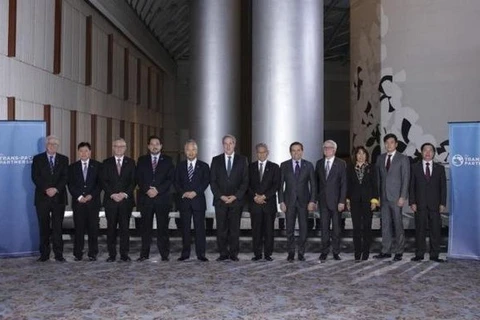
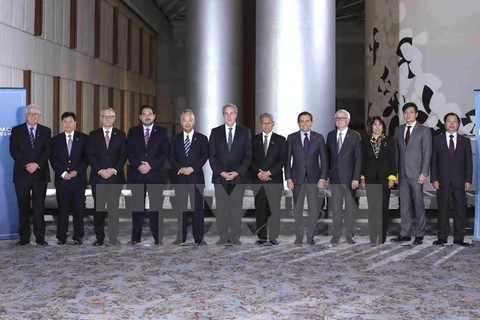
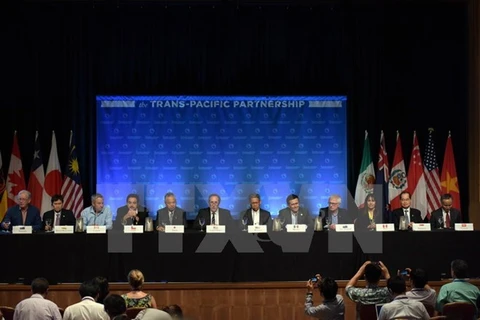
The completion of the historic Trans-Pacific Partnership agreement on October 5 has received positive response from many countries.
Many countries welcome TPP deal completion ảnh 1Canadian Prime Minister Stephen Harper at a press conference on the TPP in Ottawa on October 5 (Photo: Reuters/VNA)

The completion of the historic Trans-Pacific Partnership agreement on October 5 has received positive response from many countries.

Canadian Prime Minister Stephen Harper said in a speech in Ottawa immediately after the TPP’s signing that all industries and localities of Canada will benefit from the deal, which he described as the biggest trade agreement in history.

The PM also pledged compensation worth 4.3 billion CAD (3.3 billion USD) for farmers who will be affected by the TPP, which requires that Canada opens its market for dairy, egg, chicken, beef, pork, lamb, seafood, log and industrial goods within five years from the time the deal begins to take effect.

The PM affirmed that his Conservative Party will push forward with the implementation of the TPP if they win in the upcoming elections.

The same day, the opposition Liberal Party of Canada, the Canadian Chamber of Commerce, the Canadian Council of Chief Executives and many big economic groups in Canada also welcomed the completion of the TPP.

Blackberry CEO John Chen said the TPP will remove trade barriers and allow Canadian businesses to compete based on product and service quality.

The same day, Mexican Economic Secretary Guajardo Villarreal said the TPP will open up new business opportunities for Mexico in sectors related to the six Asian-Pacific markets which are Australia, Brunei, Malaysia, New Zealand, Singapore and Vietnam, which are predicted to enjoy high economic growth in the next 25 years.

He also said the deal will be a model for later trade agreements, adding that Mexico has been able to achieve a balance between national interests and the benefits of so-called sensitive sectors such as automobile and parts, garment and textile and agricultural products.

With the TPP, Mexico will strengthen its foothold in Chile and Peru, its two priority trade partners in Latin America, while expanding its trade ties with Japan, the minister said, citing the ministry’s figures that the 11 other TPP partners account for 72 percent of Mexico’s trade and 55 percent of foreign direct investment flow into the country.

Chilean Foreign Minister Heraldo Muñoz also said Chile will benefit from the TPP.

Speaking from Valparaíso City, the minister hailed the TPP as a global trade deal, which surpasses the Doha negotiation.

He, however, noted that the deal will have to go through the parliament, with one of the most thorny issues being Chile’s biological and pharmaceutical products.

The TPP brings together 12 countries, which are Australia, Brunei, Canada, Chile, Japan, Malaysia, Mexico, New Zealand, Peru, Singapore, the US and Vietnam.

After the signing, the document must receive approval from member countries’ governments and parliaments before taking effect.

Once realized, the TPP will become a free trade region of 800-million people, accounting for 30 percent of global trade and about 40 percent of the world’s economy.-VNA
VNA

See more

Ahmad Haikal Hasan, Head of the Halal Product Assurance Organising Agency (BPJPH) of Indonesia, speaks at the seminar (Photo: VNA)

Indonesia ready to cooperate with Vietnam in halal sector

Ahmad Haikal Hasan, Head of the Halal Product Assurance Organising Agency (BPJPH) of Indonesia, described Vietnam as a “potential supplier” of halal products with the capacity to play a larger role in the market, particularly in the fast-moving consumer goods (FMCG) sector. He revealed a plan to visit Vietnam next week to discuss the country’s progress in the global halal industry.

Delegates perform the opening ceremony. (Photo: VNA)

Thailand Week 2026 opens in Hanoi

The event brings together more than 100 companies, including Thai enterprises and Vietnamese importers, across about 120 booths. It features a wide range of Thai products aligned with consumer trends in Vietnam, including food and beverages, health and beauty, mother-and-baby and pet products, fashion and jewellery, household goods and tourism services.

Illustrative image (Photo: VNA)

Vietnam remains Singapore’s third-largest seafood supplier in 2025

Data released by the Accounting and Corporate Regulatory Authority of Singapore (ACRA) show that Singapore spent 125.5 million SGD (97.7 million USD) importing seafood from Vietnam last year, up 10.7% year on year, accounting for 10.3% of the city-state’s total seafood import market.

Workers assemble mobile phone components at Diem Thuy Industrial Park in the northern province of Thai Nguyen. (Photo: VNA)

Electronics exports surpass 107 billion USD in 2025

With an export turnover of 107.75 billion USD in 2025, computers, electronic products and components not only maintained their position as Vietnam’s largest export by value, but also contributed more than half of the overall increase in the country’s export turnover in 2025.

Experts said that Vietnam’s economic outlook continues to be underpinned by stable foreign direct investment inflows and public investment, which is playing an important role in driving growth. (Photo: thoibaotaichinh.vn)

Foreign investors maintain strong confidence in Vietnam’s market

Looking ahead to 2026, prospects remain bright as manufacturing, economic growth and foreign investment in Vietnam are expected to stay robust, with the country forecast to post the highest growth rate in the region this year, according to Adam Sitkoff, Executive Director of the American Chamber of Commerce (AmCham) in Vietnam.

Toy production at a Hong Kong-invested factory (Photo: VNA)

Vietnam targets deeper market penetration in Hong Kong in 2026

Vietnam-Hong Kong trade hit 62.3 billion USD in the first 11 months of 2025, soaring 73.1% annually. Vietnamese exports to Hong Kong amounted to 36.8 billion USD, a 90.6% hike, ranking fourth among Hong Kong’s import sources, while imports from Hong Kong stood at 25.5 billion USD, up 52.9% and ranking third.

Vietnam’s start-up market enters restructuring phase

Vietnam’s start-up market enters restructuring phase

In 2026, venture capital inflows into Vietnam’s start-up ecosystem are expected to recover gradually, though in a more selective manner. VinVentures forecasts that capital will focus on start-ups that have survived the rigorous screening of 2024–2025, possess clear business models, strong commercialisation capacity, and the ability to generate real cash flows.