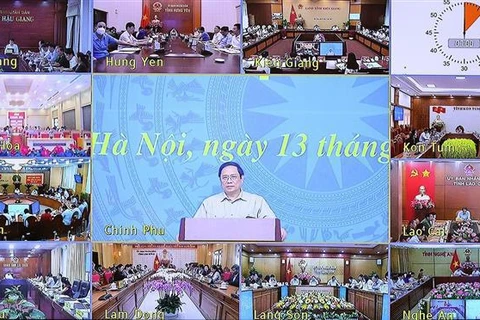
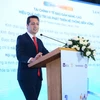
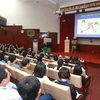
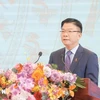
Prime Minister Pham Minh Chinh addresses the meeting (Photo: VNA)
 Chairing the 17th meeting of the National Steering Committee for COVID-19 Prevention and Control which drew the online participation of representatives from 63 cities and provinces nationwide, the Government leader requested ministries, sectors and localities to review the COVID-19 prevention and control regulations to find out and remove obstacles in the work, while enhancing the sense of responsibility of officials in the bidding and procurement.
PM Chinh, head of the committee, highlighted achievements in pandemic control as well as good socio-economic recovery and development, with Vietnam ranked second in the world in post-pandemic recovery by Nikkei.
He underlined the need to continue efforts to protect the lives of the people with the principle of flexibly adapting to and effectively controlling the pandemic.
The Ministry of Health was asked to direct and guide localities to improve the local healthcare capacity and preventive medicine efficiency, while the Ministry of Education and Training was requested to coordinate with the health sector to ensure safety of schools and complete the vaccination of the children.
Meanwhile, the Ministry of Labour, Invalids and Social Affairs was asked to review those eligible for support policies, especially disadvantaged people and children orphaned by the pandemic.
At the same time, the Ministry of Culture, Sports and Tourism was reminded to strengthen tourism promotion and consider the expansion of the policy related to visa to boost tourism development.
PM Chinh also stressed the need to continue increasing communications on the Party and State policies and directions on pandemic prevention and control and encourage people to get vaccinated.
He underlined the need to continue efforts to protect the lives of the people with the principle of flexibly adapting to and effectively controlling the pandemic.
The Ministry of Health was asked to direct and guide localities to improve the local healthcare capacity and preventive medicine efficiency, while the Ministry of Education and Training was requested to coordinate with the health sector to ensure safety of schools and complete the vaccination of the children.
Meanwhile, the Ministry of Labour, Invalids and Social Affairs was asked to review those eligible for support policies, especially disadvantaged people and children orphaned by the pandemic.
At the same time, the Ministry of Culture, Sports and Tourism was reminded to strengthen tourism promotion and consider the expansion of the policy related to visa to boost tourism development.
PM Chinh also stressed the need to continue increasing communications on the Party and State policies and directions on pandemic prevention and control and encourage people to get vaccinated.
A report from the committee showed that as of September 11, Vietnam had seen over 11.4 million COVID-19 infections, including 10.3 million recoveries and 43,000 deaths.
In August, 72,324 cases were reported, 2.4 times that in July, with 24 deaths. Particularly, in one week from September 5-11, the country recorded about 2,900 cases each day, reflecting a rising trend in the case number, according to the committee.
Meanwhile, as of September 11, 258.7 million COVID-19 vaccine doses had been injected, with about 100% people aging from 12 years old receiving at least one or two doses, 77% of adults getting three.
To date, more than 85.74 trillion VND (3.64 billion USD) has been disbursed as aid for more than 859,740 employers and nearly 55.1 million employees and other people facing difficulties due to the pandemic./.
In August, 72,324 cases were reported, 2.4 times that in July, with 24 deaths. Particularly, in one week from September 5-11, the country recorded about 2,900 cases each day, reflecting a rising trend in the case number, according to the committee.
Meanwhile, as of September 11, 258.7 million COVID-19 vaccine doses had been injected, with about 100% people aging from 12 years old receiving at least one or two doses, 77% of adults getting three.
To date, more than 85.74 trillion VND (3.64 billion USD) has been disbursed as aid for more than 859,740 employers and nearly 55.1 million employees and other people facing difficulties due to the pandemic./.
VNA