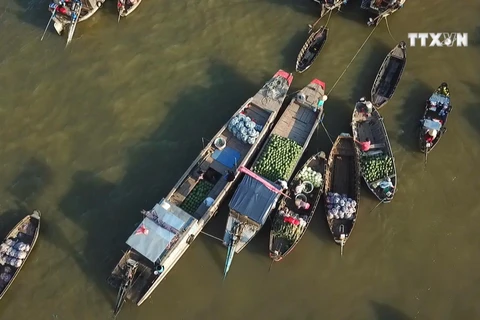
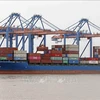
The situation of being stuck in ports and overloading at some key ports in the South East region takes place regularly, creating conditions for shipping enterprises to increase service charges. (Photo: VNA)
 Hanoi (VNS/VNA) - A trade representative has called for the construction of more deep-water ports in the Mekong River Delta to save money and time for seafood exporters.
Nguyen Hoai Nam, Deputy General Secretary of the Vietnam Association of Seafood Exporters and Producers (VASEP), said the move would allow firms to directly export their goods.
Most of the Mekong Delta's export turnover is made up of rice and processed seafood products. Every year, the region's transportation demand for export goods is about 17-18 million tonnes. However, 70 percent of export products have to be transferred to major ports in HCM City and Cai Mep port (Ba Ria - Vung Tau province), increasing transportation by 10-40 percent depending on the route.
This situation leads to frequent overloads on the connecting routes from HCM City to Mekong Delta provinces. In addition, transport service quality is poor, costs are high and there is a lack of links between different modes of transport.
As one of the largest frozen shrimp exporters in the world, Minh Phu Seafood Joint Stock Company annually exports about 6,700-7,000 shrimp containers with a turnover of 750 - 850 million USD.
Chu Van An, Deputy General Director of Minh Phu Seafood, said if there was a more suitable logistics service, goods could be exported directly from the Mekong Delta and businesses could save 30-40 percent of their costs, which would increase the competitiveness of agricultural products.
Focused investment in regional transport infrastructure would help tackle the problem, with waterways investment the best option due to the area's terrain.
A representative of Ca Mau province's Transport Department urged prioritising investment in inland waterways that are connected with road traffic to enhance transport capacity throughout the region, and to exploit the waterway system linking HCM City with other provinces and cities in the region.
The Ministry of Transport said that it will study and implement a dredging project and renovate Khai Doc Phu Hien canal connecting the Tien and Hau rivers to shorten the transport distance between Can Tho port and the seaport in the southeast.
The ministry also plans to upgrade inland waterway routes such as HCM City to Kien Luong and HCM City to Ca Mau. It will also focus on improving the transportation infrastructure system, reducing congestion on main waterways and cutting the cost of transporting goods from manufacturers to consumers, Minister of Transport Nguyen Van The said.
According to Nam, there is a lack of seaports in the delta, especially deep-water ports capable of handling export container ships.
Meanwhile, goods being stuck at ports and overloads at some key ports in the southeast region occur regularly, allowing shipping enterprises to increase service charges and wasting businesses' warehouse costs and time.
An Giang province is a big exporter and processor of seafood, but difficulties in transport infrastructure have affected the development of enterprises.
As a unit specialising in raising and processing tra fish and basa fish for export, Nguyen Anh Thu, Deputy General Director of An My Fish Joint Stock Company, said the province's transport system lacks synchronisation. This has caused difficulties and increased costs for businesses as goods cannot be transported by container trucks but must be carried by small trucks.
It is forecast that the transportation demand for the region's rice by 2020 will be about 10.2 million tonnes and aquaculture output will be about 2.42 million tonnes.
This shows the logistics market of the Mekong Delta has potential to develop and attract investors, according to Nguyen Minh Toai, Director of Can Tho city’s Department of Industry and Trade.
He said developing logistics services and building a regional level logistics centre was an urgent need.
To meet demand for import and export of regional goods, the Ministry of Transport asks the Prime Minister for approval to adjust planning for Soc Trang and Tran De seaports to seek investment and form a gateway seaport to receive vessels of up to 100,000 tonnes.
Besides, the ministry proposed the Government and the National Assembly approve the allocation of capital to upgrade the second phase of Cho Gao canal and complete investment procedures for the southern region waterways and transport logistics corridor project with loans from the World Bank.-VNS/VNA
Nguyen Hoai Nam, Deputy General Secretary of the Vietnam Association of Seafood Exporters and Producers (VASEP), said the move would allow firms to directly export their goods.
Most of the Mekong Delta's export turnover is made up of rice and processed seafood products. Every year, the region's transportation demand for export goods is about 17-18 million tonnes. However, 70 percent of export products have to be transferred to major ports in HCM City and Cai Mep port (Ba Ria - Vung Tau province), increasing transportation by 10-40 percent depending on the route.
This situation leads to frequent overloads on the connecting routes from HCM City to Mekong Delta provinces. In addition, transport service quality is poor, costs are high and there is a lack of links between different modes of transport.
As one of the largest frozen shrimp exporters in the world, Minh Phu Seafood Joint Stock Company annually exports about 6,700-7,000 shrimp containers with a turnover of 750 - 850 million USD.
Chu Van An, Deputy General Director of Minh Phu Seafood, said if there was a more suitable logistics service, goods could be exported directly from the Mekong Delta and businesses could save 30-40 percent of their costs, which would increase the competitiveness of agricultural products.
Focused investment in regional transport infrastructure would help tackle the problem, with waterways investment the best option due to the area's terrain.
A representative of Ca Mau province's Transport Department urged prioritising investment in inland waterways that are connected with road traffic to enhance transport capacity throughout the region, and to exploit the waterway system linking HCM City with other provinces and cities in the region.
The Ministry of Transport said that it will study and implement a dredging project and renovate Khai Doc Phu Hien canal connecting the Tien and Hau rivers to shorten the transport distance between Can Tho port and the seaport in the southeast.
The ministry also plans to upgrade inland waterway routes such as HCM City to Kien Luong and HCM City to Ca Mau. It will also focus on improving the transportation infrastructure system, reducing congestion on main waterways and cutting the cost of transporting goods from manufacturers to consumers, Minister of Transport Nguyen Van The said.
According to Nam, there is a lack of seaports in the delta, especially deep-water ports capable of handling export container ships.
Meanwhile, goods being stuck at ports and overloads at some key ports in the southeast region occur regularly, allowing shipping enterprises to increase service charges and wasting businesses' warehouse costs and time.
An Giang province is a big exporter and processor of seafood, but difficulties in transport infrastructure have affected the development of enterprises.
As a unit specialising in raising and processing tra fish and basa fish for export, Nguyen Anh Thu, Deputy General Director of An My Fish Joint Stock Company, said the province's transport system lacks synchronisation. This has caused difficulties and increased costs for businesses as goods cannot be transported by container trucks but must be carried by small trucks.
It is forecast that the transportation demand for the region's rice by 2020 will be about 10.2 million tonnes and aquaculture output will be about 2.42 million tonnes.
This shows the logistics market of the Mekong Delta has potential to develop and attract investors, according to Nguyen Minh Toai, Director of Can Tho city’s Department of Industry and Trade.
He said developing logistics services and building a regional level logistics centre was an urgent need.
To meet demand for import and export of regional goods, the Ministry of Transport asks the Prime Minister for approval to adjust planning for Soc Trang and Tran De seaports to seek investment and form a gateway seaport to receive vessels of up to 100,000 tonnes.
Besides, the ministry proposed the Government and the National Assembly approve the allocation of capital to upgrade the second phase of Cho Gao canal and complete investment procedures for the southern region waterways and transport logistics corridor project with loans from the World Bank.-VNS/VNA
VNA