Mekong Delta works to advance renewable energy development

Many localities in the Mekong Delta region are focusing on attracting investment and developing renewable energy projects, helping to solve energy security issues and driving socio-economic breakthroughs in the region.
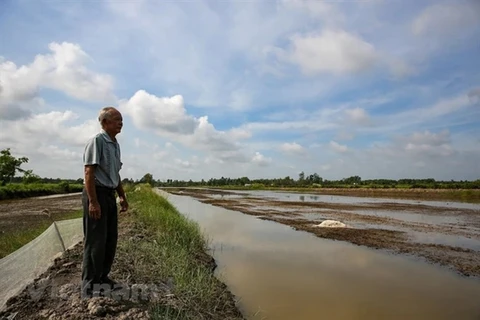
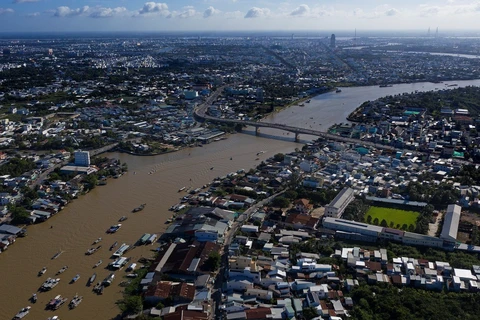
Mekong Delta works to advance renewable energy development ảnh 1With a coastline stretching about 700 km, the potential for offshore wind energy exploitation across the Mekong Delta can reach between 1,200 MW and 1,500 MW. (Photo: VNA)

HCM City (VNA) - Many localities in the Mekong Delta region are focusing on attracting investment and developing renewable energy projects, helping to solve energy security issues and driving socio-economic breakthroughs in the region.

Energy transition is an indispensable factor for achieving sustainable development and adapting to climate change in Vietnam in general and the region in particular.

Minister of Industry and Trade Nguyen Hong Dien assessed the energy industry as a spearhead for the development of the region. However, given its characteristics as a young delta susceptible to climate change, the industry must focus on clean and renewable energy sources.

Assoc. Prof. Dr. Nguyen Dinh Tho, Director of the Institute of Strategy and Policy on Natural Resources and Environment, also held that the Mekong Delta has the advantage of developing renewable energy, making it a key area for Vietnam to achieve net-zero emissions by 2050 as pledged by the Prime Minister at the 26th United Nations Climate Change Conference of the Parties (COP26).

With a coastline stretching about 700 km, a vast exclusive economic zone of up to 360,000 km2 and strong coastal winds, the potential for offshore wind energy exploitation across the delta can reach between 1,200 MW and 1,500 MW.

The German Agency for International Cooperation (GIZ) reported that the entire region annually receives an average of 2,200 to 2,500 hours of sunshine. More than 90% of the total days in a year see the delta receiving sufficient sunlight to operate solar energy panels, with average radiation ranging from 1,387 to 1,534 kWh/kWp/year.

With these advantages, the total potential capacity of solar power in the entire region could hit 136,275 MW, generating an estimated electricity output of over 216 billion kWh per year. Furthermore, the region can also exploit the potential of tidal energy and abundant biomass energy from its agricultural by-products of over 23 million tonnes per year, which have yet to be fully tapped.

To sustainably develop renewable and clean energy in the region, Dien said that the ministry will continue to lead and coordinate with relevant ministries, sectors, and localities to build the amended electricity law and the renewable energy law for submission to the National Assembly this year. It will also propose the Government issue policies on direct electricity trading.

Moreover, in the Mekong Delta, competent ministries and sectors are also implementing solutions and investing in infrastructure and research of domestic and regional links to serve the import of natural gas and LNG to ensure the supply for power plants in Ca Mau province./.

VNA

See more

Workers at the VSIP Hai Phong industrial and urban complex, which specialises in producing electronic components for office equipment. (Photo: VNA)

Roadmap aims to improve business climate and boost competitiveness

By the end of 2026, Vietnam aims to rank among the world’s top 50 performers in the United Nations Sustainable Development Goals, advance at least three places in the International Property Rights Index, and climb at least one position in the Global Innovation Index.

Vietnam is strengthening its position in the technology value chain, becoming a major manufacturing hub for complete consumer electronics products. (Photo: VNA)

ESG standards offer opportunities to reposition Vietnam’s electronics firms

The 2025-2027 period will be a critical turning point, as exporters to the European market will be required to strictly comply with ESG standards, including net-zero emissions roadmaps, labour standards, corporate governance and transparency requirements. As a key export sector, the electronics industry is being directly and strongly affected by this shift.

A production line for camera modules and electronic components at the factory of MCNEX VINA Co. Ltd, a Republic of Korean-invested company in Phuc Son Industrial Park, Ninh Binh province. (Photo: VNA)

Science, technology, innovation as engines of economic growth

To ensure that science and technology truly act as a powerful growth engine, experts emphasised the need for the Government to put in place supportive mechanisms and policies that encourage enterprises to invest in research and development, while strengthening cooperation among the State, research institutions and the business sector.

The headquarters of the Ministry of Industry and Trade in Hanoi (Photo: VNA)

PM updates lead roles to drive UKVFTA forward

The Ministry of Industry and Trade (MoIT) is named the lead agency, with overall responsibility for the agreement’s general goals and definitions, trade remedies, non-tariff barriers to trade and investment in renewable energy, competition policies, State-owned enterprises, enterprises with special or exclusive rights and those with designated monopolies, as well as institutional, general and final terms.

Vietravel Airlines is taking measures to enhance service quality and optimise operations amid high travel demand during Tet. (Photo: VNA)

Vietravel Airlines to add new route serving Lunar New Year travel peak

During the peak period of the Lunar New Year (Tet) festival in 2026, Vietravel Airlines plans to operate six – eight flights daily on the Ho Chi Minh City – Hanoi route, three flights daily on the Ho Chi Minh City – Da Nang and Ho Chi Minh City – Vinh routes; and two flights daily on the Ho Chi Minh City – Quy Nhon route.

The completion of Can Tho - Ca Mau expressway has helped shorten travel time from Can Tho to Ca Mau to just one hour and a half (Photo: VNA)

Can Tho–Ca Mau expressway fully opens from January 19

The new section, together with the Can Tho–Hau Giang segment that has been operating smoothly since late December last year, has completed the entire 110.85-km route. With total investment exceeding 27.52 trillion VND (1.04 billion USD), the four-lane expressway is built to modern standards and serves as a key transport artery linking major economic and political centres, industrial zones and seaports in the southwestern region.