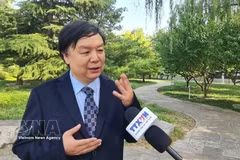
There cannot be and there has never been an apolitical military,affirmed Major General Nguyen Ba Duong from the Institute for MilitarySocial Sciences and Humanities under the Ministry of National Defence.
Ina recent article, Assoc. PhD. Dr. Duong clarified the nature of theviewpoint on “apolitical military” and confirmed that the absolute,direct and comprehensive leadership of the Communist Party of Vietnam(CPV) over the Vietnam People’s Army (VPA) is the decisive factor forall of the VPA’s successes.
Duong noted that theconcept of “apolitical military” has appeared a long time ago with theaim of separating the army from the leadership of the Communist Party orlimit its “intervention” and “involvement” in political fights.
Atpresent, some people suggested that the armed forces must maintainpolitical neutrality and put people’s interests above that of anyorganisation and individual. They said the armed forces should be loyalonly to the Fatherland and the nation, not to any political organisationor party, or the military and police only need to obey the law, and thearmy should stay out of politics.
Some even go as far as saying that the armed forces in Vietnam need not to be loyal to the CPV.
Thenature of the above-mentioned viewpoints is to depoliticise the armyand detach it from the leadership of the Party towards negating theleadership of the Communist Party, neutralizing the role of the People’sArmy and People’s Police and weakening the combative strength of thearmed forces so as to easily realise ill intentions aimed at eliminatingsocialism and revolutionary achievements the Vietnamese people havemade.
Those allegations run counter to Vietnamese law and arecompletely out of line with the moral standards and dignity of theVietnamese who always respect the fine values of the national cultureand history as well as the revolutionary achievements that they havegained at the cost of their own blood and bone, Duong said.
According to him, the authors of such recommendations ignore theestablished Marxist-Leninist viewpoints which clarify the scientificfoundation of the birth of classes and armed forces. The viewpoints makeit clear that there cannot be and there has never been any armed forceor military that neither involve in politics nor belong to any class aswell as stands neutral and only abides by law.
Duong wrote, “Thepolitics of the army actually is the issue of its class nature, it isthe answer for the questions “which class organizes, nurtures, uses andleads that army, which class does the army serve and protect theinterest for, and for whom does that army’s fighting goal serve.”
He went on to say that the politics of the proletarian military andpeople’s armed forces is to realise the political guidelines of theCommunist Party and Socialist State as well as to serve the Party,country and people, fighting for national independence and socialism aswell as a free, happy life free from want for the people. The new-stylearmy of the working class is founded, organised, educated and trained bythe Communist Party, the vanguard of the working class.
In acountry with one-party rule, the military not only abides by theConstitution and law but also obeys the leadership of the Party andstrictly follows the Party’s political platform, guidelines andpolicies.
Therefore, maintaining and enhancing the absolute,direct and comprehensive leadership of the Party as well as improvingthe efficiency of the State’s concentrated and unified management of theState are prerequisite conditions for the army to successfully fulfillits entrusted political tasks, he noted.
Dismissing the Party’sleadership and neglecting the building of the army in terms of politicswill inevitably make the military lose political orientation, go awayfrom the nature of the working class, and give up its fightingobjectives and ideals for national independence and socialism.
In humanity’s history, the founding of the military always closely associates with the birth of the State and war.
The military, in its nature, is the armed tool of a class, a state and apolitical party that nurture and use it to conduct their armedstruggles and realise their political goals.
Under a capitalistregime, the army is the armed tool of the bourgeoisie class and its taskis protecting the capitalist state and the interests of thebourgeoisie.
In developed capitalist countries like theUK, the US and France, the military is used not only to safeguardnational independence and sovereignty and the nation, but also for otheractivities such as invasion, overthrowing and intervention in othercountries with the political aim of erecting pro-Western governments.
Itcan be seen in the world history that the armies of capitalistcountries are never “politically neutral”. In countries with multi-partypolitics, any political party in power always tries their best tocontrol and use the military to protect its own interests.
A bloody lesson from the collapse of the socialist regime in the SovietUnion and East European countries is that in any circumstance, theCommunist Party must not drop the Marxist-Leninist principle of buildinga politically strong military, nor commit the mistake of abolishing theleadership of the Party over the military and letting its army be“depoliticised” and “neutralised”.
Major General NguyenBa Duong stressed that the Vietnam People’s Army (VPA) was organised,trained and led by the Communist Party of Vietnam and President Ho ChiMinh. It came from the people, fights for the people and bears thenature of the working class as well as deep people-ness and nation-ness.It is always a sharp armed tool of the Party, State and people.
The VPA’s 70-year history of development attests to a historic factthat the leadership of the Party is the decisive factor for the growthand various victories of the army over the past seven decades.
TheVPA now serves as the key force to, together with the entire nation,firmly safeguard national independence, sovereignty, unification andterritorial integrity; protect the Party, State, people and thesocialist regime; maintain peace, political stability; ensure nationalsecurity, social order and safety; and actively prevent and defeat allsabotage schemes and actions of hostile forces.
As conclusion,Duong quoted President Ho Chi Minh as saying that “Our army hasunbeatable strength as it is a people’s army built and led and educatedby the Communist Party of Vietnam”.-VNA