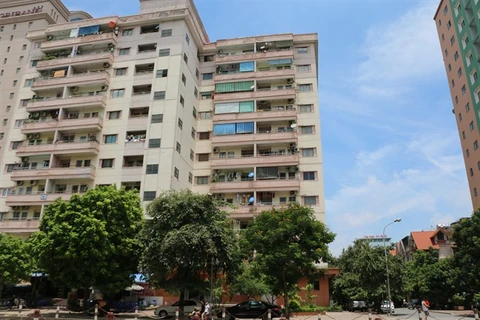
A view of high-rise buildings around Ngoc Khanh area in Hanoi (Illustrative image. Source: VNA)
 Hanoi (VNA) - The Ministry of Finance has proposed a tax on houses depending on their construction value as part of a draft law on property tax.
Under the proposed law, there are two options: imposing tax on houses with construction value of either more than 700 million VND (30,800 USD) or 1 billion VND (44,000).
The proposed tax rate is 0.3 or 0.4 percent annually, with only the surplus construction value above the proposed threshold to be taxed.
For example, if the threshold is set at 700 million VND, the owner of a 1.7 billion VND (74,800 USD) house would have to pay tax on 1 billion VND, equivalent to 3-4 million VND (132-176 USD) per year.
The construction value of a house is determined by factors including its type, scale and how many years it has been in use since construction.
If the tax on houses worth more than 700 million VND is applied, the finance ministry will be able to collect property tax of about 23.3 trillion VND (1.01 billion USD) to 31 trillion VND (1.4 billion USD) per year.
If the second option is approved, the tax collection is estimated to vary from 22.7 trillion VND (987 million USD) to 30.3 trillion VND (1.3 billion USD).
The ministry currently favours taxing houses worth more than 700 million VND at a rate of 0.4 percent.
According to Pham Dinh Thi, director of Ministry of Finance’s Tax Policy Department, data from other countries show that the lowest property tax rate stands at 0.2 percent. However, countries mostly apply high rates like Indonesia’s 0.5 percent and 1-2 percent in the Philippines.
He said taxing houses and trade-service construction work will impact enterprises’ production and business. The draft is scheduled to be submitted to the National Assembly for feedback in 2020.
The ministry is also seeking to increase land tax. Under the same draft law, land taxes in some categories might rise by multiple times compared with those currently stated in the Law on Non-Agricultural Land Use Taxes.
For example, housing land might get a 0.3 to 0.4 percent tax rate, ten times higher than current minimum rate of 0.03 percent.
The draft law on property tax also proposes tax on personal vehicles such as planes, yachts and cars worth more than 1.5 billion VND (65,000 USD).
Truong Thanh Duc, chairman of the BASICO Law Firm, said a property tax law is necessary, however, “people’s incomes must be taken into consideration when studying the law enforcement,” he said.
Dang Hung Vo, former Deputy Minister of Environment and Natural Resources, agreed with the land tax hike by ten times, saying that housing land tax of 0.4 percent, 0.5 percent-tax on business, trade and service land are reasonable. In the future, it could be increased to 0.7 to 1 percent.
If land tax is high, land prices will fall, while if the tax is low, speculative hoarding might happen. If the tax is high, anyone who wants to buy land must consider whether they can afford the tax or not, he said.
However, he opposed the housing property tax proposal, adding that developed countries impose housing tax depending on house area (not on value).
Nguyen Anh Tu, a State officer living in Hanoi, said that a house in Hanoi and HCM City cannot be bought for less than 700 million VND.
“I had to borrow 70 percent of the house value from the bank to afford the payment, not to mention additional fees. Now if I have to pay an annual property tax, I don’t know when I could pay off the debt,” he said.
Finance and banking specialist Nguyen Tri Hieu said imposing tax on land and houses is crucial to create equality in owning properties. However, the property tax law should require land tax only.
“People already pay personal income tax. There will be overlapping taxes if we require people to pay tax on the money they use to buy a house,” he said.
Le Hoang Chau, President of Ho Chi Minh City Real Estate Association, said if the law takes effect, the real estate market will be impacted, slowing business and investment activities.
Disagreeing with the proposal, the Ho Chi Minh City Real Estate Association proposed no tax on houses worth less than 1 billion VND to support low-income and low middle-income people.
Chau also proposed a 0.4 percent-tax on housing land, apartment building land and houses worth more than 1 billion VND.-VNA
VNA