Ministry steps up scientific research for COVID-19 prevention

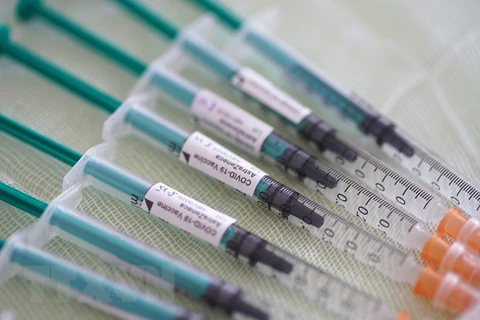
The Ministry of Science and Technology has said it is intensifying studies serving COVID-19 prevention and control, particularly those on vaccine production.
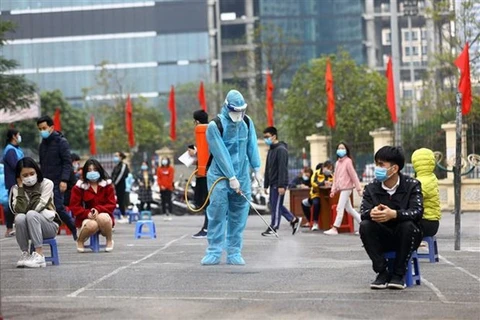
Ministry steps up scientific research for COVID-19 prevention ảnh 1Testing samples to detect COVID-19 infection (Photo: VNA)

Hanoi (VNA)
– The Ministry of Science andTechnology has said it is intensifying studies serving COVID-19 prevention andcontrol, particularly those on vaccine production.

It will prioritise cooperation with competent agencies in Vietnam and internationalpartnerships in the import, research and production of COVID-19 vaccines, it noted.

The body said it is also working with relevant units inoffering information on the pandemic developments.   

Since the first outbreak detected in Vietnam, the ministryhas joined scientists to conduct studies on epidemiology, virology, treatmentregimens, especially the production of the virus test kits. Such work laidthe basis for current mass production of the kits.

Vietnam logged three more COVID-19 cases on February 23morning, raising the country’s total community infections to 1,496, accordingto the National Steering Committee for COVID-19 Prevention and Control.

Vietnam is one of the 40 countries that have conducted humantrials of a COVID-19 vaccine. The nation expects to have 80 percent of itspopulation vaccinated against COVID-19. However, the current supply allows thecountry to inject only 20 percent of the population in 2021-2022, targeting 95percent of those vulnerable to virus infection./.
VNA
See more

Participants in the ASEAN Plus Photonics Symposium in Gia Lai province on April 8 (Photo: baogialai.com.vn/)

Gia Lai province hosts ASEAN Plus Photonics Symposium

Participants presented and discussed a wide range of advanced topics shaping the future of photonics, including nanophotonics and metasurfaces; topological and non-Hermitian photonics; photonic crystals and optical lattices; light–matter interactions and polariton systems.

Vietnamese Ambassador to Brazil Bui Van Nghi (right) and Professor and quantum physicist Olival Freire Juniorin, President of Brazil's National Council for Scientific and Technological Development, at their meeting on April 7. (Photo: Vietnamese Embassy in Brazil)

Vietnam, Brazil to strengthen cooperation in science, technology

Ambassador Bui Van Nghi expressed Vietnam’s interest in strengthening cooperation with Brazil in areas such as renewable energy and environmental technologies, as well as high-tech sectors including artificial intelligence (AI), quantum technology, and the semiconductor industry.

Teachers guide students in experiencing the application of science (Photo: VNA)

Results become benchmark for science-technology governance

The transition to facilitative governance marks not only an operational reform but also a shift in development thinking. With expanded autonomy and controlled risk acceptance, science, technology, innovation and digital transformation are expected to become key drivers of rapid and sustainable growth in the years ahead.

Students experience robotic products (Photo: VNA)

AI powers sweeping overhaul of Vietnam’s education system

Nguyen Son Hai, Deputy Director General of the Department of Information and Communication Technology under the Ministry of Education and Training (MoET), said the sector has made rapid strides in digital transformation, from online classes during the COVID-19 pandemic to nationwide platforms covering the national education database, registration for high school graduation exam, and online university admissions.

Voters can access essential information about candidates on the VNeID app, enabling them to proactively learn and enhance their awareness when participating in elections. (Photo: VNA)

Digital transformation gathers pace nationwide

Adopted by the Politburo in late 2024, Resolution 57 positions science – technology development, innovation, and digital transformation as a top important breakthrough and strategic pillar for Vietnam’s development in the new era. Early implementation shows a clear shift toward data-driven governance and technology-enabled public services.

Can Tho city pledges to allocate at least 1% of total budget spending to science, technology and innovation (Illustrative image. Source: VNA)

Plan issued to implement Vietnam–France agreement on science-technology cooperation

Under the plan, the Ministry of Science and Technology will take the lead, in coordination with relevant ministries and agencies, in directing, guiding, monitoring and inspecting the implementation of the agreement. The ministry will also prepare reports on the signing and implementation progress for submission to the Ministry of Foreign Affairs for consolidation and reporting to competent authorities as required.

An overview of the provincial steering committee of Tay Ninh on implementing Resolution 57 on April 2 (Photo: VNA)

Tay Ninh moves to accelerate digital transformation

In science, technology and innovation, Tay Ninh has identified six major priorities: development of the digital economy, a carbon credit market, a Halal ecosystem, renewable energy, enterprise innovation support, and applications of artificial intelligence and big data.

Vietnam successfully held its first auction of national “.vn” domain names from March 18 to 20. (Photo: VNA)

Sci-tech revenue up 17% in March

The sci-tech sector contributed 133.5 trillion VND to the country’s gross domestic product (GDP) in March, a 28% increase from the same period last year.