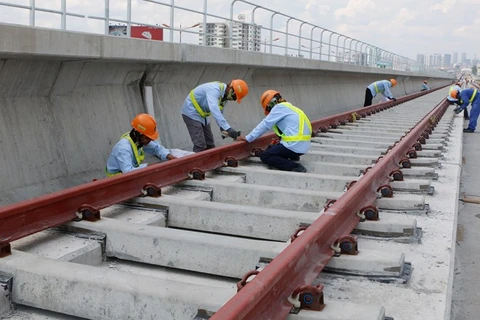
A view of the ongoing project of Nhon-Hanoi Station Urban Railway. The investment capital for the project is now about 1.17 billion EUR (1.3 billion USD) instead of 783 million EUR as initially planned (Photo: VNA)
 Hanoi (VNS/VNA) - Vietnam has been advised to carefully consider whether to borrow official development assistance (ODA) loans in the future.
The Ministry of Planning and Investment (MPI) made the warning during its recent report consulting the government on ODA.
Statistics from the ministry showed that during 2016-2017, Vietnam borrowed 6.7 billion USD in ODA loans, including 2.2 billion USD in preferential loans and 216.8 million USD from non-refundable aid, the Tien Phong (Vanguard) newspaper reported.
In the past, the interest rate of many ODA projects stayed at a low level and the payback period was about 25-40 years, with a reasonable grace period of 5-10 years.
They helped Vietnam access advanced technologies, boost innovation and were a catalyst to attract other investment capital, especially, from domestic sources, the report said.
However, ODA projects have shown shortcomings, such as interest rates reportedly increasing now, the ministry said.
If Vietnam did not tread carefully, it could fall into an “ODA and preferential loan’s trap,” with ODA’s interest rates and arrangement fees higher than interest rates on commercial loans in the domestic market, the ministry said.
For example, some ODA loans could have requirements of technologies and selected contractors, causing the actual borrowing cost to be higher than competitive bidding, the ministry said.
Additionally, the capability of localities that host ODA projects was still limited. Some ongoing ODA projects had to extend their execution time, the ministry said.
“Some localities do not give priority for allocating capital for ODA projects from their local budget, they often wait for the State budget,” the ministry added.
The ministry also named ODA projects that had investment capital increasing a lot compared to initial estimates.
For instance, the investment capital for the ongoing project of Nhon-Hanoi Station Urban Railway is now about 1.17 billion EURO (1.3 billion USD) instead of 783 million EURO as initially planned.
Delays in land clearance and slow construction progress were blamed as the major causes for the increases of investment capital, the ministry said.
According to the ministry, another shortcoming in implementing ODA projects during 2016-17 was a lack of reciprocal capital from the Government, delaying land clearance. The situation mainly occurred in transport projects and projects in Hanoi and Hai Phong city.
Minister of Planning and Investment Nguyen Chi Dung said that in the future, the government should only provide ODA capital for large-scale projects and projects that harmoniously combined domestic and international loans.
International loans should only be used to import technologies, machines and equipment, he said.
The ministry said ODA loans and preferential loans should only account for about 30-50 percent of the total investment capital for a project.
The government was urged to better use ODA loans for projects to improve infrastructure, develop smart agriculture or boost export activities, the ministry said. “Vietnam should be prepared for an exit strategy,” the ministry said.
ODA should be only a temporary foreign-currency mobilisation channel. The biggest benefit of foreign loans is having foreign currency resources to access technology, assets and advanced expertise.
Vietnam needs to focus on building the domestic capital market, accessing foreign capital market and improving the quality of domestic human resources to approach the international level, the ministry said.-VNS/VNA
VNA