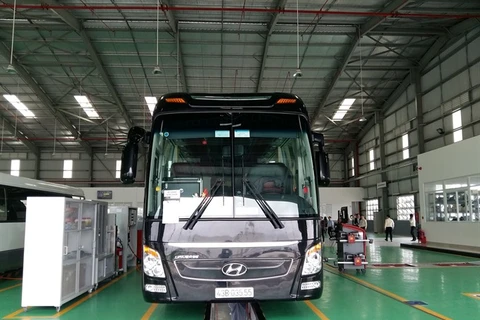
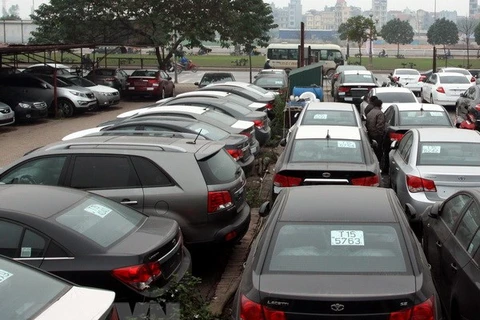
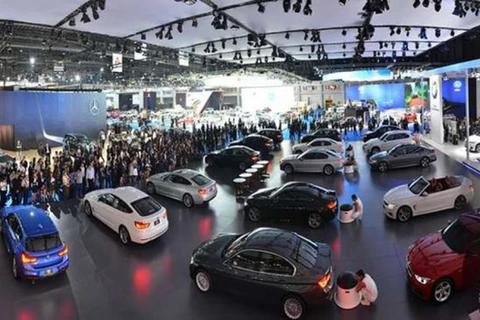
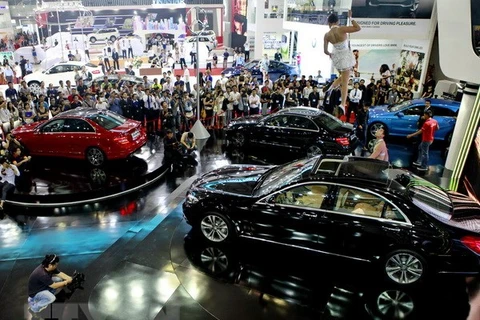
The Ministry of Industry and Trade has asked the Ministry of Finance to remove the special consumption tax for locally-manufactured auto parts. (Photo: vietnambiz.vn)
 Hanoi (VNA) - The Ministry of Industry and Trade (MoIT) has asked the Ministry of Finance to remove the special consumption tax for locally-manufactured auto parts.
This is part of a recommendation document that MoIT sent to the finance ministry in order to revitalise domestic automobile industry in the future and reduce the import of autos.
The MoIT said that it is needed to have more measures to help local automakers cut production cost and accelerate the product’s competition capacity as well as revising policies on tax and fees.
The ministry wanted the finance ministry to exempt the import tax on materials for part and components manufacturers who invest in Vietnam, which should be in association with their commitment on long-term investment, volume of products, technology transfer and use of local labour force.
The MoIT also recommends the application of a tax payment guarantee for a period of eight months instead of the current 30 days.
The MoIT expected the finance ministry to study to amend and supplement a number of the above contents, which were proposed by Thanh Cong Group, with regard to laws on value-added tax, special consumption tax, and corporate income tax, in addition to personal income tax and natural resources protection tax.
Earlier, at the review conference of the industry and trade sector held in Hanoi on January 15, General Director of Hyundai Thanh Cong Le Ngoc Duc proposed that the MoIT, in coordination with the finance ministry, consider several recommendations as those mentioned above.
According to Duc, in order to achieve the goal of developing the automobile industry in Vietnam, the Government has issued decrees such as Decree 116 on conditions for production, assembly, import and business of warranty service, car maintenance, and Decree 125 that regulates the roadmap for import duty exemptions of parts and components for manufacturers who meet conditions such as emission standards, engine displacement capacity for the car with nine seats and less, passenger car and truck.
However, he said such privileges were not strong enough to be of significant priority for locally-assembled autos to help them compete with complete built-up units imported from ASEAN.
Under the ASEAN Free Trade Agreement (AFTA) commitments, a zero percent tax has been applied on cars imported from the bloc with a localisation rate of 40 percent or more in the country of origin from January 1.
A MoIT report quoted by enternews.vn showed that the price of an automobile in Vietnam is currently high in the region but its quality is lower than an imported one.
“Locally-assembled autos in Vietnam have a similar price doubling as those seen in regional countries and much higher than other countries which have a stable automobile industry such as Japan and the United States,” said the report.
"The domestic automobile industry has not yet reached the standards of the real automobile industry because most are at the level of simple assembly; the production line mainly consists of four key stages including welding, painting, assembly and inspection. There is no cooperation, linkage and specialisation between automakers and assemblers and part suppliers. There is no such system used by material suppliers and large-scale parts and components makers.
"The localisation rate of new autos is only between 7 percent and 10 percent on average (compared to the target of 40 percent in 2005 and 60 percent in 2010). Currently, locally-produced products with very low technological content are tubes, tires, chairs, mirrors, cables, plastic products and batteries," the report pointed out.
The MoIT has on numerous occasions warned that if such privileges and incentives were not approved, the domestic automobile industry would find it difficult to compete with imported cars.-VNA
VNA