Moody's upgrades two Vietnamese banks

Moody's has upgraded the ratings of two Vietnamese banks, citing their improvements in the standalone credit profile.
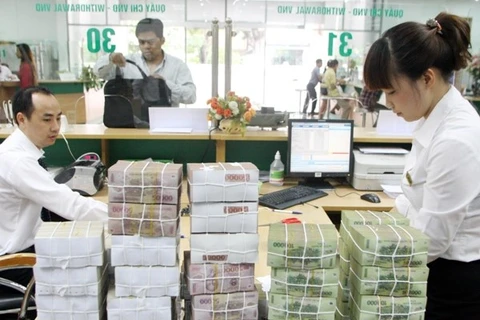
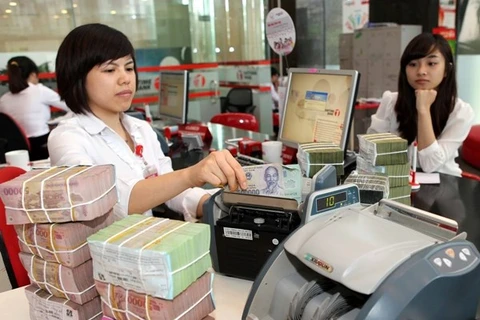
Moody's upgrades two Vietnamese banks ảnh 1Customers make transactions at an Asia Commercial Bank (ACB) branch in Hung Yen province (Photo: VNA)

Moody's has upgraded the ratings of two Vietnamese banks, citing their improvements in the standalone credit profile.

The long-term deposit and issuer ratings of both the Vietnam Technological and Commercial Joint Stock Bank or (Techcombank) and Asia Commercial Bank (ACB) were upgraded to B2 from B3 last week.

At the same time, the United States-based credit rating agency also lifted the two banks' baseline credit assessment (BCA) to B3 from CAA1.

Moody's also changed the outlook of both Techcombank and ACB to stable from positive.

According to Moody's, Techcombank's asset quality metrics have improved in 2014 and in the first half of 2015, although from a relatively weak base. The improvements in asset quality were driven by write-offs, recoveries and some credit growth.

The unlisted bank's problematic assets decreased to 12.8 percent of gross loans as of June 2015, from 14.4 percent in December 2014 and 20.1 percent in December 2013.

The bank's balance sheet contraction – namely in available for sale securities – led to an improved equity-to-assets ratio of 9.1 percent as of June 2015, from 8.5 percent in December 2014. During the same period, the bank's tangible common equity-to-risk weighted assets also improved to reach 10.1 percent from 9.2 percent.

Moody's said that it also viewed as positive that the bank was not materially reliant on market sources for funding, with its ratio of market funds to banking assets amounting to 14 percent as of June 2015. As of the same date, liquid assets such as cash, interbank, government bonds and trading securities amounted to 36 percent of the assets.

"These liquid assets were of relatively good quality, because government securities made up about one-third of the balance," Moody's said.

It said the ACB's asset quality metrics had stabilised as the management pursued a more conservative strategy on loan growth.

"While problem loans still account for a large proportion of the total assets, the bank has made gradual progress in resolving or writing off its problem exposures," it said.

ACB's problem loans ratio declined slightly to reach 4.66 percent at the end of June 2015, from 4.75 percent at the end of 2014, and down from a high of 7.77 percent at the end of 2012. Moody's attributed some of the improvement to the transfer of assets to the Vietnam Asset Management Company.

ACB's moderate loan growth has also further reduced the risk that newer loans could deteriorate and materially weaken asset quality. Loan growth was nine percent in 2014 and three percent in 2013, significantly below the system averages of [15 percent] in 2014 and [15 percent] in 2013, Moody's said.

The bank's profitability has also stabilised, with core revenue growth – including net interest and fee income – of six percent in 2014, following a 32 percent reduction in 2013.-VNA
VNA

See more

Rice harvest in Xuan Giang commune, Ninh Binh province. (Photo: VNA)

Plan issued to develop agricultural logistics system

A key target is that by 2030, all concentrated agricultural, forestry and fisheries production areas will have access to essential services, including product traceability, quarantine, testing, quality certification, processing and market development. The move reflects growing international demand for stricter food safety, quality and traceability standards, which have become increasingly important for agricultural exports.

Delegates at the signing ceremony (Photo: VNA)

Vietnam, RoK boost micro-business cooperation

Vietnam's young population, dynamic market, and big growth potential are a perfect fit for the strengths that Korean micro-businesses bring in K-brands, technology, and service expertise, said KFME President Song Chi Young.

Cars at a public parking lot in Hai Phong city. (Photo: VNA)

Vietnam's auto sales rise 15%, hybrid, imported vehicles continue to outperform

With auto loan interest rates remaining competitive, stable vehicle supply, and an increasingly diverse product range, Vietnam's automotive market is expected to maintain its growth momentum through the remainder of 2026. SUVs, MPVs, and hybrid vehicles are likely to remain the main drivers of overall market sales.

The MoU signing ceremony between Becamex VSIP Binh Dinh and PV Gas CNG in Gia Lai province on June 26, 2026 (Photo: nhandan.vn)

Gia Lai positions itself as magnet for sustainable investment

Vice Chairman of the provincial People's Committee Nguyen Huu Que said ESG is no longer a communications message or a cost burden, but an essential requirement for accessing global capital. Gia Lai has chosen ESG as a pillar for building new competitive advantages and achieving sustainable development.

Chairman of the Tay Ninh provincial People's Committee Le Van Han delivers remarks at the inauguration ceremony. (Photo: VNA)

Suntory PepsiCo inaugurates 300-million-USD plant in southern Tay Ninh province

Built on nearly 20 hectares at Huu Thanh Industrial Park, the facility is the company's largest and most advanced plant in Vietnam and the biggest production site in Suntory PepsiCo's Asian manufacturing network. The factory has a designed annual production capacity of over 1.24 billion litres and is equipped with highly automated production, filling and warehousing systems.

Ho Chi Minh City inaugurates a UAV postal route linking Can Gio commune and Vung Tau ward on February 12, 2026. (Photo: VNA)

Ho Chi Minh City promotes UAV applications to develop low-altitude economy

With its enlarged development space, Ho Chi Minh City now combines strengths in urban development, industry and services with high-tech agriculture, the marine economy, logistics and diverse ecological areas. These conditions provide an ideal testing ground for UAV applications in urban management, land administration, environmental monitoring, disaster prevention and response, agriculture, logistics and public services.

Workers produce outdoor wooden furniture for export to Europe at the factory of Hong Ngoc Co., Ltd. in Phu Tai Industrial Park, Quy Nhon Bac ward, Gia Lai province. (Photo: VNA)

Vietnam's wood exporters race to stay on growth path

Despite headwinds from Middle East tensions that have pushed up freight and logistics costs, exports of wood and wood products were estimated at 1.53 billion USD in June, lifting first-half export turnover to 8.54 billion USD, up 4.4% from a year earlier, according to the Ministry of Agriculture and Environment (MAE).

Workers make clothes for export to the Japanese market at Hung Viet Garment Company in Hung Yen province. (Photo: VNA)

Vietnam seeks stronger export growth in H2

Despite the encouraging performance, Vietnam's exports remain heavily dependent on a limited number of major markets and product groups, while the domestic value added of many export products remains relatively low because of their reliance on imported raw materials and components.

Hiep Phuoc Industrial Park in Hiep Phuoc commune, Ho Chi Minh City. (Photo: VNA)

Ho Chi Minh City: Industrial, export processing zones attract over 2.6 bln USD in H1

Speaking at the at the city's regular socio-economic press briefing on July 9, Deputy Head of the Ho Chi Minh City Export Processing and Industrial Zones Authority (HEPZA) Tran Viet Ha said that foreign direct investment (FDI) accounted for nearly 1.6 billion USD of the total, including 65 newly licensed projects worth more than 867 million USD and 83 existing projects that added over 707 million USD in registered capital.