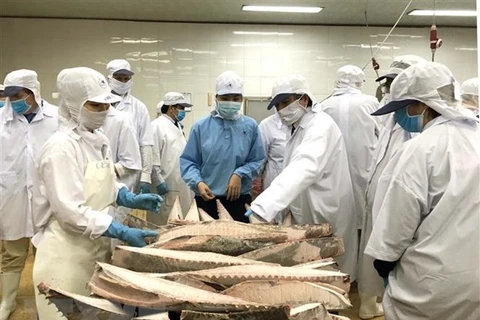
Processing Tra fish for export (Source: VNA)
 Hanoi (VNA) – Localities need to take stronger actions to counter the European Commission’s illegal, unreported, and unregulated fishing (IUU) yellow card warning, said Deputy Minister of Agriculture and Rural Development Phung Duc Tien.
Speaking at a conference held by the Ministry of Agriculture and Rural Development (MARD) in Hanoi on April 24, Tien said that as per results of inspections, localities nationwide had not yet implemented drastic enough measures to deal with the yellow card.
Storm shelter infrastructure for ships has not met requirements, while the upgrading of fishing ports and fishery logistics has not received adequate attention, human resources for fisheries management are not sufficient, and the rate of ships keeping fishing records as required reached only 21.2 percent, he said.
This resulted in the traceability of caught seafood falling short of EC requirements, he noted.
Deputy Director of the Directorate of Fisheries Nguyen Quang Hung underlined the necessity to raise awareness of fisheries management agencies at all levels and fishing communities towards combating IUU.
EC recommendations have been integrated into the Law on Fisheries 2017 and documents guiding the law of the Government and the MARD, Hung said.
The violation of fishing vessels on the waters of Pacific Island countries has almost ceased, while the inspection and control of fishing vessels operating on the sea has made progress, he said.
However, he noted that violations have not been handled strictly according to the direction of the Government and the Prime Minister, with law enforcement to prevent Vietnamese fishing vessels from exploit illegally seafood in foreign waters proving to be ineffective.
In addition, fishing vessels violating rules in foreign waters is still a complicated issue, fishing vessel monitoring systems have not yet met requirements, control over fishing vessels entering and leaving ports is weak, and the certification of aquatic products remains limited with many mistakes, he added.
Hung informed that around the end of May to early June 2019, an inspection delegation from the EC’s Directorate General for Maritime Affairs and Fisheries (DG MARE) will begin a fact-finding trip to Vietnam to inspect the implementation of recommendations related to the fight against IUU fishing.
He urged relevant ministries and sectors nationwide, and authorities of 28 coastal localities to make more efforts and mobilise resources to effectively implement the work.
On October 23, 2017, the EC issued a "yellow card" warning to Vietnam, after the country failed to demonstrate sufficient progress in the fight against IUU fishing.
Countries that fail to meet EC standards are given a "yellow card", followed by a "green card" if the problems are resolved, or a "red card" if they are not. A red card can lead to a trade ban on fishery products.
According to EC requirements, the Vietnamese seafood sector had to implement nine recommendations, included revisions of the legal framework to ensure compliance with international and regional rules, applicable to the conservation and management of fisheries resources; ensuring the effective implementation and enforcement of the country’s revised laws; and strengthening the effective implementation of international rules and management measures.
The EC also wanted Vietnam to issue sanctions and increase the level of sanctions against IUU fishing, which should be written in the revised Law on Fisheries, and give concrete evidence proving Vietnam’s efforts in the fight against IUU fishing. –VNA
VNA