More room to develop Vietnam's international shipping fleet

The potential is great, but the development and operation of Vietnamese cargo shipping has not been commensurate with the role and position of the country.
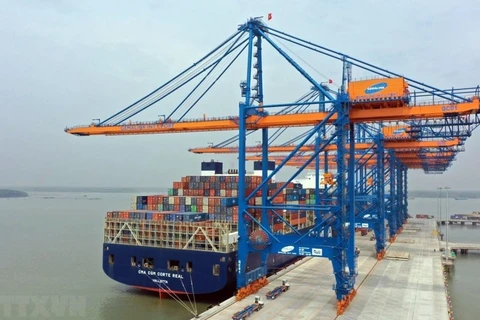
More room to develop Vietnam's international shipping fleet ảnh 1There were 1,502 ships under the Vietnamese flag as of December last year. (Photo: VNA)
Hanoi (VNS/VNA) - The potential is great, but the development and operation ofVietnamese cargo shipping has not been commensurate with the role and positionof the country.

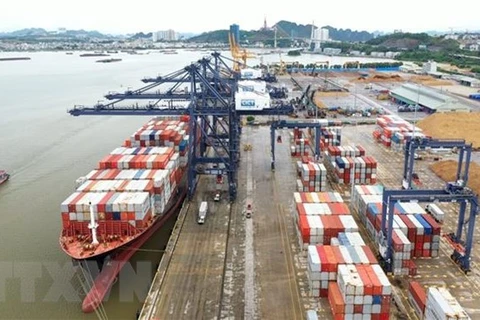
In theproject to develop Vietnam's international shipping fleet by the Vietnam MaritimeAdministration (Ministry of Transport), the administration said that thecountry's seaport system in recent years has developed relatively synchronouslyand modernly and is able to welcome some of the world's largest ships.

However,containers of goods imported and exported to/from Vietnam are mainlyhandled by foreign shipping lines, especially on long-distance sea routesfrom/to developed countries such as Europe and the US.

The domesticfleet currently mainly undertakes domestic transportation and shortinternational routes in Asia. The international shipping market share of Vietnam'sshipping fleet has been on a downward trend in recent years.

The fleetstructure is not as good as it could be with mainly small tonnage shipscarrying dry and bulk cargo. There is a lack of container ships and largetonnage ships operating on international routes.

There were1,502 ships under the Vietnamese flag (excluding data of ships underconstruction) as of December last year, with a total tonnage of about 7.15million GT and 11.7 million DWT.

The numberof ships ranged from 1,000 to over 1,200 ships in the 2016-2020 period.

The numberof ships has decreased by over 200 last year compared to 2016, equivalent to adecrease of 17.2 percent.

Comparedwith the 2010-15 period, Vietnam's transport fleet has decreased by over 400ships. However, the total tonnage of the transport fleet grew by over 6 percent.

On the basisof the situation of the international transport market and the growth trend ofgoods through Vietnam's seaports over the years, the maritimeadministration shows that there is a huge potential for developing aninternational shipping fleet.

However,Vietnamese shipping enterprises’ development and operation have not been commensuratewith the role and position of the country.

The VietnamMaritime Administration proposed many solutions to develop Vietnam's shippingin the 2021-2026 period, with a vision for 2030.

Accordingly,the first is to renovate mechanisms and reform administrative procedures,creating a stable and favourable legal corridor to support businesses tooperate effectively.

Regardingthe financial solution, ship owners should be allowed to not pay VAT whenimporting ships to transport goods for Vietnamese goods owners until the end of2026; exempt import tax and reduce 50 percent of tonnage fees when ship ownersbuy and operate container ships of 1,500 TEUs or more or ships powered by cleanenergy and LNG carriers.

The StateBank of Vietnam has a policy that allows Vietnamese ship owners who have shipsoperating on international routes with foreign currency revenue to be allowedto borrow foreign currency to invest in buying ships.

Anotherimportant solution is to improve the quality of crew members. The Vietnam MaritimeAdministration recommends calling for private investment in human resourcetraining, including domestic and foreign training.

There arepolicies and special incentives for employees of the shipping industry in orderto encourage workers to stick with the work for a long time.

Speaking ata seminar on developing the Vietnamese international shipping fleet last week,Deputy Minister of Transport Nguyen Xuan Sang said that the ministry had beencompleting a project to develop the Vietnamese international shipping fleetwith many synchronous solutions and a specific roadmap to submit to theGovernment to facilitate the development of not only the international shippingfleet but also the domestic fleet.

The deputyminister affirmed that he would continue to gather suggestions and opinionsfrom businesses and associations to complete this important project indetail./.
VNA

See more

Vietnamese Ambassador to the Republic of Korea Vu Ho speaks at the forum.(Photo: VNA)

Forum promotes Vietnam–RoK supply chain connectivity

Cao Thi Phi Van, Deputy Director of ITPC, said that after more than three decades of cooperation, Vietnam–RoK ties are shifting from traditional manufacturing cooperation towards mastering future-oriented technologies such as semiconductors, artificial intelligence (AI), digital finance, renewable energy and global supply chains.

Fitch Ratings gives positive assessment of Vietnam’s economic fundamentals (Illustrative image. Source: VNA)

Fitch Ratings gives positive assessment of Vietnam’s economic fundamentals

Deputy Minister Tran Quoc Phuong stressed that Fitch’s credit assessments have enhanced Vietnam’s image and credibility in international financial markets, and provided additional motivation for the country to continue improving institutions, strengthening policy management efficiency and increasing economic transparency.

Consumer purchases E10 biofuel at a PVOIL petrol station on Thai Thinh street in Hanoi. (Photo: VNA)

Hanoi strengthens oversight of transition to E10 biofuel

To ensure compliance with the transition roadmap, the Hanoi Market Surveillance Sub-Department has requested petrol traders to proactively review and upgrade storage tanks, fuel pumps and other technical conditions necessary for E10 distribution, thereby preventing disruptions to fuel supply serving consumption and production demands across the capital.

A Phu Tho civil servant guides a local how to switch from presumptive tax mechanism to tax sef-declaration. (Photo: VNA)

📝OP-ED: Vietnam’s tax reform: Fair play, not revenue squeeze

At a time when social media disinformation grows more sophisticated, transparency and public disclosure are the most potent counter to distortions. Facts, data and real-world results deliver the strongest rebuttal to attempts that twist reality and erode trust in tax administration reform.

Experts are expected to analyse opportunities for boosting exports and investment cooperation between Vietnam and South American countries at the coming seminar. (Illustrative photo: VNA)

Seminar on trade promotion in South American market to take place in Hanoi

A seminar on opportunities and challenges in developing the South American market will be held in Hanoi on May 28. It aims to provide updates on the economic outlook, market trends and import demand in South America, particularly in Argentina and Chile, amid continued fluctuations in global supply chains.

A view of the second Asia Agri Food International 2026 in Ho Chi Minh City on May 19 (Photo: VNA)

India pushes stronger agri-food cooperation with Vietnam

Experts noted that Vietnam has established itself as one of Southeast Asia’s leading agricultural product exporters, while India remains a major global supplier of agricultural and food products. By combining India’s production capacity and technological strengths with Vietnam’s dynamic processing and export ecosystem, the two countries can build more resilient supply chains in the region.

A panel discussion at the Meet Australia 2026 programme on May 19 (Photo: VNA)

Meet Australia 2026 promotes sustainable partnership opportunities

Meet Australia 2026 is not only a trade and investment promotion event but also a forum connecting trust, vision and action between Vietnam and Australia, as well as between national-level cooperation orientations and development needs of localities and businesses from both countries.

A customer purchases E10 biofuel petrol at a PVOIL station on Thai Thinh street in Hanoi. (Photo: VNA)

Authorities ordered to closely monitor rollout of E10 biofuel from June 1

According to the agency, the move is aimed at ensuring the effective and synchronised implementation of the E10 transition roadmap under Circular No. 50/2025/TT-BCT, issued by the Ministry of Industry and Trade on November 7, 2025. The plan seeks to avoid delays or supply disruptions that could affect the domestic fuel market.