More Vietnamese consumers go cashless: study

Some 77% of Vietnamese consumers believe they could go cashless for three days, according to a new survey by Visa entitled “Consumer Payment Attitudes Study 2022”.
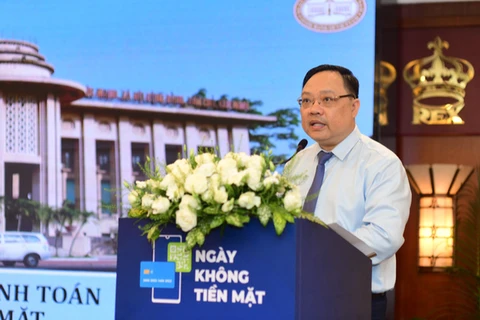
More Vietnamese consumers go cashless: study ảnh 1Visa recently revealed its “Consumer Payment Attitudes Study” which says that more Vietnamese consumers are going cashless. (Photo: Courtesy Visa Vietnam)
HCM City (VNS/VNA) - Some 77% of Vietnamese consumersbelieve they could go cashless for three days, according to a new surveyby Visa entitled “Consumer Payment Attitudes Study 2022”.

In the study, Visa found that 90% of study respondents attempted to gocashless at some point in 2022, as compared to 77% in 2021.

The COVID-19 pandemic transformed consumer behaviour worldwide, and ViệtNam was no exception, Visa said, adding that the percentage of Vietnameseconsumers using card or mobile wallet payments increased across every categorycompared to 2021.

According to the study, 66% of consumers used online card payments last year,while 70% used online or in-app mobile wallet payments, a dramatic increasefrom 32% in 2021.

“Digital payments continue to grow in popularity among consumers in Vietnam,with VisaNet data showing that the payment volume across all Visa paymentmethods in the country rose 32% year-on-year in 2022, payment value throughonline transactions also rose substantially, while cross-border payment volumegrowth more than doubled compared to the previous year,” Dung Dang, Visacountry manager for Vietnam and Laos, said. 

QR payments also experienced substantial growth in usage last year, with 61% ofconsumers using this method, as compared to 35% in 2021.

Taken together, this indicates a gradual shift away from cash, evidenced by thefact that consumers both carried less cash in 2022 and used it for fewerpayments, according to the study. 

The two most common reasons for fewer cash payments include thepossibility of losing it or having it stolen, and the fact that more businessesnow support cashless payment methods. 

Increased use of digital options is evident beyond payment methods as well with90% of Vietnamese consumers being interested in virtual banking.  

Post-COVID consumer behaviour is also coming into focus. New trends haveemerged in what consumers spend their money on in the retail space, and howthey approach their finances overall, the study found.

It shows that Vietnamese have embraced home delivery, with tech-enabled onlinepayment pre-delivery being the most popular method. Overall, 85% of consumerstried home delivery for the first time during the pandemic, and in the future,they expect 8 out of 10 purchases to be made online and be received via homedelivery. Offering online payment and home delivery are clear needs forbusinesses moving forward.

New shopping habits have also emerged, with 64% of consumers purchasing moremedicine and vitamins to maintain their health, while the same percentages areshopping through large online market places and home-based businesses.These spending habits reflect global post-COVID trends, in which e-commerce hasgrown rapidly while a majority of consumers are trying new shoppingbehaviours. 

Shifting saving and spending trends, meanwhile, mean businesses must adaptto different behaviour. Some 80% of consumers say they are now saving moremoney for the future, while 78% aim to closely plan and track monthly expenses.This indicates a widespread focus on being financially responsible, as does thenearly universal setting of monthly budgets for household expenditures. 

As a result, consumers are likely to reduce spending on certain items, whichbusinesses must anticipate. On the other hand, businesses can move to areaswhere consumers plan to increase spending, including groceries, fashion andclothing, and staycations or domestic travel, according to Visa./.
VNA
See more

An overview of a meeting between Politburo member and Secretary of the Hanoi Party Committee Tran Duc Thang and representatives of Saint Petersburg businesses. (Photo: VNA)

Saint Petersburg’s metro expertise valuable for Vietnam

As Hanoi implements its master plan with a 100-year vision, in which metro lines are identified as the backbone of the capital city’s transport network, Secretary of the municipal Party Committee Tran Duc Thang met with representatives from several Saint Petersburg companies specialising in urban rail development.

An art performance at 2026 Dak Lak Durian Festival. (Photo: VNA)

Dak Lak Durian Festival seeks to elevate Vietnam’s agricultural brand globally

Dak Lak has about 41,000ha of durian, with this year’s output estimated at nearly 500,000 tonnes. The province has 280 growing-area codes covering around 7,500ha, along with 41 packing facilities approved for export. In 2025, Dak Lak’s durian sector contributed about 1.1 billion USD to the country’s export turnover.

Delegates cut the ribbon to inaugurate the Ho Chi Minh City-Shenzhen direct air route. Photo: baodautu.vn

Vietravel Airlines launches direct Ho Chi Minh City-Shenzhen route

Vietravel Airlines' new route connects Tan Son Nhat International Airport (SGN) in Ho Chi Minh City with Shenzhen Bao'an International Airport (SZX), meeting growing demand for travel between the two markets for investment, trade, tourism and visiting relatives.

Thanks to digital transformation among local officials, Tam Dao commune of Phu Tho province has achieved an almost 100% on-time rate for processing administrative applications, helping improve public services for residents. (Photo: VNA)

Institutional reform fuels private sector's growth in Phu Tho province

The private sector is increasingly emerging as a key growth engine of the economy. To unleash its potential and ensure sustainable development, the northern province of Phu Tho is stepping up institutional and administrative reforms to cut costs, shorten procedures, and build a more transparent, business-friendly investment climate.

Hoa Phat Wharf inside the Dung Quat Economic Zone (Photo: VNA)

Dung Quat EZ, Quang Ngai IPs draw nearly 19.4 bln USD

The Dung Quat Economic Zone and Quang Ngai industrial parks have so far attracted 441 projects worth around 19.4 billion USD, according to the Dung Quat Economic Zone and Quang Ngai Industrial Parks Authority (DEZA).

The Kim Long Motor Hue factory (Photo: VNA)

Hue courts capital to turn industrial zones into growth engine

The economic and industrial zones in Hue city host more than 200 active investment projects worth over 152 trillion VND (5.84 billion USD), with 139 already operational. Since the start of 2026, they have generated about 32 trillion VND, contributed 4.2 trillion VND to the state budget and brought in 730 million USD in exports, while employing more than 46,000 workers.

Processing cashew nuts for export at Nguyen Thong Co., Ltd. in Dak Lak province. (Photo: VNA)

Vietnam’s exports to New Zealand post strong growth

According to the Customs Department, two-way trade reached 844 million USD in the first half of 2026, of which Vietnam’s exports to New Zealand totaled 399.7 million USD, up 18.8% year-on-year, while imports stood at 444 million USD.

Starting from September 2026, agricultural products from the Mekong Delta are expected to be transported directly from Cai Cui Port to Guangxi, China. (Photo: VNA)

Investing in logistics to boost agricultural production and exports

Logistics is increasingly becoming a major bottleneck for exports as transport costs rise and requirements for data management, low emissions and supply chain transparency become more stringent, requiring coordinated investment in logistics infrastructure, data infrastructure and transport capacity.

Harvesting rice in the Mekong Delta (Photo: VNA)

Vietnam seen as gateway for Canadian farm produce to ASEAN

As Canada steps up trade diversification and seeks to reduce its dependence on the North American market, Vietnam could serve both as a market for Canadian goods and a base for Canadian businesses to build production capacity and expand operations in the region.