MSMEs play significant role in ASEAN transformation towards circular economy: ASEAN chief

MSMEs play significant role in ASEAN transformation towards circular economy: ASEAN Secretary-General

Micro, small and medium-sized enterprises (MSMES) play a significant role in transforming ASEAN towards a circular economy and prepare the region for sustainable future, Secretary-General of ASEAN Kao Kim Hourn said in an article published on June 26.
MSMEs play significant role in ASEAN transformation towards circular economy: ASEAN Secretary-General ảnh 1Secretary-General of ASEAN Kao Kim Hourn. (Photo: phnompenhpost.com)

Jakarta (VNA) – Micro, small and medium-sized enterprises(MSMES) play a significant role in transforming ASEAN towards a circulareconomy and prepare the region for sustainable future, Secretary-General of ASEAN Kao Kim Hourn said in an article published on June 26.

Hiswriting titled “EmpoweringASEAN MSMEs to embrace circular economy” marks the UN’s MSME Day (June 27) in recognitionof the tremendous contributions of MSMEs to the achievement of the UNSustainable Development Goals (SDGs).

Kao said that deeplyrooted as part of local society, MSMEs are frequently regarded as vitalenablers of socio-economic development. In ASEAN, MSMEs account for 85% ofemployment and 44.8% of the region’s GDP. They provide primary sources ofincome and livelihoods for a significant number of individuals and households.

Through partnerships with other local businesses, MSMEs are an integral part ofthe value chain, enabling access to a variety of products for their customersand servicing the local community.

Due to their lean structure andversatile business model, MSMEs have the ability to embrace new developments,such as the circular economy and digital technologies.

The ASEAN leader said in the last three years, the region witnessed many businesses, particularly MSMEs, rapidly adopting innovativetechnologies and practices to remain relevant and competitive.

Additionally,in building a circularity ecosystem, technology adoption also plays a crucialrole in enabling better tracking and traceability while supporting innovativebusiness models.

He saidthat those developments resulted in reduced physical resource requirements,decreased commuting-related emissions and sharing economy being enabled throughdigital platforms. The development illustrates how an MSME sets sail on theirjourney towards the circular economy.

The secretary-general of ASEAN saidthat to build an enabling environment for MSMEs to thrive in a circulareconomy, governments must put in place a long-term strategy and implementbalanced actions that create strong economic incentives. This endeavour shouldbe supported by good governance and close stakeholder engagement, investment ininfrastructure and technology, as well as human resource development.

He said ASEANare committed to promoting circularity in MSMEs across the region. Throughcollaborative efforts, ASEAN member states are working towards achieving acircular economy that is inclusive and bring benefits to all sides. One of thekey approaches is to promote MSME understanding and upskill them to embracecircular business practices through various initiatives and activities.

He added that one important initiativeis the Framework for Circular Economy for ASEAN Economic Community (AEC), whichwas adopted in 2021, that created a structured pathway for a supportiveecosystem for circular business models. It builds upon existing initiatives andintroduces new activities to accelerate the region’s transition to circulareconomy.

A number of engagements involvingthe government and the private sector are also taking place this year, offeringa platform for sharing best practices and ensuring inclusivity as part of thepolicy-making process.

Kaoemphasised that it is imperative that ASEAN, across all sides, whether publicor private sector, work closely together to support and nurture more MSMEs.

“As wehonour the importance of MSMEs and the role they play in the economy, let usalso recognise the challenges that they face, particularly in accessingfinancing and technology. By addressing these challenges and creating aconducive environment for MSMEs to thrive, we can unlock their full potentialand contribute to sustainable economic growth,” he said./.

VNA

See more

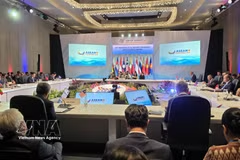
An overview of the ASEAN Foreign Ministers’ Meeting on November 14, 2026 (Photo: VNA)

Vietnam backs ASEAN culture of consultation, dialogue, preventive diplomacy

Deputy Minister of Foreign Affairs Dang Hoang Giang stressed that amid conflicts and instability in various parts of the world, ASEAN should give top priority to strengthening the foundations of peace and stability, uphold the rule of law and promote the bloc’s principles and norms of conduct, particularly the Treaty of Amity and Cooperation in Southeast Asia (TAC).

The welcome ceremony for Prime Minister Le Minh Hung at Ninoy Aquino International Airport on November 14 afternoon (Photo: VNA)

Vietnamese PM arrives in Philippines for 49th ASEAN Summit

PM Le Minh Hung’s attendance underscores Vietnam's sustained commitment to the bloc, which aligns consistently with the foreign policy set forth by the 14th National Party Congress, which defines ASEAN as a bloc of strategic importance and a top priority in Vietnam’s external relations.

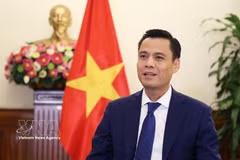
Deputy Minister of Foreign Affairs Dang Hoang Giang. Photo: VNA

Vietnam aims to promote ASEAN unity, resilience and practical cooperation: Deputy FM

Prime Minister Le Minh Hung's attendance at the 49th ASEAN Summit and related summits in Manila, the Philippines, from November 14-17 aims to concretise Vietnam's foreign policy of independence, self-reliance, resilience, multilateralisation and diversification, and reaffirm ASEAN's position as Vietnam's foremost strategic priority in its foreign policy.

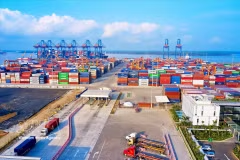
A road is under construction in Dong Nai city, Vietnam. (Photo: VNA)

ADB: Southeast Asia needs 7.1 trillion USD in infrastructure investment by 2040

ADB estimates that the region will need an average of 476 billion USD in infrastructure investment annually during 2026–2040, equivalent to 8.7% of GDP. However, at current investment levels, government budget resources would cover only around 45% of this demand, leaving an annual financing gap of 264 billion USD.

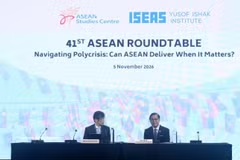
Thai Deputy Prime Minister and Minister of Foreign Affairs Sihasak Phuangketkeow (R) takes part in the Q&A session at the 41st ASEAN Roundtable. (Photo: VNA)

Thailand calls on ASEAN to proactively address polycrisis

Thai Deputy Prime Minister and Minister of Foreign Affairs Sihasak Phuangketkeow noted that no single member state could tackle challenges ranging from major-power competition and economic fragmentation to climate change and energy and food security on its own. Regional cooperation is therefore a strategic imperative, enabling ASEAN not only to overcome crises but also to sustain its development momentum.

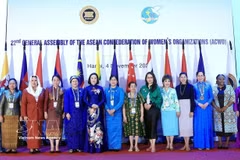
Participants in the 22nd General Assembly of the ASEAN Confederation of Women’s Organisations pose for a group photo. (Photo: VNA)

Women play key role in building united, resilient, sustainable ASEAN Community

Hosted by the Vietnam Women’s Union (VWU), the 22nd ACWO General Assembly marked another milestone in ACWO’s cooperation and development, allowing ASEAN women’s organisations to strengthen solidarity and mutual trust, share experience and identify cooperation priorities for the region’s next stage of development.

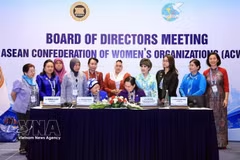
Delegates sign an agreement admitting the Timor-Leste Women’s Network Rede Feto as ACWO’s 11th member. (Photo: VNA)

ASEAN Confederation of Women’s Organisations holds Board of Directors meeting in Hanoi

Amid ongoing regional and global changes, which bring both new opportunities and challenges for women, the role of the ASEAN Confederation of Women’s Organisations in connecting organisations and promoting collective action has become increasingly important. This requires continued innovation in its operating methods, stronger ties among members and greater promotion of women's voices and roles in building a united, resilient, inclusive and sustainable ASEAN Community.

Haze in Kuala Lumpur Airport, Malaysia (Photo: VNA)

ASEAN countries step up efforts to combat transboundary haze

ASEAN already has the ASEAN Specialised Meteorological Centre (ASMC), based in Singapore since 1993. The establishment of the ASEAN Coordinating Centre for Transboundary Haze Pollution Control is expected to complement this mechanism by strengthening cooperation among member states and improving the region's response to transboundary haze pollution.

Japanese Minister of National Defence Koizumi Shinjiro (Photo: Xinhua/VNA)

Japan shores up defence ties with ASEAN

Japanese Minister of National Defence Koizumi Shinjiro said members must bridge differences to tackle shared challenges and proposed expanding Japan–ASEAN cooperation with outside partners into AI, unmanned systems and the protection of undersea critical infrastructure.

Speakers at the discussion (Photo: VNA)

ASEAN digital pact key to facilitating cross-border business

At a panel discussion on policy frameworks for the digital economy, held as part of the Autumn Economic Forum 2026 on October 27, speakers said ASEAN needed to ensure national systems could work together while protecting data and facilitating business, rather than impose uniform rules across the region.