Nearly 17,000 HCM City children get measles vaccination

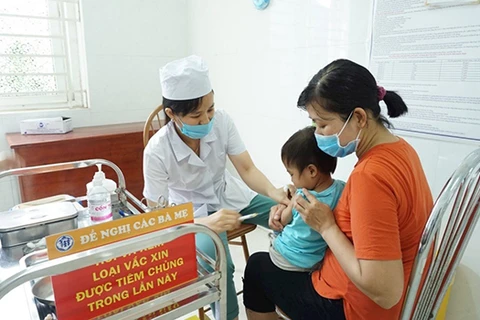
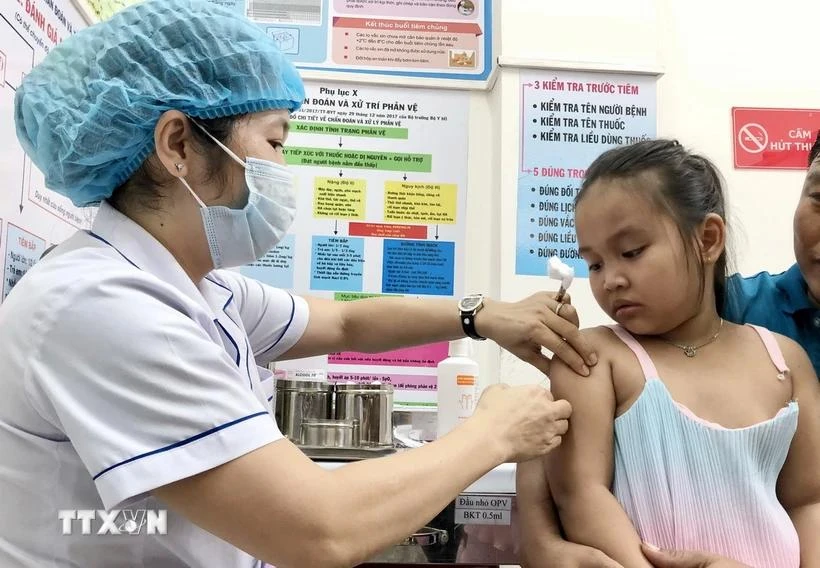
Nearly 17,000 children aged 1-5 in Ho Chi Minh City got measles jabs from August 31 to September 2 as the city recently declared the contagious and serious airborne disease an epidemic.

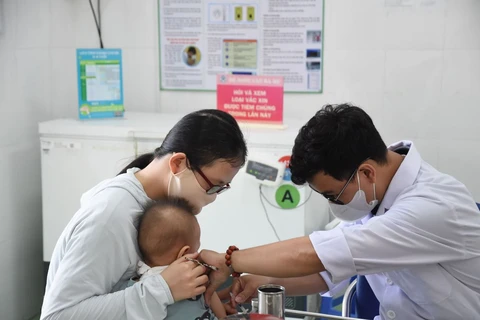
A kid gets measles jab at An Lac ward medical station in Binh Tan district. (Photo: VNA)

HCM City (VNA) – Nearly 17,000 children aged 1-5 in Ho Chi Minh City got measles jabs from August 31 to September 2 as the city recently declared the contagious and serious airborne disease an epidemic.

Under the vaccination campaign carried out in 22 districts and Thu Duc city, 6,821 more children will be vaccinated on September 4.

The vaccination process has been carried out in accordance with the Ministry of Health’s regulations, according to the city’s Centre for Disease Control.

The one used in this campaign is the Measles-Rubella (MR) vaccine produced by the Centre for Research and Production of Vaccines and Biologicals (Polyvac) which is being used in the national expanded immunisation programme.

The priority groups for vaccination in this campaign are children aged 1 - 5 living in HCM City, and high-risk children aged 6 - 16 receiving treatment at hospitals, regardless of their vaccination history.

Others are children aged 6 - 10 who have not received the full dosage of the vaccine, healthcare workers at risk of exposure to measles, and those caring for high-risk children who have not been vaccinated or have not received the full measles vaccine dosage.

The campaign is expected to contribute to protecting high-risk children who are more likely to experience severe complications from measles, such as those with congenital or chronic diseases including cardiovascular, kidney, hematological diseases, and children with immunodeficiency.

Measles can spread rapidly following an incubation period of seven to 21 days.

Medical experts have cautioned the disease can lead to serious complications, including pneumonia, encephalitis, otitis media, keratitis, diarrhea, and even death.

Measles can only be effectively managed when the community immunity rate reaches 95% and each individual has received two doses of the vaccine./.
VNA

See more

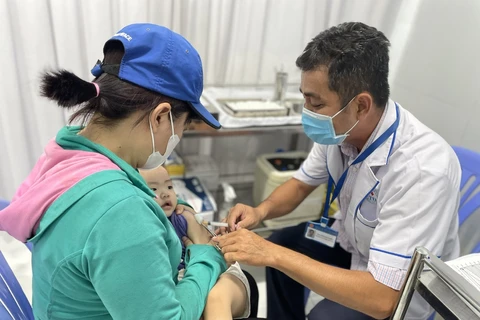
A nurse from Children's Hospital No. 1, Ho Chi Minh City, collects a blood sample for HIV testing from an infant. (Illustrative photo: VNA)

Health cooperation adds fresh momentum to Vietnam-US relations

Through this MOU, the US Department of State, working with Congress, plans to provide 98.75 million USD in life-saving global health assistance over the next five years, including 21.385 million USD in dedicated Global Health Security funding, to support Vietnam’s transition to full country ownership of its HIV/AIDS and tuberculosis programmes while strengthening its capacity to detect and respond to emerging and re-emerging infectious disease threats.

Minister of Health Dao Hong Lan and US Ambassador to Vietnam Jennifer McNamara Wick sign the memorandum of understanding on health cooperation. (Photo: US Embassy in Vietnam)

Vietnam, US launch five-year health cooperation

The cooperation will also support Vietnam in strengthening its healthcare capacity and gradually enhancing self-reliance in HIV/AIDS and tuberculosis prevention and control programmes, as well as in responding to emerging and re-emerging infectious diseases.

Director of the Ho Chi Minh City Department of Health Tang Chi Thuong (third, right) presents flowers to congratulate six young doctors who have volunteered to work at grassroots-level health stations (Photo: VNA)

Ho Chi Minh City strengthens grassroots healthcare workforce

Ho Chi Minh City's Department of Health on September 10 reviewed a pilot programme combining hospital-based practice with work at grassroots health stations and organised the fourth healthcare job fair, attracting nearly 1,000 candidates and 94 recruiters offering 806 positions.

Children undergo health screening. (Photo: Dong Da General Hospital in Hanoi)

Vietnam to screen students nationwide for five health risks from 2028

Vietnam will launch nationwide screening for five groups of school-related diseases and health conditions among students from preschool through high school from 2028, including overweight and obesity, refractive errors, spinal curvature, oral diseases and mental health disorders.

A doctor provides dental checkup for a student. (Photo: VNA)

Free health checkups for children ahead of new school year

According to the Hanoi Department of Health, the city has 4,776 educational institutions with more than 2.2 million preschool and school students. The health campaign will run from August 18 to September 4, targeting 100% coverage before the new school year begins.

Spraying insecticide to prevent dengue fever in Dan Hoa commune, Hanoi. (Photo: VNA)

Hanoi steps up dengue prevention as cases rise

According to the Hanoi Centre for Disease Control (CDC), 316 dengue cases were recorded across 74 communes and wards in the city from August 7-14, up 81 from the previous week. Eleven new outbreaks were also reported, bringing the total number since the beginning of 2026 to 63, with 24 still active.

Screening and early cancer detection using advanced medical equipment at a healthcare facility (Photo: VNA)

Vietnam targets Southeast Asia’s leading medical tourism position by 2030

Medical tourists to Vietnam currently mainly comprise overseas Vietnamese and visitors from Cambodia, Laos, the Republic of Korea, Japan, Australia and several European countries. Popular services include cosmetic dentistry, assisted reproduction, aesthetic medicine, general health check-ups and some advanced medical specialties.

An ambulance from the pre-hospital emergency care service in Phu Quoc special zone in An Giang province. (Photo: VNA)

Pre-hospital emergency care system to be launched nationwide

From 2027, the national pre-hospital emergency management platform will be put into operation, connecting data with the 113, 114 and 115 emergency call systems to facilitate rapid emergency dispatch and improve public access to emergency services.

Foreign patients travel to Vietnam for robotic cancer surgery at one-tenth of US costs

Foreign patients travel to Vietnam for robotic cancer surgery at one-tenth of US costs

With robot-assisted surgery costing tens of thousands of dollars in the US and Singapore, a growing number of international patients are traveling to Vietnam for robotic cancer surgery, including procedures for prostate, gynecological and gastrointestinal cancers, using the US made da Vinci Xi system at costs starting from just 3,000 USD.