Neu pole sends off evil spirits, welcomes blessings

Vietnamese people in the old days put up tall bamboo poles with red garment strips hanging from them during Tet, believing that poles prevented ghosts and monsters from entering the community during the holiday. The tradition of raising the Neu (or Tet) pole remains alive today in many villages and homes around the country. ​
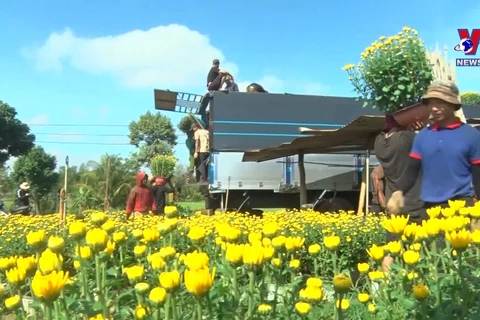
Neu pole sends off evil spirits, welcomes blessings ảnh 1Tradition of raising the Neu (or Tet) pole remains alive today in many villages and homes around the country (Photo: baochinhphu.vn)

Hanoi (VNA) - Vietnamese people in the old days put up tall bamboo poles with red garment strips hanging from them during Tet, believing that poles prevented ghosts and monsters from entering the community during the holiday. The tradition of raising the Neu (or Tet) pole remains alive today in many villages and homes around the country.

Vietnamese people erect a Neu tree in front of their house to show off their land holdings and mark the border of their house. The bamboo pole was stripped of its leaves, except for a tuft at the top.

The decoration on the Neu trees varies between regions and periods. On the top of the bamboo tree, they often hang a snatch of pineapple leaves, chicken feathers and a circle of New Year cards made of bamboo and do (poonah) paper. According to cultural researchers, the circle of bamboo cards symbolizes happiness and chicken feathers represent holy birds with powers that can help the family.

The pole is also believed to ward off ghosts and demons from entering the community during Tet. It also seeks to show the way to ancestors who want to return home for the Lunar New Year holiday.

As legend goes, the Tet pole erecting tradition is originated from the Buddhism. Legend has it that long time ago, devils occupied the land of humans. Seeing humans’ suffering, the Buddha helped them fight the devil. With his power, the Buddha drove away the devils. The devils, having been expelled to the sea, asked for the Buddha’s mercy so that they can come back to the mainland to visit their ancestors’ grave for a few days in a year. The Buddha allowed them to comeback during the Lunar New Year.

In turn, the Buddha taught that in front of each house, high bamboo pole with a red piece of garment, chime and gongs should be erected during the Lunar New Year Festival to signal the devils that the land is belong to humans. The higher the bamboo tree is, the further the devils would stay away. Besides, the Buddha also told humans to draw an arrow pointing to the East side and sprinkle limestone flour on the doorstep to prevent the devils from entering the house.

The Northern people of Vietnam erected the pole in Lunar December 23rd since in the early morning of this day, the Kitchen Genie were left for the meeting in the heaven. Without these genies, the devils may devastate the folk. Thus, the Tet pole was erected until Lunar January 7th for driving the devils.

The pole will be taken down on the seventh day of the first lunar month to mark the end of the holiday. The Tet pole image has long been considered the most solemn symbol of Vietnamese Lunar New Year. It connects to a profoundly humane legend. The Tet pole erecting in the springtime is for the good hope of the coming year. The Tet pole under the sunshine expresses the awakening spring power in the hearts the Vietnamese. Those are nice significances transformed by Vietnamese ancients to the young generations. For this reason, at many Vietnamese villages in the days before Tet, many families set up the Tet pole in front of the village temple in the witness of the villagers.

The Tet pole erecting is a long-standing tradition of Vietnamese people. In the first days of the year, this ceremony brings about the animated atmosphere./.
VNA

See more

The illustrated book “100 Dieu tu hao Viet Nam” (Photo: nhandan.vn)

Book introduces 100 remarkable facts about Vietnam

The illustrated book “100 Dieu tu hao Viet Nam” (100 Proud Facts about Vietnam) compiles 100 highlights of Vietnam’s legacy across 11 major themes, including heroic history, cultural beauty, literature and the arts, medicine, education, architecture, science, cuisine and community values.

Children perform Xoan folk singing at the cultural camp. (Photo: VNA)

Hung Kings festival opens with vibrant cultural, tourism activities in Phu Tho

Beyond its role as a sacred national commemoration, the event helps promote cultural values, strengthen national unity and enhance cultural exchanges. A notable feature is the flexible organisation in 18 commune and ward clusters, encouraging the localities' participation and enriching the festival’s content.

A corner of the Book Street in Hanoi (Photo: VNA)

Hanoi celebrates Reading Culture Day with book street activities

Organised by the Book Street’s management board in collaboration with publishers and distributors, the programme will brings together 14 publishing and distribution units across 15 booths, offering readers access to a rich and diverse selection of book titles spanning literature, children’s books, life skills, economics, history, science-technology and education, among others.

Vietnam’s Consul General in Osaka Nguyen Truong Son speaks at the 9th Vietnam cultural festival in Osaka on April 19, 2026. (Photo: VNA)

Vietnam cultural festival in Osaka draws tens of thousands of attendees

Saito Naoki, Mayor of Ikuno Ward – where the event took place, expressed his pleasure at the rapid growth of the Vietnamese community in the area. He praised such cultural festivals for helping Vietnamese residents maintain their traditions while fostering mutual understanding and closer ties with Japanese locals.

Urawadee Sriphiromya, Thai Ambassador to Vietnam (third from left); Camila Polo Florez, Colombodian Ambassador to Vietnam (C); and Saadi Salama, Ambassador of Palestine to Vietnam (fifth from left), experience indigenous coffee culture in a coffee garden in Dak Lak. (Photo: doanhnghiepkinhtexanh.vn)

World Coffee Heritage Forum: A dialogue connecting coffee culture, knowledge

The recognition of "The knowledge of coffee cultivation and processing in Dak Lak” as a National Intangible Cultural Heritage marks an important milestone. It affirms the value of indigenous knowledge, creative labour, and the harmonious connection between local livelihoods, culture and nature in the Central Highlands.

The artwork "Harvest Day" by Doan Thi Thu Huong. (Photo: cand.com.vn)

Vietnam to join Venice Art Biennale with first national showcase

As Vietnam makes its debut at the Biennale, the exhibition “Vietnam: Art in a Global Flow” does not seek to assert its position through scale or grand statements, but rather opens up a space for meaningful artistic dialogue - an invitation to listen to subtle voices, contemplate in stillness, and reflect on the capacity to nurture sustained creative energy in a dynamic and ever-evolving art world.

Viet Youth Readiness Hub debuts at the event (Photo: VNA)

Vietnamese Canadian youth hub launched to fight mother tongue erosion

The Viet Youth Readiness Hub is seen as a dedicated platform to connect, support, and empower Vietnamese-Canadian youth. It aims to emerge as a central force to host social events, advance heritage education, foster exchange and integration among young Vietnamese in Canada.

At the event “Vietnamese Language in the heart of Kyushu, Japan” (Photo: VNA)

Vietnamese in Japan revive mother tongue among young generations

While the number of Vietnamese-origin children in Japan is surging, opportunities to actually speak Vietnamese in daily life are vanishing fast. Many children can understand the language but default to Japanese in response, gradually relegating their mother tongue to a secondary role, sometimes even treating it as a “second foreign language” inside their own houses.

A tribute to Hung Kings in Ho Chi Minh City (Photo: VNA)

Hung Kings’ Commemoration Day 2026 to spread sacred values, foster national unity

Following the merger of Phu Tho, Vinh Phuc, and Hoa Binh provinces into the new Phu Tho province last year, the Hung Kings Temple Festival has taken on heightened significance. It now serves not only as a tribute to the ancestral homeland but also a unified cultural platform that extends sacred ancestral values to Vietnamese communities at home and abroad.

A traditional art performance at Bach Ma temple in Hanoi (Photo: VNA)

Traditional arts hold untapped economic power

Traditional arts embody deep aesthetic values, worldviews, and national identity, shaping the country’s distinctive “aesthetic identity” and foundational cultural tastes